What is Prorated Rent, and Why Does It Matter to Property Investors?
Prorated rent is the portion of monthly rent owed for a partial month of occupancy. It applies most often to mid-month move-ins, short move-out extensions, and due-date changes.
The avoidance of loss is the guiding principle of business economics, wrote Peter F. Drucker, an influential business thinker. "If you're a business owner of real estate, your number one goal is to eliminate days without income," echoes Jim Miller, founder of Performance Asset Management (PAM). And prorated rent can help a property owner do just that.
Tenants in southeastern Wisconsin don’t always move in on the 1st. That happens when tenants avoid paying double rent, wait for a move-in ready unit, align schedules on a new job, close a home sale, or end a lease elsewhere mid-month. Regardless of why, prorated rent covers the days a tenant actually occupies a unit that month. The same math works when a rent due date moves. One prorated payment covers the days between the old date and the new one.
Wisconsin law doesn't set a formula for prorating a mid-month move-in. But prorated rent helps property owners start a lease mid-month, so a unit ready on the 15th earns rent from that date. For investors, getting the math right is key, because missteps can translate into lost time, lost profits, and lost tenant trust. Learn two standard methods to calculate prorated rent, mistakes to avoid, and how to choose the right method for a property.
How Do You Calculate Prorated Rent for a Property in Southeastern Wisconsin?
Divide the monthly rent into a daily rate, then multiply that rate by the days occupied. Investors typically find the daily rate using the actual days in that month or an annualized 365-day year.
Calculating prorated rent means knowing the value the unit is worth each day. With prorated rent, each day is money, and one miscounted day is a rent payment for that day. The count changes monthly, as some months have 30 days, others have 31, and February has 28 or 29. The calendar will determine that figure, and the lease determines the calculation method:
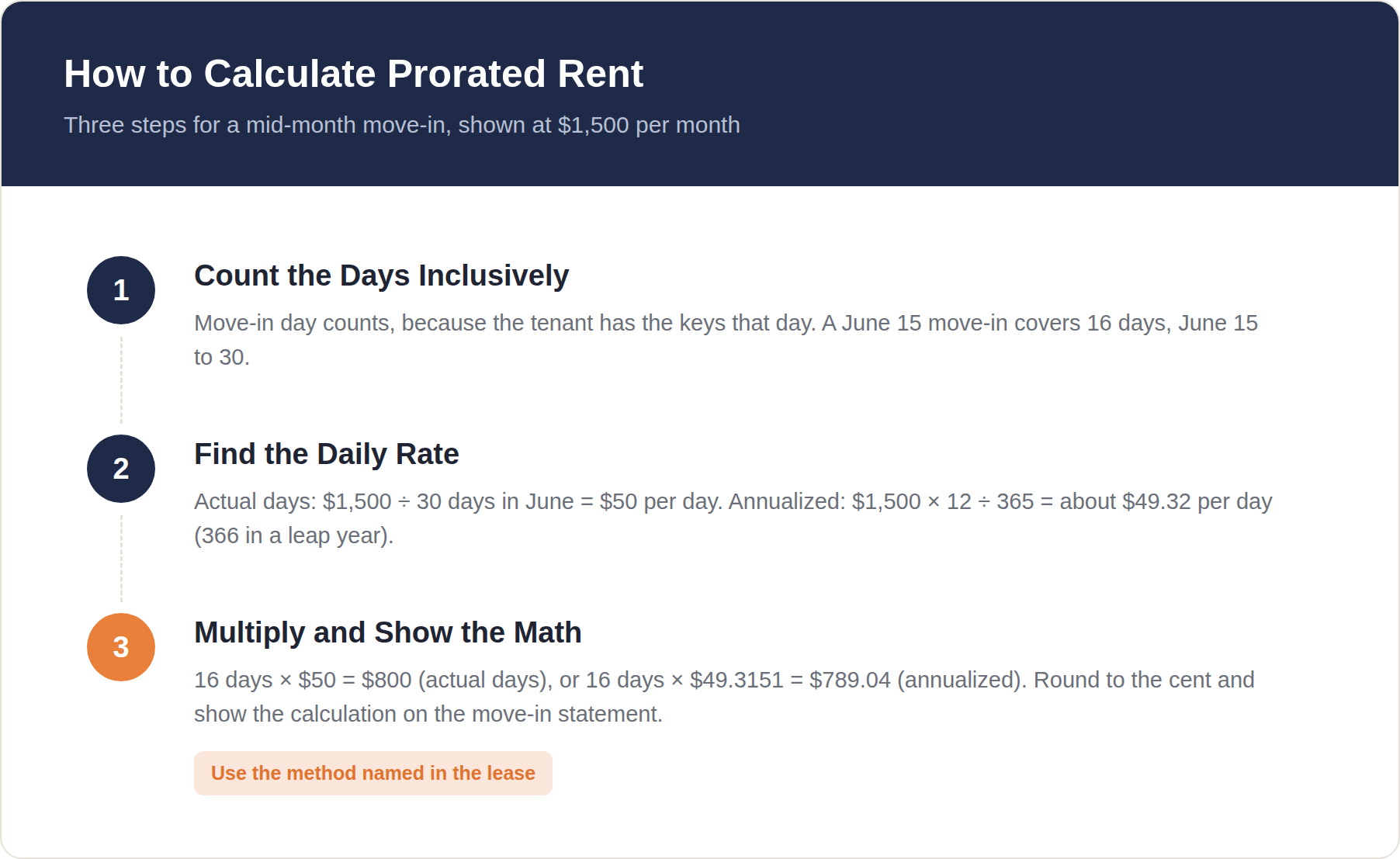
Count the exact number of days the tenant will occupy the unit. This means counting inclusively, so a June 15 move-in covers 16 days from June 15 to 30. Move-in day counts because the tenant has the keys that day. Remember, a tenant can check the math, and a wrong charge creates a poor impression early in the relationship.
Find the daily rate using the actual days method or the annualized method. Using the actual days method means dividing the monthly rent by that month’s total number of days. At $1,500 rent in June, the actual-days rate is $1,500 divided by 30, or $50. Sixteen days at $50 per day produces a prorated June rent of $800.
- Actual days = Days occupied × (Monthly rent ÷ Days in month)
- Annualized = Days occupied × (Monthly rent × 12 ÷ 365)
The annualized method multiplies monthly rent by 12, then divides the total by 365. At $1,500 monthly rent, the annualized daily rate works out to about $49.32. Sixteen days at the annualized rate produces a prorated June rent of $789.04. In leap years, many leases divide by 366 instead.
Multiply the daily rate by the number of days occupied. Round to the nearest cent and show the full calculation on the move-in statement.
Which Proration Method Should Wisconsin Investors Use?
Either method works when the lease names it and every tenant is billed the same way. The two methods differ most in February and in 31-day months, so consistency matters more than the choice.
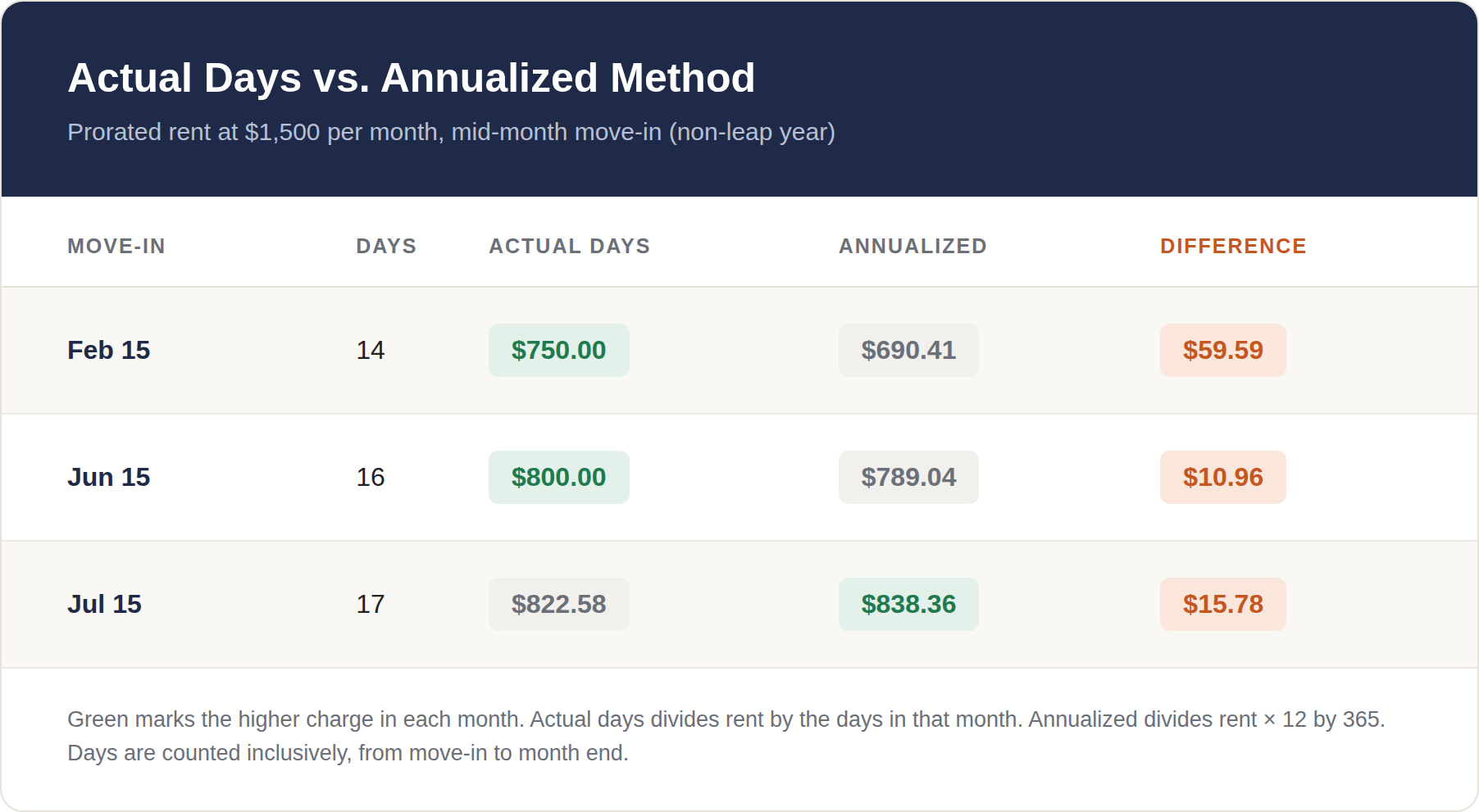
Despite the similarities in the methods, the two never produce the same number, and the gap depends on the month the tenant moves in. During a month that has 30 days, such as June, the actual days method runs about $11 more. A July 15 move-in covers 17 days in a 31-day month:
- Actual days gives $822.58 for those 17 days, while annualized gives $838.36.
On the other hand, the annualized method charges more when the move-in date starts in a month 31 days long and that flips June's result. February shows the widest gap between methods because it has only 28 days. In a non-leap year, a February 15 move-in covers 14 days under either method.
- Actual days charges $750.00 for those days, while annualized charges only $690.41.
That $59.59 swing is why investors should name one method in the lease.
How Does Prorated Rent Work at Move-out?
When a tenant stays past lease end, prorate the extra days using the same daily rate. Put the new end date and prorated amount in writing before the original lease ends.
In addition to providing flexibility during a move-in, a property owner can use prorated rent when a tenant needs more time to move out. Jim allows for short extensions for loyal residents when the timing still fits with the next move-in. Aligning the listing with the new move-out date keeps the unit earning.
- Ten extra August days at $1,500 cost $483.87 using the actual-days method.
- The same ten days cost $493.15 using the annualized 365-day method.
Property owners can use the method in the lease to determine the final charge, so it matches the first month's math. Document the new end date and prorated amount in a signed lease addendum. Creating a signed addendum shows that the tenant has the consent of the property owner, which keeps an extension from becoming a holdover.
Investors can protect themselves against tenants who stay without the owner's consent. Landlords may recover minimum damages of “twice the rental value apportioned on a daily basis,” according to Wis. Stat. § 704.27.
For timing the next tenant's arrival, read our article: Vacancy vs. Back-to-Back Rentals. Investors who want to learn more about tenants leaving before the lease ends can read Lease Breaks vs. Evictions. Either way, check the lease against Wisconsin Chapter 704 statutes and Wisconsin's ATCP 134 rental rules, which both govern rental agreements in the state.
How Can Investors Avoid Making Mistakes When Prorating Rent?
Investors avoid prorating mistakes by counting days inclusively, choosing one calculation method, and writing it into the lease. Applying that method the same way and showing the math can help prevent prorated rent disputes.
Jim breaks down the concept behind prorating rent very simply: rent begins when the unit is delivered. “None of us start leasing a car that gets delivered two weeks from now,” he said. “We start making the lease payments on the car we're driving today.” For property owners, that means forgetting to count the move-in day undercharges the tenant by a day.
Avoid relying on memories and handshakes. Use a written formula to track different charges, especially for property investors with multiple rentals, and remain consistent with calculation methods. Switching methods between tenants can put an investor in a tough spot. A written formula can also catch leap years, which skew rates by a small but real amount.
Investors who decide against recording calculations and sharing those records risk leaving tenants guessing about charges. A clear, accurate move-in charge can help build trust, and tenants judge an owner’s character in the first five days after a move-in, according to Jim.
To avoid any issues, get the math right from day one. Choose a calculation method, write it into the lease, and apply it consistently. Remember to count days inclusively and keep tenants informed by showing the math on move-in and move-out statements.
PAM has been managing single-family homes, duplexes, and small multifamily properties across six southeastern Wisconsin counties for 17 years. For questions on choosing a prorated rent method for a specific property, schedule an appointment with Jim.