What Are the Pros and Cons of Allowing Pets in a Milwaukee Rental?
Allowing pets in a Milwaukee rental can widen the applicant pool and support rent, but it adds wear and lease risk. The pros can outweigh the cons when the pet policy is screened, priced, and written into the lease.
“I used to be a no pets person,” admits Jim Miller, founder of Performance Asset Management (PAM), which has managed properties for southeastern Wisconsin investors for 17 years. While that may have worked early on, 59% of Wisconsin households have a pet, according to American Veterinary Medical Association data compiled recently by World Population Review.
That share of pet owners makes establishing a pet policy a priority for property owners long before reviewing tenant applications. Saying no to pets narrows the applicant pool and can leave a unit listed longer than necessary. However, approving pets without a process exposes Wisconsin investors to added wear, unplanned costs, and lease disputes.
PAM's approach sits between those outcomes, and it’s built on screening, fees, and lease terms. Become familiar with that approach. Learn how pets impact rent, what belongs in a lease, how service and emotional animals are different, and how to decide on a policy.
What Risks Come with Allowing Pets, and How Does PAM Manage Them?
The main risk of allowing pets is added wear that raises rent-ready costs at turnover. PAM manages that risk by screening pets, charging a monthly pet fee, and backing PAM-screened pets with its Pet Guarantee.
Floors and finishes in particular show added wear from pets. Investors can encourage tenants to report issues early, which is also one of the PAM resident guidance notes. Pet damage that goes unreported until move-out adds to turnover cost, which in southeastern Wisconsin can run approximately $5,000 for each unit.
When tenants fail to manage their pet damage, that can increase turnover costs, cutting into investor Net Operating Income (NOI). Jim states that a successful placement can be judged by how well the residents care for the property. An important question he asks about a placement is, “How do they take care of the asset?” And PAM applies that same scrutiny to pets.
Each pet application requires verified records, behavior history, and breed and weight information. And residents are required to pay a $50 monthly fee for each approved pet who lives in the unit. That fee supports pet management liability, along with added wear, according to the PAM pricing page.
PAM-screened pets are also covered by PAM's Pet Guarantee, one of six guarantees offered to investors. Those details are published for investors to review on the PAM Guarantees page, which describes the program as “built to expand the applicant pool without expanding investor risk.”
What Should a Pet Policy Have When It’s in the Lease?
A pet policy should spell out which pets are approved, what tenants pay, and who covers damage beyond normal wear. Wisconsin courts have penalized property owners for charges a lease didn't clearly authorize, so specific terms protect investors.
Including a pet policy in the lease is the best way for investors to stay protected. Leases should name each charge and its dollar amount to hold up in court. “It’s that level of specificity inside of the leases" that protects investors, said Jim, who notes that Wisconsin courts have grown more punitive toward leases that overreach on charges.
At PAM, every approved pet must be directly added to the lease of the resident, who must submit an application before bringing an animal into the unit. Unauthorized pets are treated as a lease violation under PAM’s resident policies. These actions help keep the responsibility for pet damage beyond normal wear and tear and outside of what fees cover back on the resident.
Breed restrictions vary by property and are based on owner preference, HOA rules, and insurance, according to PAM's resident FAQ. Some insurers won’t cover breeds such as pit bulls, others charge more for certain breeds like pit bulls and Rottweilers, and some companies refuse dog owners altogether, according to the Insurance Information Institute (Triple-I).
“Liability claims related to dog bites and other dog-related injuries cost homeowners insurers $1,862 million in 2025,” according to Triple-I and State Farm. Before finalizing a pet policy, investors should speak with their insurer to confirm if breed restrictions exist and learn what they entail. For more about potential pet charges, read PAM's guide to Milwaukee application fees.
How Are Service and Emotional Support Animals Different From Pets?
Wisconsin's fair housing law treats service animals and emotional support animals separately from pets, so pet policies and fees don't apply to them. Owners can request documentation and may deny a request only in limited cases defined by state law.
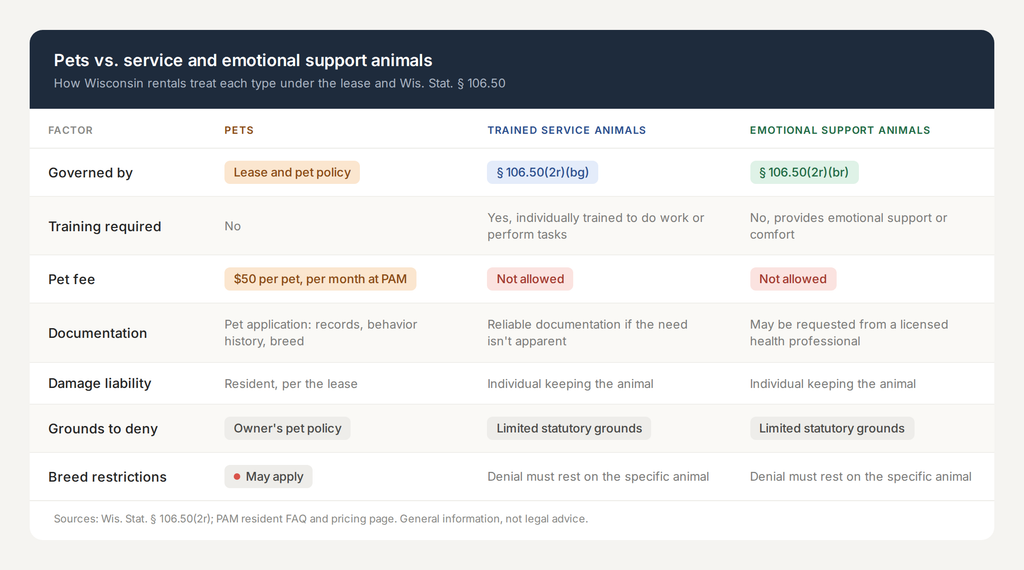
Wis. Stat. § 106.50, which is Wisconsin's fair housing law, recognizes that service and emotional support animals are separate from pets. The key difference between the two types and a pet is a person's disability-related need for the animal. Examples include:
- Animals individually trained to do work or perform tasks: a dog who guides a person who is blind or interrupts a panic attack.
- Emotional support animals: a cat that provides comfort to someone managing PTSD or a rabbit who can help a person ease their anxiety or depression.
Requiring tenants who can prove a disability-related need for the animal to pay fees or any form of extra compensation is discrimination. Consistent with that, PAM's resident FAQ states pet fees do not apply to these animals. Property owners do have the right to request reliable documentation for tenants with a disability or need that isn’t readily apparent.
For example, a person with an emotional support animal can provide a document from a licensed health professional. According to Wis. Stat. § 106.50, property owners can deny a request in specific, limited circumstances, such as missing documentation, a direct safety threat, or substantial property damage.
Even with the proper documentation, tenants who keep these animals remain liable for sanitation and damage the animal causes. PAM handles these requests using a written method that follows Wisconsin fair housing standards. Investors managing their own rentals should also follow relevant laws while documenting every service and emotional support animal request.
Federal enforcement shifted in 2026, when the U.S. Department of Housing and Urban Development (HUD) narrowed its focus to “those cases involving animals trained to provide disability-related assistance.” Because guidance recently changed, confirm requirements with an attorney before making a decision on a request for a service or emotional support animal.
How Should Investors Decide Whether To Allow Pets?
Start by checking whether comparable rentals near your property allow pets, since pet policy shapes the rent range tenants expect. Then confirm your screening and lease can support that policy.
The decision starts with researching the local market. But Jim understands property owners who say no. “If you’re not going to accept pets, that’s fine,” he said. Pet acceptance is among the foundational amenities that shape a rental's price, and those amenities "will have a big impact" on a rental's rent range, he said.
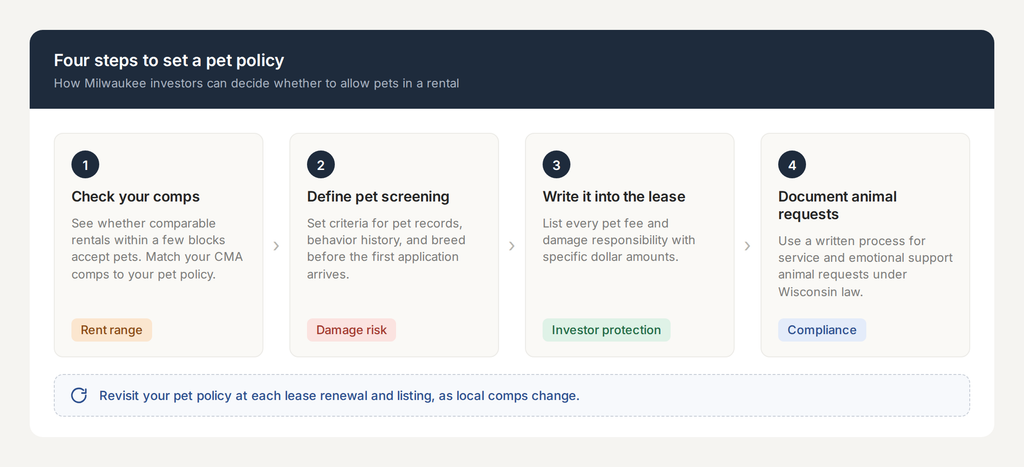
Apply these four steps to make a decision on pets for a property:
- Check whether comparable rentals within a few blocks accept pets, as a comparative market analysis is only accurate when its comps share your pet policy.
- Define screening criteria for pet records, behavior history, and breed.
- Write every pet fee and damage responsibility into the lease with dollar amounts.
- Set up a documented process for reviewing service and emotional support animal requests.
Investors should keep revisiting their pet policy at each lease renewal and listing, as local comps change. For additional support, PAM's free Rental Analysis shows what comparable Milwaukee rentals currently earn. To learn more about your southeastern Wisconsin market or to talk through a pet policy, book time with Jim.