How Much Does It Cost to Apply for a Rental in Milwaukee?
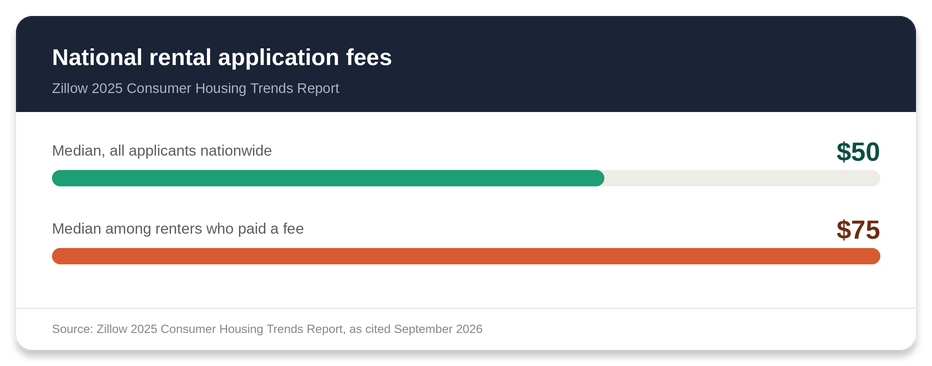
Nationwide, the median rental application fee was priced at $50, according to Zillow's 2025 Consumer Housing Trends Report. Even though that's a useful benchmark, property owners have to understand every recurring cost from the start to know the exact amount to charge.
“I wouldn't start that process without getting some feedback on what that pricing was going to look like,” said Jim Miller, owner of Performance Asset Management (PAM). After spending 17 years serving southeastern Wisconsin residents, PAM charges $25 for its application fee to help cover the cost of screening applications before move-in.
Compared to researching, viewing, signing, and moving, application fees are a small part of renting. But misunderstandings still happen, such as when renters confuse it with a security deposit. For renters who reported paying an application fee, the national median is $75, reports Zillow. Wisconsin caps what a landlord can charge and keep for a credit report portion of an application at $25 (actual cost, up to that amount), according to Wis. Stat. § 704.085.
Because the application fee price also depends on the property type, the screening provider, and possibly the management company, investors working with a property manager should ask what that charge includes. But before asking questions, understanding market figures helps investors set expectations before comparing companies.
What Does a Rental Application Fee Actually Cover?
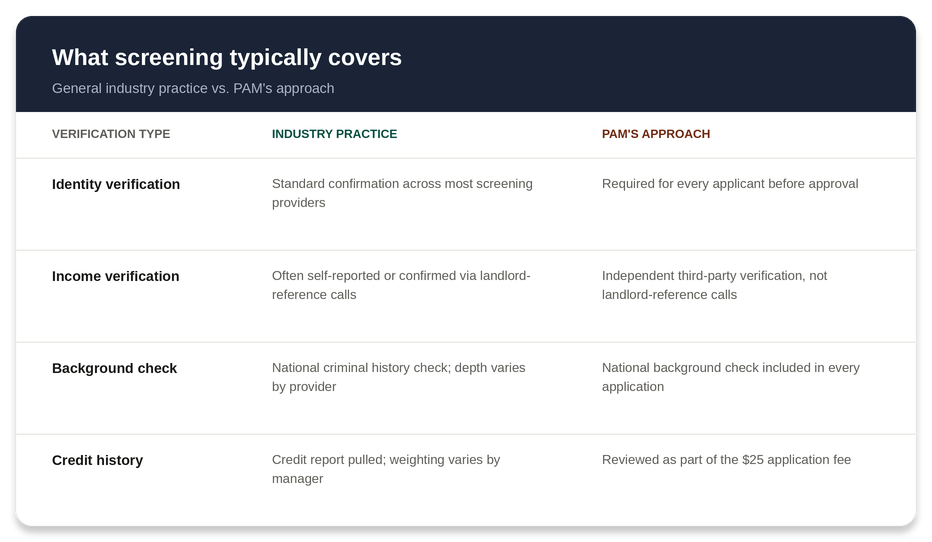
Application fees are generally intended to fund applicant verification, though what's included varies by property manager. Common categories can include identity confirmation, background checks, and credit report review.
Under the Fair Credit Reporting Act, background and credit reports are legally classified as “consumer reports.” This means that landlords must have a permissible purpose to request them and must notify applicants in writing if the report leads to a denial or other adverse action, according to the Federal Trade Commission.
“PAM prioritizes third-party income verification over older landlord-reference phone calls,” said Jim. For more information on that methodology, including why PAM moved away from landlord references, read The PAM Resident Screening Checklist: A 99.5% Eviction Avoidance Rate.
Investors working with any manager should ask exactly what their application fee funds, as other property managers may weight credit scores or references differently than PAM does.
Are Pet Fees Separate From the Application Fee?
Pet-related charges are commonly structured as either a one-time deposit or a recurring monthly fee, though potential residents also commonly confuse these with rental application fees.
Some property owners charge a one-time pet deposit that they collect before the move-in date. Other owners or their managers structure pet costs as a recurring monthly fee added to the rent. Screening fees may apply if there are multiple pets. Most importantly, the lease should clearly state which structure applies before anyone signs.
Are There Rules Governing What Landlords Can Charge for Applications?
Wis. Stat. § 704.085 places specific limits on certain landlord-charged credit-check costs, capping what a landlord can charge and keep for a credit report at $25 (actual cost, up to that amount).
Before agreeing upon and charging rental applicants any fee structure, investors should confirm current requirements with a landlord-tenant attorney, because how a fee is labeled can affect how it's treated legally. For example, if a landlord charges $50 and calls it an application fee:
Only $25 of that is recognized by Wis. Stat. § 704.085 as a chargeable cost that a property owner can keep, and it must be tied to the actual cost of the credit report.
If the other $25 isn't one of those specifically authorized charges, it may get treated as an earnest money deposit, which is a different legal category, with its own rule that it has to be refunded or applied to rent/security deposit, instead of kept by the landlord.
Because details matter, as seemingly small wording issues can have legal ramifications, some investors choose to work with an experienced property manager who stays current on compliance issues as well as evolving landlord-tenant statutes. Mistakes here can cost far more than the application fee a property owner collects.
Under Wis. Stat. § 100.26, violations of Wisconsin's landlord-tenant trade practices rules can carry a civil forfeiture of up to $10,000 per violation. That’s in addition to paying a resident twice their monetary loss, plus costs, and attorney fees under Wis. Stat. § 100.20(5).
Why Does a Cheap Application Fee Sometimes Cost Property Investors More?
A lower application or placement fee can mean less verification happens before a resident moves in.
“The strength of a manager's screening process, not the dollar amount charged, is what predicts placement outcomes,” said Jim, adding that some managers charge minimal fees while skipping real verification, while others charge more without a better process.
Over a 12-month lease, one bad placement can lead to thousands in missed rent, legal fees, and unit turnover. This amount is detailed in What Does a Bad Resident Placement Actually Cost Wisconsin Investors, which breaks down lost rent, legal fees, construction, and resident replacement into a total of $4,500 to $7,500 per event.
Because those downstream costs can exceed savings from a lower fee, PAM focuses on protecting investor returns by eliminating preventable placement mistakes.
Investors who are ready to evaluate their manager in terms of rental application fees should ask about the amount and get details, but also ask about their resident application process as a whole. For more specific answers on how PAM answers those questions, set aside time to speak with Jim.