Performance Asset Management Investors
In the complex world of real estate, a one-size-fits-all approach rarely works, especially when it comes to matching property managers with investors, who often struggle with choosing the right type of management company to meet their needs.
Because property owners range from accidental landlords with a single unit to well-funded companies juggling thousands of properties, management companies with specialized experience work best in specific situations.
At Performance Asset Management (PAM), our philosophy is that strong returns happen when operations are disciplined, residents are satisfied, and thinking is done over the long term. So, instead of trying to force relationships, we make sure that our goals, timeline, and approach are in line with each of our investors.
Whether it's tenant screening expertise, knowledge of Fair Housing laws, quick response times to high-volume maintenance requests, retail marketing, or other specialized services, we provide the top-tier support once needs and experience align. To ensure that’s the case, we welcome investors to self-assess and conduct thorough research before reaching out to ensure that the relationship between owner and manager creates real value, not frustration.
What Investor Works Best with a Property Management Company?
The team at PAM primarily works closely with long-term thinkers and planners, who think in years and decades, as opposed to much larger-scale operations operating on a purely quarterly basis, such as private equity groups. More specifically, investors who value durable cash flow, resident retention, disciplined operations, and data-driven decisions.
Short-term optimization is achievable in the industry, particularly when aligned with long-term goals. But that achievement requires creating conditions that increase resident satisfaction through management responsiveness to create asset appreciation.
Real estate is neither completely safe nor totally risky and instead exists in an adaptive space that is impacted by goals and approaches. For example, one of our clients who is seeking income for retirement uses a different model than a firm seeking a quick financial turnaround. Our role is to apply proven strategies to aid performance while providing visibility and insight along the way.
How Can a Property Management Company Protect my Investment?
Even though investors will have different levels of experience, background matters much less than goal alignment. Today, a significant portion of our investor base lives outside of Wisconsin, with many clients owning fewer than 25 units in the state. Property management companies typically work best with three types of investors:
First-time/ accidental investors: those who own a single-family home due to a job relocation or life transition, as opposed to creating an investment plan. These investors value education, transparency, and guidance. We help them move away from reactive decisions into an informed strategy by providing education and structure.
Portfolio builders: intentionally purchased 2-5 units over time for savings or retirement purposes and want to transition into using new systems. In our experience, they have a strong grasp of fundamentals and need us to help them build on their disciplined processes, visibility, and evaluations.
Experienced investors: purchases for pure return on investment and scale to maximize cash flow and tax efficiencies with strict KPIs. While they understand the math, leverage, and scale, we offer more detailed reports, strategy refinements, and expense forecasting.
Overall, investors who work well with PAM view property management as a long-term investment, as opposed to a short-term cost. Whether an investor is learning the fundamentals or optimizing an established portfolio, PAM works best with owners who value transparency, resident satisfaction, and decisions made with the full lifecycle of the asset in mind.
How Can Data Help Me Make Better Investment Decisions?
Our property managers work best with investors who understand or want to learn more about the lifecycle of a property from the initial downpayment to the final sale. For example, the Cap Rate can provide an understanding of how much income a property is expected to generate in relation to its purchase price at the time of acquisition.
Capitalization Rate = Year-1 Net Operating Income (NOI) / Purchase Price
For example, if a property is purchased for $1,000,000, year-one gross rent is $90,000, and
operating expenses are $30,000, then the first year of NOI is $60,000. Consequently, the Cap Rate is 6%.
Because real estate profit comes from annual cash flow, loan paydown, appreciation, and tax benefits, it can be beneficial to consolidate multiple profit sources. Investors who take this approach tend to work best with PAM in terms of optimizing returns.
Using the Cap Rate in combination with other educational tools, such as the IRR formula and CapEx planning, discussing optimal refinance and acquisition timing, along with expense-side visibility over income visibility for scaling investors, aligns well with our business model.
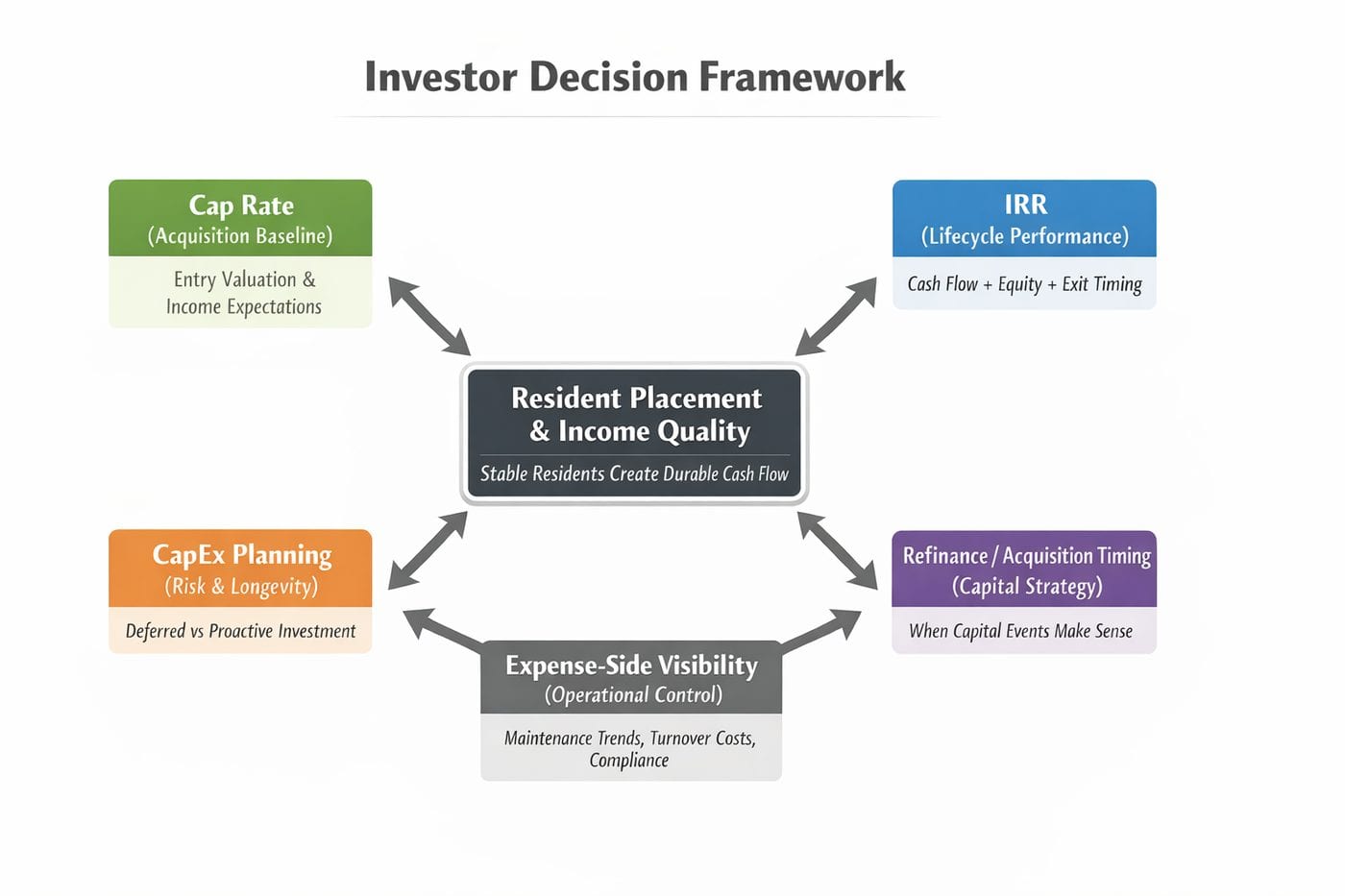
Anchoring investment decisions in real operating performance instead of assumptions helps investors and property managers assess deals by providing a baseline for measuring improvement over time.
Who Performance Asset Management is Not a Good Fit For
Just as important as identifying alignment is recognizing intentional non-alignment. Investors who apply a cash-on-cash approach with a focus on maximizing immediate returns while neglecting property appreciation, long-term value drivers, and tax benefits traditionally fail to be the best fit. In short, PAM does not work well with:
Short-term flippers operating on 24–36 month exit timelines
Private equity or institutional investors pursuing roll-up strategies
Owners who suppress maintenance to inflate short-term financial statements
Investors who view property management as adversarial rather than collaborative
Some property management strategies focus on cutting costs and minimizing resident experience in favor of short-term financial gains. Even though this approach can lead to immediate cash flow, it can also harm asset value and increase risks in the long run.
Investors seeking low management fees and minimal property manager involvement have available options that align with those goals. Instead of a full-service property management partner focused on long-term performance, Welcome Home Milwaukee and MPI Property Management both serve investors with those needs. Both property management groups are also based in Milwaukee and serve the Southeastern Wisconsin area.
Working with Performance Asset Management
PAM is built around clear communication, defined decision-making boundaries, and measurable outcomes so investors are clear on the type of information to expect, when to expect it, and how decisions are made.
Owners receive financial and operational reports, including income, expenses, and variance explanations. And because clear boundaries prevent confusion and delays, PAM handles day-to-day operations, resident communication, rent collection, compliance, and routine maintenance execution.
Owners remain responsible for strategic decisions such as capital expenditures, pricing strategy adjustments, and portfolio-level changes. Separating operational execution from ownership strategy avoids bottlenecks while keeping investors fully informed and in control.
Measuring Success
Since success is defined as durable performance, PAM typically evaluates outcomes using meaningful KPIs, including:
Resident retention rate, as a leading indicator of asset stability and cost control
Net operating income (NOI) consistency, rather than one-time spikes
Maintenance cost trends over time, not just monthly totals
Delinquency and compliance metrics, to manage risk proactively
Together, these metrics provide investors with a clear picture of how their properties are performing operationally—not just financially—while supporting long-term value creation.
How Do I Know if a Property Management Company is the Right Fit?
Property management is a business, and investors who work with our brand understand we prioritize residents because of the impact that those relationships have on the experience.
In terms of working with residents, we avoid weaponized hidden fees and instead appreciate the transparent math behind IRR over quick cash returns and expense exposure.
Any investor who has begun to determine their needs, evaluated the experience of property managers in the industry, and feels ready to assess services can continue to move forward by asking themselves relevant questions:
Questions Investors Should Ask
Do I understand my full expense exposure over ownership?
Do I agree that resident experience drives returns?
Am I aligned with their approach to maintenance, compliance, and communication?
Am I investing for durable performance—not just a quick exit?
Investors must consider the skill set that a property management company offers and the type of space that needs support before setting up an agreement. As a Wisconsin-based company, PAM works best with long-term rental property investors focused on durable cash flow, resident satisfaction, and data-driven decision-making.
For more information on choosing a property manager, schedule time to speak with our in-house experts. Learn more about IRR in real estate investing, CapEx planning for rental properties, and resident retention strategies to get the best long-term returns.