

Property Management Contracts Explained
In real estate, contracts between investors and property managers are designed to help avoid misunderstandings that cause financial ruin and legal problems. Both parties need to agree on when the relationship begins, and even more importantly, when it ends. One of the more common questions becomes what is the appropriate property management contract length?
To eliminate confusion, Performance Asset Management (PAM) contracts are drafted to protect, clarify, and create flexibility. As a Wisconsin-based property management company, our contracts are structured around Midwest investor expectations. That said, termination is allowed at any time by either party to promote the idea that volunteers should be on board, instead of hostages. We believe contracts should be transparent and flexible.
While the fact that termination is allowed at any point is clear, more detailed answers to investor questions are available to help land owners evaluate how contracts impact the relationship between an owner and a manager while driving performance and meeting legal requirements. Understanding how a contract impacts risk, accountability, and alignment helps investors make better long-term decisions about their portfolios.
How Long are Contracts at Performance Asset Management?
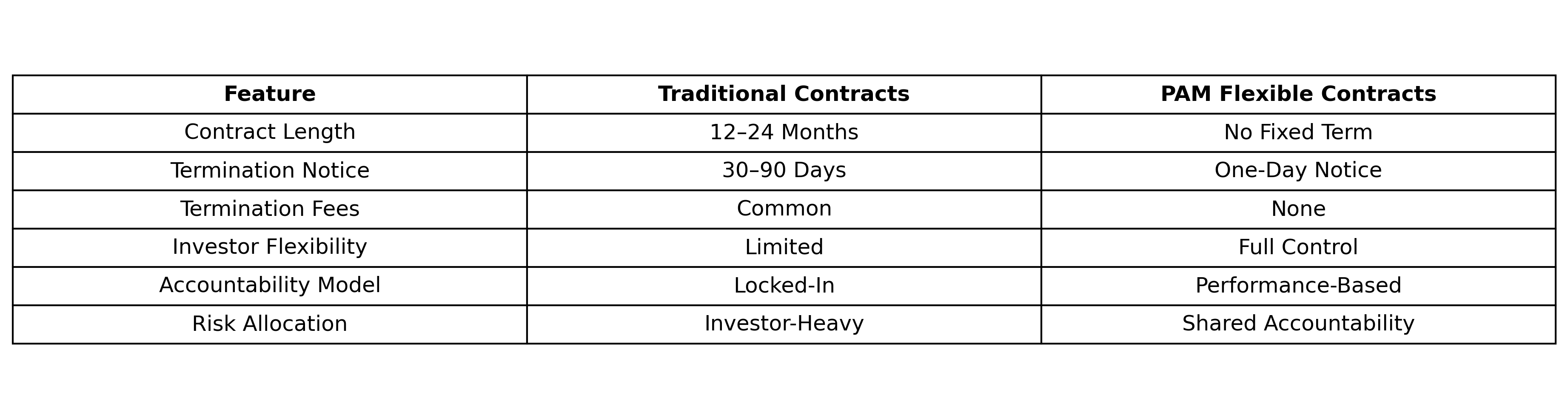
PAM agreements can be terminated at any time, with a one-day notice and no penalties.
Some contracts can last for a year to align with tax cycles and standard lease terms. Others can encourage managers to increase efforts at attracting tenants through a 90-day trial period, followed by a year-long commitment. The takeaway is that the common misconception that contracts have to last for 12-24 months is hardly the case.
Regardless of the length of the contract, the exit strategy is arguably the most important component. Contracts may require 30, 60, or 90 days to walk away, making the duration of the contract much less relevant. At PAM, the property owners can end the contract with a one-day notice without any penalties.
The reasoning behind a one-day notice is simple: life changes, portfolio strategies shift, and both parties should feel confident about the arrangement. This approach avoids complications with long surrender periods, penalizing parties for misalignment, and locking in revenue models. With two-way accountability, investors or property managers can exit if the alignment falters.
View this table to better understand traditional property contracts versus those offered by PAM:
FAQ: Property Management Contract Flexibility at PAM
Q: If I cancel with a one-day notice, what happens next operationally?
A: When you provide notice to terminate your contract, PAM begins an off-boarding process immediately. This includes transferring relevant property information, tenant records, and financial documentation back to you. Your tenants continue their lease obligations uninterrupted, and any ongoing rent collection or maintenance services are wrapped up according to the timeline you specify. Our goal is to ensure a smooth transition with minimal disruption for both you and your residents.
Q: Are there any exceptions to the one-day notice policy?
A: While a one-day notice is standard, certain situations may require additional coordination to maintain operational integrity. Examples include:
Active evictions in process
Open insurance claims
Emergency maintenance or repair events
In these cases, PAM will work with you to establish a practical transition timeline that protects residents and complies with legal obligations, while still keeping your exit as seamless as possible.
Q: What happens if I sell my property while under contract?
A: If you sell your property, the PAM management contract terminates automatically. We coordinate closely with you and your buyer to ensure the lease agreements remain intact and tenants experience no disruption. Our team can also assist in transitioning management responsibilities to the new owner if requested, giving you confidence that your property continues to be managed professionally through the sale.
What Does Contract Length Mean in Property Management?
An investor-friendly property management agreement clearly discloses fees, allows flexible termination, and defines legal authority without long-term penalties.
Most property management contracts begin once the document is signed. However, fees are collected according to the document, and at PAM, we must collect rent from tenants before we receive our 10% fee.
Contracts help establish operational guidelines, such as preventing investors from directly contracting with residents to avoid confusion and protect the resident experience. In this example, investors can avoid a divorced parents dynamic, where, in an unhealthy situation, tenants can act like children playing the parties against each other.
Contracts will also establish the property manager as the legal operator and authorized representative to handle issues like insurance claims, litigation, emergencies (floods, deaths, and disasters), and to communicate responsibilities, avoiding friction and misalignment.
Red Flags in Property Management Contracts
Unlike proactively laid-out agreements, poorly defined contracts can allow for long surrender penalties. For example, an investor might be charged a $150 a month fee for being forced to stay in a contract for the remaining ten months, resulting in a $1,500 penalty over time. Other common red flags include:
Hidden fees: Some contracts include vague charges for “administrative costs” or “early termination processing” that can add up quickly.
Rigid renewal clauses: Automatic renewal without clear opt-out terms can lock investors into another term without consent.
Limited transparency on services: If the contract does not specify what services are included, investors may end up paying extra for routine tasks like marketing, maintenance coordination, or compliance management.
Unclear legal authority: Contracts that fail to clearly define the property manager’s authority can create confusion around handling emergencies, insurance claims, or resident disputes.
How Do Property Management Contracts Work for Investors?
Contracts should be easy to understand, avoiding overly complex or ambiguous language, and all of the fees should be completely disclosed. When that happens, a contract can be the right resource to help a property-based relationship grow. On the other hand, if the terms are poorly laid out and misunderstandings arise, the situation can be just as miserable as being stuck in a living situation with the wrong person.
For investors who want more information on their contracts to help them better understand the business relationship with the property manager, here is a list of questions that will help foster a transparent agreement between the two parties:
How long are your property management contracts?
Can you cancel the property management contract at any time?
What parts of the property management contract discuss legal requirements?
What happens if I sell a rental? How much notification do you need?
Does your property management company charge termination fees?
What will your property management contract include?
When do I need to pay your property management company?
What is the notification for terminating the contract?
What type of evidence and maintenance logs will be provided?
Wisconsin property management contracts must align with state landlord-tenant laws, which is why local operators structure agreements differently from national firms. The right contract will lower long-term risk, better align parties, and lead to more adaptable portfolios.
Being successful in real estate involves managing risk as well as developing investments. Creating a property management contract that clearly defines responsibilities, fees, and exit options will protect the investor and the resident experience.
Flexible contracts, like those offered by PAM, allow investors to adapt to changes in life, strategy, or conditions without being locked into long-term obligations. Investors who wish to continue the discussion of property management contracts can schedule a phone call, where we can provide more clarity and save headaches through transparency.