What Does “Leasing” Mean for Performance Asset Management?
Imagine an investor listing a property for $1,200, believing the market will support it. But two months later, the space gets rented for $1,000, the price that data initially supported. The numbers look consistent, but the investor lost $200. Instead of increasing returns, a decision reduced them—and that choice is exactly why investors benefit from understanding leasing.
In addition to illustrating why a leasing policy is crucial for investors, the analogy highlights why Performance Asset Management (PAM), our award-winning property management company, views leasing as a form of resident placement rather than filling a vacancy. The difference emphasizes quality over speed and choosing the right people for the right place, instead of rushing to make decisions that lead to regular turnovers.
Each unit PAM manages operates as a business, structured by standard 12-month leases that are legally binding contracts in Wisconsin. Leasing is crucial because the profitability of each investment is highly influenced by residential behavior. In this article, you’ll learn how leases determine cash flow, expense control, and long-term returns to define success or failure. Use that information to examine your leasing structure or consider working with a property manager.
Why Should Property Managers Treat Leasing as an Investment?
Leasing matters because resident performance determines cash flow stability, expense control, and long-term returns.
When our residents are properly placed, those relationships tend to last 36 to 60 months, making long-term tenants a key factor in reducing turnover expenses. For example, a five-year resident can eliminate multiple expenses associated with recurring costs for painting, cleaning, and overall preparation. And even conservative turnovers can cost thousands of dollars.
More specifically, when a unit gets turned over, the costs can exceed profits—dramatically reducing any returns on the investment. Few investors buy into real estate for the amount earned per month in rentals, because after paying insurance and routine expenses, there’s very little buffer. For investors in Southeast Wisconsin, renting single-family homes typically yields just a few hundred dollars per unit each month.
Although the low cash flow margins make turnover especially damaging to returns, leasing can protect the income side of renting. In short, by stabilizing income and reducing cash flow interruptions, strong leasing protects the Internal Rate of Return (IRR), which is the annualized return on an investment over a specific period.
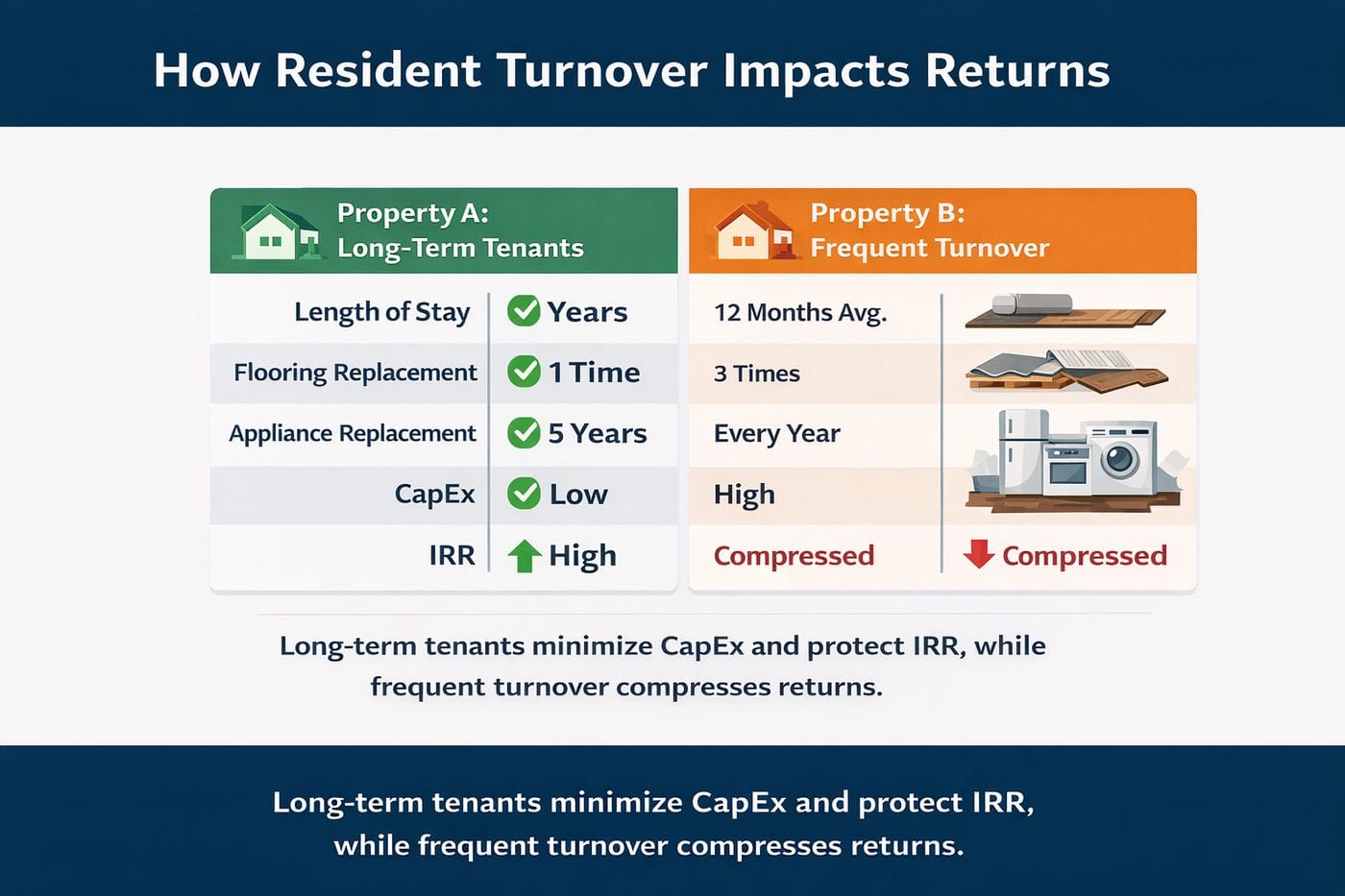
Resident wear patterns also influence long-term CapEx outcomes, since long-term residents who avoid damaging the unit preserve capital by slowing asset depreciation. For example:
If tenants at property A stay five years before moving on, and the flooring is only replaced once, with appliances replaced on schedule
While property B requires five different residents over the same time frame, the flooring needs to be replaced three times, and the appliances are replaced every year
The same rent yields very different IRR and CapEx
How Does Performance Asset Management Reduce Leasing Risks?
PAM uses income, rent history, and liquidity as predictive correlators to reduce payment and turnover risk.
Over 15 years of experience specializing in residential investment properties owned by small-to-mid-scale, long-term investors have taught PAM that rushed leasing leads to chronic turnover and operational drag, both completely preventable problems that absorb resources.
By leveraging technology, PAM reduces those risks with third-party, verified data. Instead of relying on self-reported information from prospective tenants, it’s possible to reliably predict rent payment behavior and length of stay. Two of the strongest predictors of rent payment behavior are 24-month rental payment histories and net income or take-home pay. When viewed together, PAM can make a proactive decision on how the renter will perform.
Rental history shows time stamps verified by third-party services, which confirm on-time rent payments. Net income offers insight into financial health, as it shows how much a person earns after taxes, health insurance, and voluntary deductions, such as contributions to an IRA, HSA, Roth accounts—the amount a prospective tenant can actually allocate towards rent.
PAM also considers liquid assets as short-term indicators because people with assets tend to behave in a way that aligns with property performance. By prioritizing a correlation between hard facts and data over generalized screening shortcuts, PAM can accurately lower the risks involved with leasing to problematic residents that depreciate property value and drain returns.
To ensure accuracy, internal performance tracking validates these criteria over time. Our data confirms whether income stability assumptions were accurate, whether wear patterns align with expectations, and whether operational drag was minimized by analyzing the following metrics:
On-time rent collection
Late payment frequency
Length of stay
Turnover-related costs
Make ready and damage expenses
Maintenance frequency tied to usage (instead of age)
Evaluating Whether a Leasing Policy Is Actually Working
Investors evaluating a leasing policy should review performance over a 24 to a 36-month window, which will help with recognizing patterns, as opposed to focusing on isolated outcomes.
Measure vacancy as unpaid rent, as opposed to how long a space is empty. For example, a 5% vacancy target represents approximately two unpaid months over three years. Leases that meet or exceed that benchmark signal operational success.
Investors should also compare the promises offered by property management companies to the amount of actual rent collected. PAM involves investors early on through a 120-day lease renewal process, encouraging pricing discussions before urgency creates risk. Additionally, weekly audits ensure that investors have access to visible, accurate, and functional data.
Market feedback is also continuously monitored and incorporated into our processes. Disciplined leasing protects returns by minimizing vacancy loss, while consistent resident placement reduces operational drag. For our long-term investors, choosing the right residents is the most crucial decision affecting success.
How to Decide If PAM Is the Right Choice for Leasing Your Property
Quality placement isn’t a tradeoff for quickly placing tenants. Poor tenant placements create additional workload, slowing operations, decreasing on-time rent collections, increasing early turnover, and necessitating repeated re-leasing processes that waste time and money.
At PAM, each listing begins with a local comparative market analysis (CMA) where comparable properties are analyzed within a half-mile to one-mile radius. Pricing decisions are finalized based on market conditions, not target rent alone. In the current Southeast Wisconsin rental market, demand is price-sensitive, making disciplined pricing essential to momentum.
Partnering with a property manager who treats leasing as a strategic investment is essential to success. PAM’s approach—using verified rental histories, income analysis, predictive performance metrics, and comparative analysis —is designed to align each resident placement with the financial goals of the property owner.
To learn how PAM can help you maximize your ROI with leasing, fill out our form to schedule your free consultation. Together, let’s examine leasing policies and whether those processes consistently translate into reduced vacancy and stable performance.