What Is “Humanation” in Property Management?
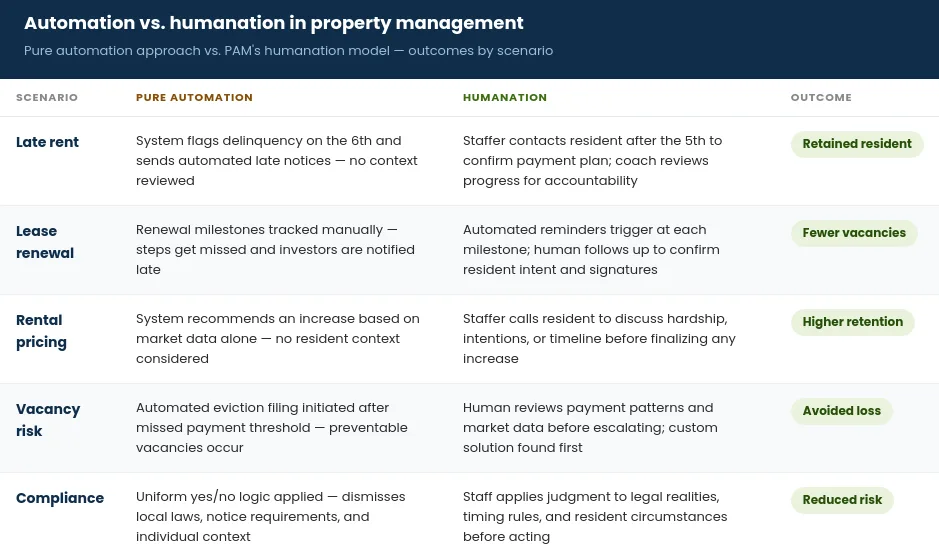
A resident in Racine, Wisconsin, had been paying rent around the 20th of every month. So, the automated system sent late notices. Eviction could have been the next step. But a staffer made a few phone calls and confirmed the landlord was fine with rent being paid on the 20th. That meant the resident got to stay where she wanted, all because a person supported a process.
These kinds of experiences are common for us at Performance Asset Management (PAM), as we have been in business for almost two decades. What started as a real estate venture turned into a property management company. We understand the struggles investors face and understand the goals property owners wish to achieve.
We combine automated industry tools with required human outreach at important points in our workflow. Automation helps with clarity, consistency, visibility, and timing across many moving parts. It helps to make sure nothing falls through the cracks. But the human connection is still there. Real people are necessary when residents need conversation, understanding, and problem-solving.
We call our approach “humanation,” and it provides the personal touch that managing residents requires. This sometimes emotional and always relationship-driven industry works best when technology strengthens services built on human connections.
For investors considering a property manager, this article covers what humanation means, how it solves common leasing and rent collection problems, and why pure automation isn't enough to protect your returns.
How Does Humanation Solve Common Property Management Problems?
PAM built humanation to solve visibility problems, manual process failures, and the limits of standard property management software.
Lease Renewal Support
A few years ago, PAM adopted automated processes to increase visibility and keep up with modern industry technology. It offered support with gaining clarity around tasks, timelines, and responsibilities. For example, manual lease renewal systems created too many communication breakdowns. The tools lead to missed steps in the hundreds of monthly renewals:
Messages get lost in inboxes
Follow-ups via phone calls can be forgotten
Multiple residents on a lease fail to receive all communications
Investors are notified behind schedule
Missing even a few communications can cause confusion. For instance, whether a lease will be renewed or expire, as manual systems make it difficult to keep track of:
120-day renewal notices
90-day pricing discussion
60-day resident responses
Final renewal signatures
Missed deadlines can cause unexpected vacancies costing thousands in lost rent. These issues can also lead to additional marketing costs and increased turnover. Fully manual systems cause things to fall through the cracks. In Wisconsin, the average cost of turning a vacant unit — including lost rent, cleaning, and marketing — is around $5,000–$5,500, according to PAM data.
Automation makes sure nothing is missed. But the process still needs human follow-through to drive real relationships. Combining a CRM and workflow model supports the full customer experience.
How Does Humanation Impact Property Investor Cash Flow?
Humanation can improve investor cash flow by combining consistent workflows with human decision-making.
Rent Collection and Pricing Rentals
For rent collection, a staffer contacts unpaid residents after the fifth to confirm payment plans. Automation ensures actions stay consistent, avoiding missed follow-ups. That employee owns the monthly list, creating clear responsibility. A coach reviews the progress, adding a second layer of accountability and oversight while reducing delinquency and stabilizing cash flow.
Industry research shows that retaining an existing resident costs significantly less than finding a new one. According to the Institute of Real Estate Management, maintenance responsiveness and repair quality are top drivers of tenant satisfaction and lease renewal.
Each new tenant represents risks, as problematic residents can cost:
Extended vacancy: $1,500–$8,000
Legal and court costs: $1,000–$5,000
Property damage: $1,500–$12,000
Missed rent or collections loss: $1,000/month
Poor resident placement can cost owners between $5,000 to $25,000 in losses. Our humanation approach solves both — keeping timelines visible and ensuring every property moves through each process on time. Actual employees also review issues like pricing, as automated tools need human intervention.
Automated pricing can recommend increases based on marketing data. But residents have real-life challenges that impact whether a price change is feasible. A phone call can reveal:
Financial constraints
Temporary hardships
Long-term residency intentions
Employment or family changes
For example, a resident might decline a $50 increase but accept a $25 increase. A property manager can negotiate that compromise. That intervention is something automation alone cannot do.
Why Pure Automation Isn't Enough for Property Management
Pure automation fails in housing because every situation is personal. Legal realities, timing rules, and individual context can't be resolved by a yes or no workflow. When problems arise, complications occur within their own specific context.
Attempting to solve housing decisions with a simple yes or no workflow can cause problems. It dismisses laws, notices, timing rules, and compliance responsibilities. Residents need understanding over an automated system. Investors need responsiveness and clear communication.
Real conversations help uncover problems before they grow. And human judgment helps with finding solutions that work for everyone involved. In the example with the Racine, Wisconsin, tenant who kept paying rent on the 20th of every month, PAM reached out to her to ask about the situation.
The landlord was happy to adjust when the rent was due, especially since the resident wanted to stay in the apartment. Our intervention made her a tenant in good standing. Without that phone call, she would have received eviction warnings through an automated system.
How Does Humanation Protect Property Investor Returns?
Humanation protects investor returns by reducing avoidable vacancies, increasing renewal clarity, and delivering the kind of resident experiences that keep properties occupied and cash flow stable.
With humanation, PAM can combine automation efficiency with human conversations at intentional points in specific processes. This proactive approach leads to better decisions and outcomes, as stronger communication can prevent unnecessary vacancies while supporting residents and protecting investor returns.
If you are a Southeastern Wisconsin-based property owner, schedule a conversation with the PAM team to walk through your current lease renewal, rent collection, and pricing processes — and find out where humanation could make a difference.