Why is Resident Placement Important?
Quality residents play a decisive role in the success of a residential property investment. For investors, residents directly affect your cash flow, maintenance costs, and the long-term value of your property. When the wrong resident is placed, problems happen quickly—many of which are preventable through a disciplined screening process or by partnering with a property management company.
The philosophy for residents at Performance Asset Management is that when tenant placement is done right, 80–90% of annual performance is already won. In the Southeastern Wisconsin area where we operate, real estate professionals estimate that investors face the risk of losing tens of thousands annually due to bad tenants.
In addition to financial risks and property damage, there’s a decline in community reputation to consider. Choosing the wrong tenant can also lead to draining legal expenses while compromising the safety of renters or neighbors. For property investors, learning how to make tough decisions regarding resident criteria is key, or understanding how to choose the right property management company to do the job for you.
What Criteria Do Property Managers Use to Screen Residents?
In real estate, business operates within neighborhoods, and responsible residents need to be suitable neighbors who can be part of a larger community. Even though screening standards will change based on different environments, most property managers rely on a similar criteria to evaluate applicants.
Although these inputs are widely recognized in the industry, they have different purposes. Some are designed to help confirm identity, while others assess financial stability and rental history. When viewed with other data, these guidelines are a solid starting point for developing residential screening criteria:
Credit reports: identify judgments, unpaid obligations, and patterns of financial distress that tell a story beyond a simple score
Criminal history: taken into account with fair housing laws, with an emphasis on safety-related offenses rather than blanket disqualification
Rental payments: verifiable evidence of rental payments made by applicant, how much was paid, and whether or not rent was paid on time
Landlord feedback: insights from previous landlords can identify patterns of behavior, especially from property owners years prior, who have little to lose in being honest
Bank statements: assesses financial reserves and the ability to pay rent along with other expenses, including emergencies
Income verification: calculated based on net income, income stability, and alignment with rent affordability thresholds
Government-issued identification: confirms identity and ensures consistency in materials
According to the federal Fair Housing laws and Wisconsin’s Open Housing Law, it is illegal to reject a tenant based on race, religion, color, National origin, gender or gender identity, familial or marital status, age, sexual orientation, handicap, participation in the Section 8 Program, or some arbitrary discrimination (i.e. tattoos, style of dress, or general looks).
How Does Performance Asset Management Qualify Residents?
While some property managers and landlords may have a positive experience with a long, elaborate checklist, PAM considers the items on the above list and evaluates criteria together while placing more focus on the following:
24-Month Rental Payment History (Strongest Predictor)
Past behavior can give good insight into how a renter will perform in the future. In particular, rental history shows whether or not a tenant can navigate through life challenges without letting obstacles negatively impact rent payments. Successful rental payment history for years can be one of the strongest predictors when still used in conjunction with other factors.
Because rent payment is oftentimes digitized through cash apps and rental portals, time stamps are available on each one of those bank transactions. That means third party verification services should be available on rent payments. Using these metrics can be a valuable tool for assessing a tenant and their ability to pay rent and do so on time.
Net Income
At PAM, we understand that the industry standard is to seek residents according to the 30% rule, which means rent should be about a third or less of how much a person earns.
However, our focus is on net (or take-home pay) instead of gross income, which helps gain a more realistic view of financial health. A tenant's rent could be 30% of their gross, it might actually be 45-50% of their net, after taxes, health insurance, and retirement savings.
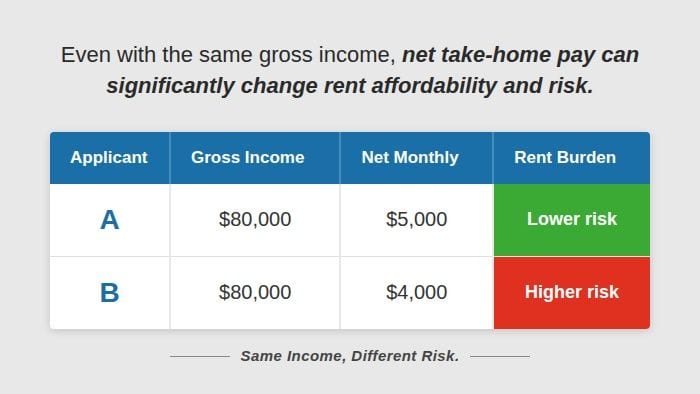
Property owners and investors who review net income can analyze actual cash flow available to cover rent. For example, two rental applications could both earn $80,000 gross per year, but their financial folders are completely different:
Applicant A: A single person with minimal tax withholdings and no retirement contributions might take home $5,000/month.
Applicant B: A person with a family, high health insurance premiums, and aggressive 401(k) contributions might only take home $4,000/month.
Bank Account Balance
Some landlords stop at verifying income, but bank account balance can be another truth-teller for financial behavior. Because people with assets behave in a way that aligns with great property performance, reviewing a bank account balance, especially in relation to net income is another one of our top indicators.
For example, a tenant who has $4,000 in the bank is more likely to make rent payments than a renter with a $0 balance. If a negative life event happens, such as car trouble, a medical bill, or being laid-off for a short time, the person without padding in their bank account has to make a choice between an immediate emergency and paying rent.
What Should Owners Remember About PAM’s Resident Placement Criteria?
Poor resident placement can cost owners between $5,000 to $25,000 in losses while creating safety, legal, and neighborhood reputation risks.
Choosing good tenants and eliminating potentially problematic renters starts by being able to make difficult decisions regarding resident criteria, evaluating residents personally or selecting an appropriate property management company to handle these responsibilities effectively.
How PAM Balances Fair Housing Compliance with Risk Management
Fair Housing laws have evolved during the past 15 years that PAM has been working throughout Wisconsin. Naturally, our PAM’s screening process reflects those changes.
Criminal history alone is not used as an automatic disqualifier. Instead, PAM focuses on safety-related considerations permitted under current regulations, such as offenses involving children or domestic violence, while relying on financial and rental performance data to guide approval decisions.
When the resident is financially stable and historically consistent, maintenance requests are more manageable, and communication is clearer, the long-term occupancy improves. When placement is handled poorly, even well-located properties can underperform.
Applying Resident Placement Criteria to Protect Your Investment
For Wisconsin property investors, resident placement is one of the most impactful decisions affecting long-term performance. Residents influence cash flow consistency, maintenance intensity, legal exposure, and the overall reputation of your property within its community.
Performance Asset Management’s resident placement criteria are designed to reduce those risks by relying on math, documented behavior, and affordability—not assumptions. By focusing on rental payment history, net income, and financial reserves, PAM prioritizes long-term stability over short-term occupancy.
For Wisconsin investors, choosing the right resident is one of the most impactful decisions affecting long-term returns. Whether evaluating residents independently or selecting a property management partner, understanding how screening decisions are made is essential to protecting both the asset and the community it serves. Speak with us directly for more information on choosing the right resident.
Schedule a Call