Why Does a Resident Placement Process Help Determine NOI?
In 2008, millions of Americans watched their property values drop by 25% to 50%, and the root cause of that crisis wasn’t the suddenness of the collapse. The bigger problem was that a system had been quietly placing people into financial commitments they couldn’t afford. The same structure works in residential property management today.
When a Southeastern Wisconsin property manager places a resident into a home they statistically can’t afford, the math catches up. Although the vacancy clock temporarily stopped, between months three, six, or eight, when a tenant has to get evicted, extended vacancy, utility exposures, turnover costs, and legal fees come down all at once.
Some property managers have processes preventing that outcome. Others use a business model that depends on it. Both can be identified through a set of observable signals. Performance Asset Management (PAM) has spent almost 17 years building a resident placement process around those signals in Milwaukee and across Southeastern Wisconsin. Learn what those processes look like in practice and what they look like when they’re missing.
What Are the Green Flags That Confirm a Property Manager's Placement Process Is Built on Affordability?
The strongest green flags are documented, third-party-verified data points that show a manager has a repeatable, affordability-first screening process that values your long-term NOI over their short-term convenience.
Green Flag 1
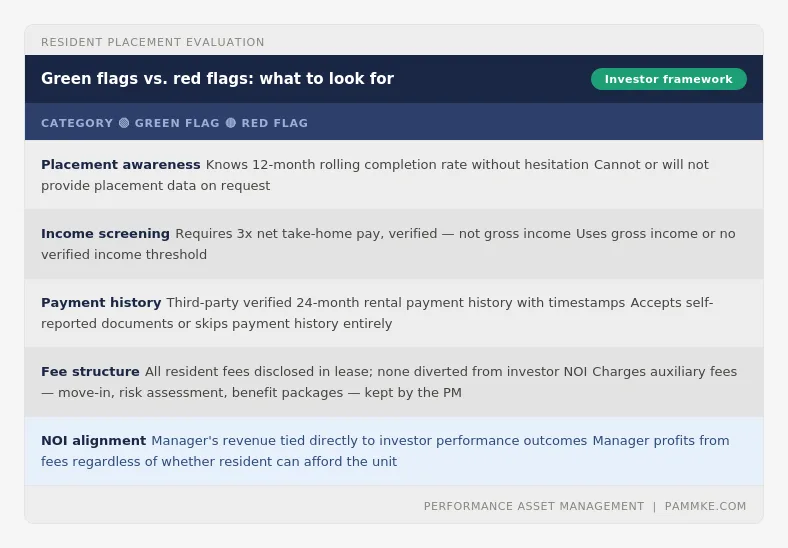
Managers who know their 12-month rolling placement without hesitation show a culture of accountability and a company that tracks what matters to investors.
Green Flag 2
The company requires tenants to have an income of at least 3x the monthly rent, verified as net take-home pay, rather than gross income. And that’s because net income reflects the actual amount of cash flow a tenant has after taxes, healthcare, and other debt obligations, while gross income can be misleading.
Green Flag 3
They verify the last 24 months of rental payment history through third-party sources, such as timestamps, because self-reported documentation by comparison is less credible.
Green Flag 4
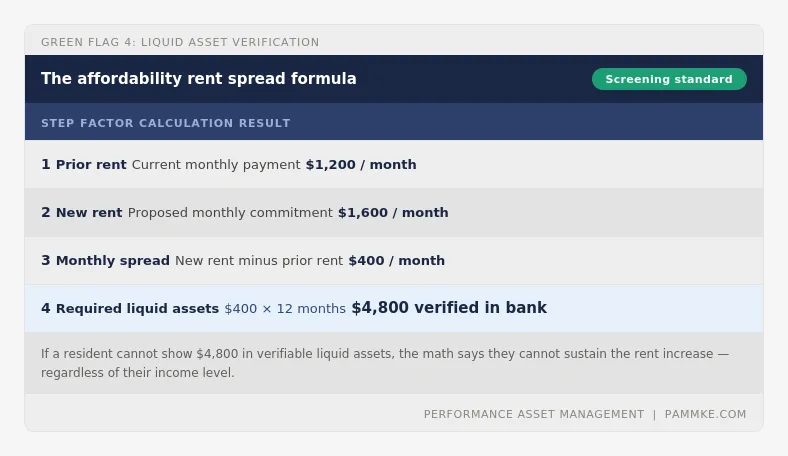
Companies that check liquid bank account balances against a rent increase spread before approving applications. For example, a resident moving from $1,200 to $1,600 per month should have 12 times the $400 (i.e., $4,800) spread in verifiable liquid assets.
Green Flag 5
Property managers who share their written screening criteria and performance data on request, similar to how a car dealership lets you get a test drive. A manager who won’t show you their process either knows it won’t survive scrutiny or doesn’t have one.
What Are the Red Flags That Signal a Wisconsin Property Manager Is Prioritizing Their NOI Over Yours?
Any fee structure, concession policy, or screening shortcut where the property manager profits when a resident fails is a structural NOI misalignment red flag.
Red Flag 1
Managers who offer rent concessions or move-in specials signal that the application didn’t meet the baseline for affordability, but they got placed anyway. Affordability is the primary driver of evictions, according to the Eviction Lab at Princeton, which has documented the financial and operational triggers of eviction broadly.
Red Flag 2
They offer security deposit installment plans or monthly risk assessment fees to residents, which go 100% towards the property management company and provide no financial protection to the investor.
Red Flag 3
Property managers who charge other hidden fees each month, such as move-in, lease preparation, or resident benefit packages. Some Wisconsin managers make $90 each month on these hidden fees.
Red Flag 4
They refuse to share their resident placement completion rate. A company with a high rate of placing tenants would want to show that information. Silence in this case is the answer.
Red Flag 5
Companies that fail to align their NOI with their investors by charging auxiliary fees regardless of whether a resident can afford the unit have prioritized their financial interests above yours, and that misalignment is dangerous.
Can a Wisconsin Property Manager Score Well on Green Flags and Still Deliver a Failed Placement?
Even a 97% placement success rate means 3 residents per 100 will fail, and what separates good managers from great ones is the documented process they run when that happens.
While achieving a 100% placement rate is a great goal to have, no screening process can fully eliminate life cycle events. Tenants will lose their jobs, medical emergencies will happen, couples will go their separate ways, and families will grow.
Managers who understand this truth also know that the difference between a 94% and a 97% placement rate isn’t luck. It requires consistently and thoroughly reviewing each application against the same affordability criteria. But the question becomes: What does a manager do when a placement fails?
Companies that have a documented lease break process, show the same level of discipline, because without a process each failed placement relies on improvisation. Investors should ask to be walked through what happens when a resident gives notice before a lease ends. The managers who have specific, documented processes have earned a green flag in this scenario.
How Should a Wisconsin Investor Use This Framework Before Signing a Property Management Agreement?
Treat the green and red flag framework as a pre-hire due diligence checklist, because the questions investors ask before signing a management agreement are far less expensive than the ones they ask after a bad placement.
Just one state away, the Summary of Rights for Safer Homes Act took effect January 1, 2026. This act requires full fee disclosure in leases, meaning that landlords have to provide a summary of rights to their tenants as the first page of their written lease.
As an effort to create more transparent spaces, the new Illinois state law doesn’t say that fees are eliminated. However, undisclosed fees and hidden practices have become much harder to defend in court, increasing the liability for investors. Investors should get ahead of that trend now. Wisconsin Investors screening a manager should ask:
What is your 12-month rolling placement completion rate, and can I see the data?
What is your written policy on rent concessions and security deposit alternatives?
How many residents placed using your tools completed their full 12-month lease?
What fees do you charge residents that are not included in the base monthly rent?
The questions cost nothing to ask. A bad placement costs significantly more.
What Does PAM's Resident Placement Process Look Like in Practice?
PAM's resident placement process is built on the same affordability signals this article identifies as green flags: documented, third-party verified, and tracked against a 12-month rolling completion rate across Milwaukee and Southeastern Wisconsin.
A property manager with processes who protects your NOI and one who has a business model that erodes it have signals on both sides. The green flags in this article confirm when a manager has built affordability into placement decisions, while red flags reveal managers who place their own interests ahead of the investor.
This distinction matters because poor resident placement leads to high turnover, which translates to high costs that depreciate your returns. Talk to your current manager or start using the questions outlined in this article to evaluate their processes.
Performance Asset Management has spent almost 17 years building and refining this process across Milwaukee and Southeastern Wisconsin. To see the placement data, screening criteria, and fee structure behind it, schedule a conversation with PAM founder Jim Miller.