What's the Real Difference Between a Month-to-Month Lease and an Annual Lease for Investors?
About 25 years ago, investors believed month-to-month leases made it easier to remove bad residents. In practice, it's just the opposite. A month-to-month resident can legally give notice on the first day of the month they plan to vacate, leaving an investor with 28 days to find a replacement, according to Wisconsin Statute § 704.19.
Month-to-month leases were framed as flexible, but that framing ignores true enforcement costs. Getting rid of a resident typically triggers legal, vacancy, and construction expenses. And in a market where affordability concerns are slowing resident movement across southeastern Wisconsin, that window isn't just tight. It's a structural flaw.
After 17 years of business, Performance Asset Management (PAM) knows that fewer than 10% of residents on a month-to-month lease actually move out on the date in their notice. The rest stay until an investor is forced into the same process a 12-month lease would have resolved weeks earlier. Continue reading to understand why an annual lease better protects you as an investor.
Why Are Month-to-Month Leases Harder to Enforce in Wisconsin?
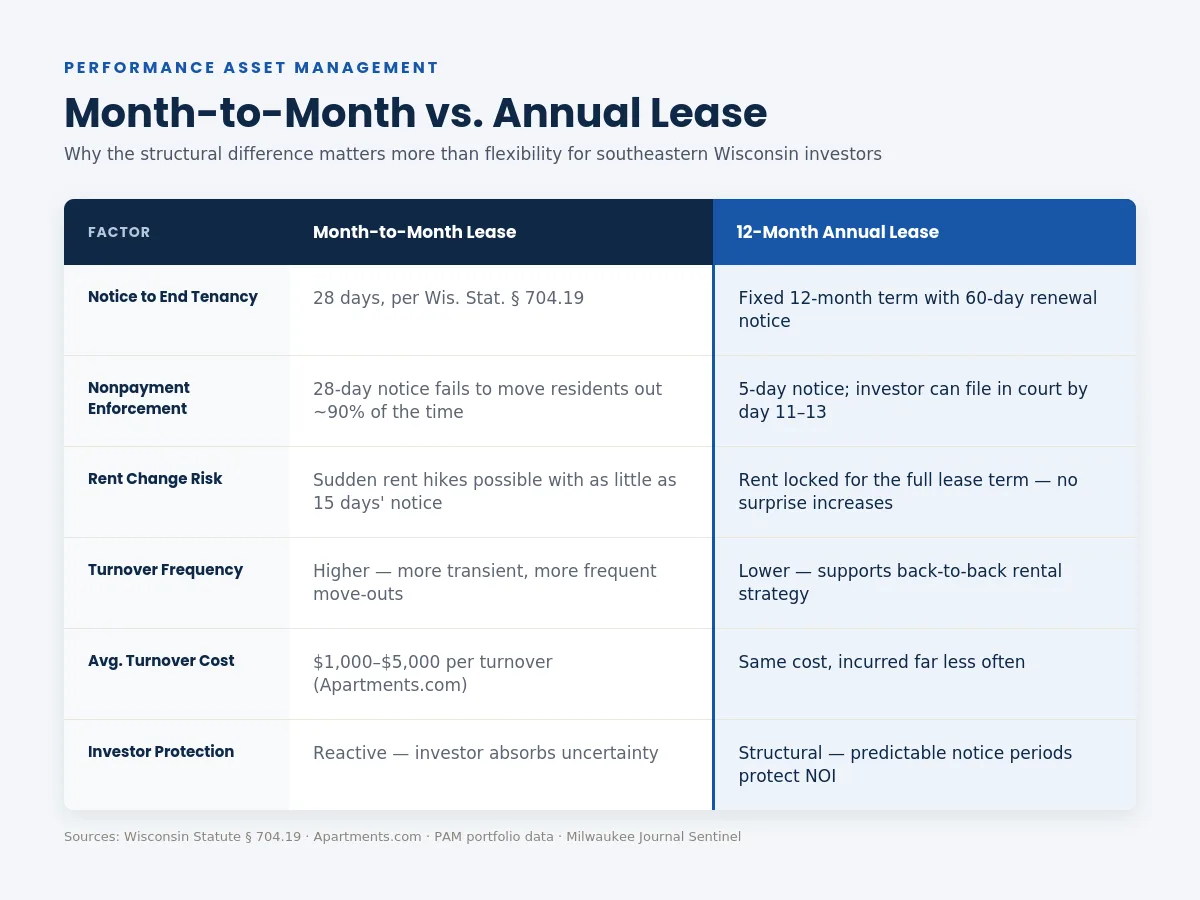
An annual lease resolves nonpayment faster than a month-to-month lease because Wisconsin's 5-day notice can be filed almost immediately, while month-to-month residents can ignore a 28-day notice.
After factoring in the time it takes to process a notice, the annual lease gets an investor into court by day 11–13. Alternatively, the month-to-month path burns 28 days on a notice that fails 90% of the time. Then, investors still have to initiate the exact same legal eviction process from scratch, since most residents who fail to pay rent have to be forced out of the rental.
Because of the enforcement gap, the month-to-month leases marketed as "easier to exit" are actually the slower, riskier option in Wisconsin. This issue was recently reported on in the Milwaukee Journal Sentinel, where a resident with a yearlong lease at $1,600 per month was set to expire on April 30. However, in March, she agreed to switch to a month-to-month lease.
Before the switch took effect, the building was sold to a new owner who quoted a new month-to-month rate of $2,583. She was asked to pay that 61% increase with 15 days’ notice. An attorney who was interviewed for the article cited Wisconsin Statute § 704.19 to conclude that this sudden rent hike violates that requirement.
That case and PAM's enforcement data point to the same conclusion: a lease with no fixed term fails to protect. Residents can get 15 days’ notice for a $1,000 rent increase, and investors can be stuck waiting out a resident who won't leave.
What Financial Risks Come from Relying on Month-to-Month Residents?
Month-to-month leases drive more frequent turnover, and each turnover adds vacancy, construction, and resident-placement costs that directly reduce NOI. Frequent turnover can lead to a quick property value drop, which can compound losses for investors.
While apartments.com estimates that the national average for turnovers costs between $1,000 and $5,000, PAM data suggests that in southeastern Wisconsin, it costs roughly $5,000 for each turnover. Because month-to-month leases are more transient and residents move more often, turnover costs can spike.
Housing instability has been linked to stress and job loss, according to the Urban Institute research on housing and upward mobility — the same dynamic that plays out when residents cycle through month-to-month leases.
Frequent turnover can also cause more wear and tear, which can hurt property value. Perceived advantage from short-term leases can disappear quickly through the expense door.
Is There Ever a Good Reason to Use a Month-to-Month Lease?
PAM uses a month-to-month lease in exactly one case: a short extension for a departing, in-good-standing resident that aligns their move-out with a back-to-back rental listing.
Outside that narrow exception, PAM does not recommend month-to-month leases because they consistently underperform annual leases on investor returns. For example, if a loyal resident renewing in July asks to stay one extra month, PAM grants short extensions specifically when and because they help hit back-to-back rental timing goals.
The extension still has to serve the core goal of going zero days without vacancy, because that translates to the property always earning. Outside that specific scenario, PAM never uses or recommends a month-to-month lease. Investors who bring in month-to-month success stories rarely have real data behind them. And the numbers rarely agree with the story.
Why Do Annual Leases Deliver Stronger NOI Than Month-to-Month Leases?
Annual leases require a 60-day notice before a move-out, giving investors time to re-lease a unit before it sits vacant and supporting PAM's goal of eliminating days without rental income.
PAM's core operating principle is eliminating investor days without rental income entirely. Because annual leases require residents to give a full 60 days' notice before moving out, that 60-day window gives PAM time to market and re-lease the unit proactively. PAM initiates the process 120 days before a lease expires. By day 90, residents have an offer they can accept.
A month-to-month lease cannot legally require a 60-day notice under Wisconsin law, and attempting to enforce a 60-day notice on a month-to-month creates real legal liability.
On the other hand, predictable notice periods can help protect investor NOI. Structured process, not lease length, is what actually drives strong long-term returns, and annual leases give PAM the runway needed to execute reliable back-to-back rentals.
The next step isn't complicated: audit your current leases. If any of your units are on month-to-month terms outside of a short, intentional back-to-back extension, that's an open exposure to the exact risks this article covers.
You don't have to make that call alone. PAM's lease and renewal process is built entirely around eliminating those risks for southeastern Wisconsin investors. If you want a second set of eyes on your current lease structure, schedule a call.