What Is Step-Up in Basis and Why Does It Matter for Rental Investors?
Imagine buying a rental in southeastern Wisconsin in your forties for $200,000, and after 20 years, it’s worth $600,000. Selling it next year means paying capital gains tax on the $400,000 gain. But letting a family member inherit it means they could sell the same property the day after your death and owe nothing. That’s Step-Up in Basis in a nutshell, and here’s why it’s important.
Step-up in basis resets a rental property's cost basis to its fair market value on the date of the owner's death, not the original purchase price. Property owners nearing retirement can use this single mechanic and make it one of the most important levers in an exit strategy on a long-term investment.
Spending 17 years working with investors taught Performance Asset Management (PAM) how to conduct legacy planning conversations for single-family homes, duplexes, and other held rentals. Many investors spend decades focused on increasing monthly cash flow, but avoiding hefty capital gains taxes can have a more significant impact on long-term returns. Keep reading to learn more about legacy tax planning and make the right decision for your investment.
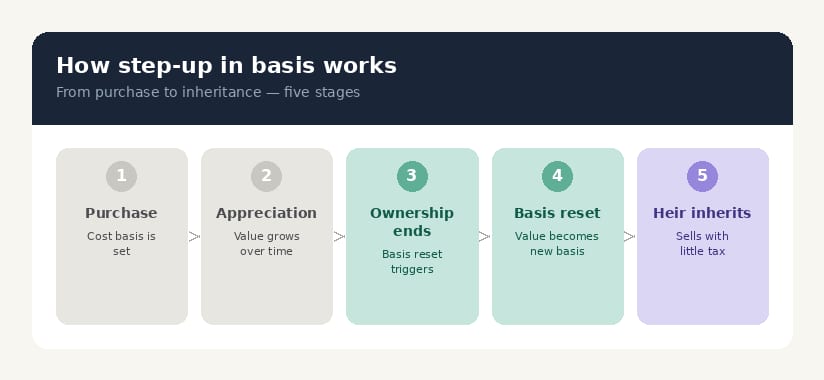
How Much Capital Gains Tax Does Step-Up in Basis Eliminate?
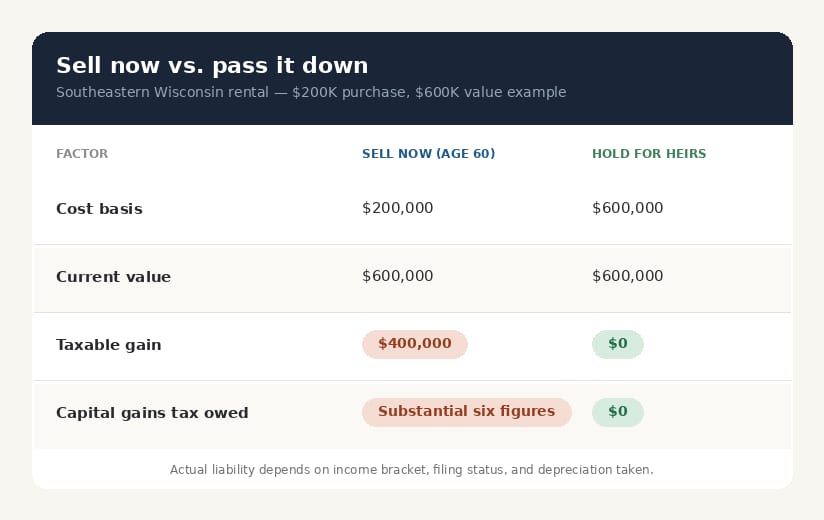
A Wisconsin investor who bought a property for $200,000 and later sees it appreciate to $600,000 would owe capital gains tax on the entire $400,000 gain if sold while living.
In that same example, if the investor instead holds the property until death, heirs who inherit and sell can avoid capital gains tax on that appreciation entirely. Actual liability depends on income bracket, filing status, and depreciation taken over the holding period.
As for a rough capital gains tax estimate, on a $400,000 gain, assuming long-term capital gains treatment without factoring in depreciation, southeastern Wisconsin investors can owe a substantial six-figure amount.
Heirs who inherit at that point can avoid taxes if they sell immediately, and the difference between those two outcomes can be a significant saving. That math becomes more significant the longer a property appreciates, which means if the original owner held onto the asset for 30 instead of 20 years, the value of the asset increases substantially.
Long-held Wisconsin rentals purchased decades ago can carry some of the heftiest embedded gains today. Investors who want to run their own numbers should speak with a qualified tax advisor who can confirm exact figures based on the specific asset.
Why Do Many Investors Consider Legacy Tax Planning?
As real estate investors reach financial independence, their priority often shifts from monthly cash flow toward how assets eventually transfer to family, friends, or causes.
That shift in mindset is what makes legacy tax planning, including step-up in basis, increasingly relevant across the investor community. Property investors often start by being primarily concerned with increasing monthly cash flow. After an investor achieves financial stability, their priorities often shift towards longer-term goals.
Among the assets wealthy Americans expect to inherit, 32% are real estate investments, one of the largest categories, according to Bank of America. U.S. stocks are the highest, at 38%, and emerging market equities are third on the list at 23%. Real estate investments are at the top of the list of Americans between 21 and 43 years old at 31%.
Visa's economic research states $36 trillion will pass to younger generations over the next 20 years, equivalent to roughly $515,000 per inheriting household, according to a 2026 data report by Visa Business and Economic Insights.
How Should Investors Decide Between Selling, Holding, or Passing Down a Rental Property?
Selling a rental property can immediately generate liquid assets, but it triggers a capital gains tax that takes away from the full appreciation earned during ownership.
Holding a property until death and allowing heirs to inherit it can fully eliminate that tax burden. In the end, the decision is choosing between immediate cash flow and long-term legacy goals. Investors who need access to liquidity, such as the purchase of another southeastern Wisconsin property, may choose to sell despite hefty capital gains taxes.
Those who are focused on legacy transfer benefit more from holding. Because family circumstances, individual health, and overall financial picture will heavily influence every investor, a one-size-fits-all strategy is impossible to create.
Setting specific goals and monitoring property performance with an industry expert, such as an experienced property manager, helps investors know whether they're on track for whichever path they eventually choose.
Investors who periodically reassess this decision are better positioned to make optimal choices, as circumstances and goals evolve. Waiting too long to make a plan can limit available options, especially if an investor waits until an action is necessary.
What Should Wisconsin Investors Ask Before Making a Legacy Tax Decision?
Investors should speak with a qualified tax professional to determine how their ownership structure affects step-up eligibility before making any exit decision.
Additionally, a property management company experienced in investor returns with a focus on long-term asset performance can play a role. Because a well-maintained rental holds more value for family members or heirs whenever that eventual transfer takes place, make sure to ask the property manager and tax advisor the following questions:
How does personal ownership structure affect step-up in basis eligibility?
Is the property held individually, in an LLC, or inside a trust?
Do state and federal rules interact differently for a Wisconsin-based rental property?
How does this current process fit into a broader retirement and estate plan?
Does the current performance support long-term value through a transfer?
Every investor will have a unique situation, making professional guidance essential. Knowing about step-up in basis and how investors use it to avoid capital gains taxes on inherited property is an advantage. Investors are using legacy tax planning to sidestep hefty six-figure taxes. Before deciding to sell, hold, or pass down a rental, consult a tax advisor first.
After being armed with information from a tax professional, consider working with a property manager to get answers to long-term investment questions. For more information, set aside time to speak with PAM Founder Jim Miller.