What Is a Cash-Out Refinance, and Why Isn't It Taxed Like a Sale?
Buying a property at a 2.75% interest rate might seem like a fairy tale in many parts of America. But picture locking in that rate in 2013 and sitting on it today, with 18 years on a mortgage. Refinancing means giving up that rate, since the new loan is priced at today's market. And it also offers two things selling doesn't: no taxable event, and the property stays with the investor.
A cash-out refinance lets investors borrow against appraised value. The investor takes out a new, larger loan that replaces the mortgage balance. The difference between the new loan and the old balance is paid out in cash. Because nothing was sold, the IRS doesn’t tax it as a capital gain, unlike selling a property, which converts appreciation into a realized gain.
A cash-out refinance is different from a home equity loan or HELOC, which leaves the original mortgage untouched and adds a second loan on top of it, preserving the original rate. Cash-out refinancing replaces the old mortgage with a new loan and the rate resets on the full balance.
Refinancing keeps ownership the same: in the hands of the investor. After 17 years and with more than 450 units in southeastern Wisconsin under management, Performance Asset Management (PAM) has shown owners how properties continue generating rental income even after refinance closes. The new loan is secured by the property and its current higher value. Learn how to determine whether a cash-out refinance is the right move.
Why Are Wisconsin Investors Sitting on Ultra-Low Legacy Interest Rates?
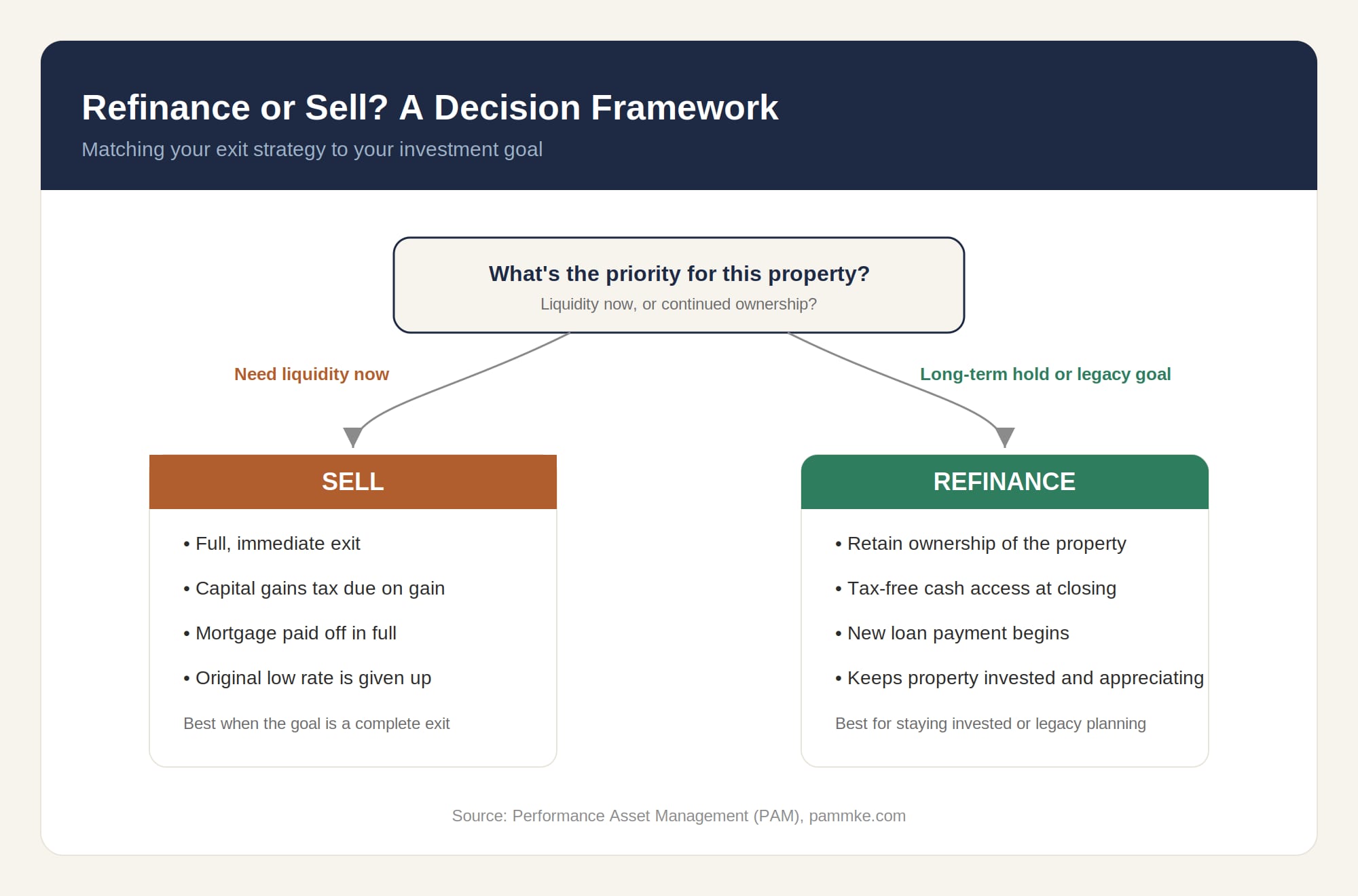
Wisconsin investors who bought between 2012 and 2021 often locked in rates near 3%, far below today's market. Selling surrenders that rate immediately and for good. Refinancing also resets the rate on the full loan, but it avoids a taxable sale and lets the investor keep the property along with its future appreciation.
Just like in the example above, PAM Owner Jim Miller regularly speaks with investors sitting on interest rates as low as 2.75% who have about a decade left on the mortgage. “They don’t want to sell it,” he said, adding that they shouldn’t have to. Those investors are paying a fraction of what borrowers pay in today’s housing market.
Since selling means giving up the low rate immediately and paying tax on the gain, cash-out refinancing offers a different tradeoff: a new rate on the full loan balance. But the loan proceeds generally aren't treated as taxable income.
For investors who don't want to sell regardless of the tax consequences, that tradeoff often wins. The math depends on how the new payment compares to the tax the sale would trigger.
This strategy works best for properties that have an established operating history, so lenders can confirm how the asset performs, Jim said. Providing documentation that details how an asset generates returns can lead to better refinancing terms. And the longer an investor has owned and managed a property, the stronger their position to benefit from this strategy.
For conventional cash-out refinances eligible for sale to lenders like Fannie Mae or Freddie Mac, both generally require at least six months of ownership. Typically, if an existing first mortgage is being paid off, it has to be seasoned for 12 months minimum.
How Does Refinancing Compare to Selling in Terms of Numbers?
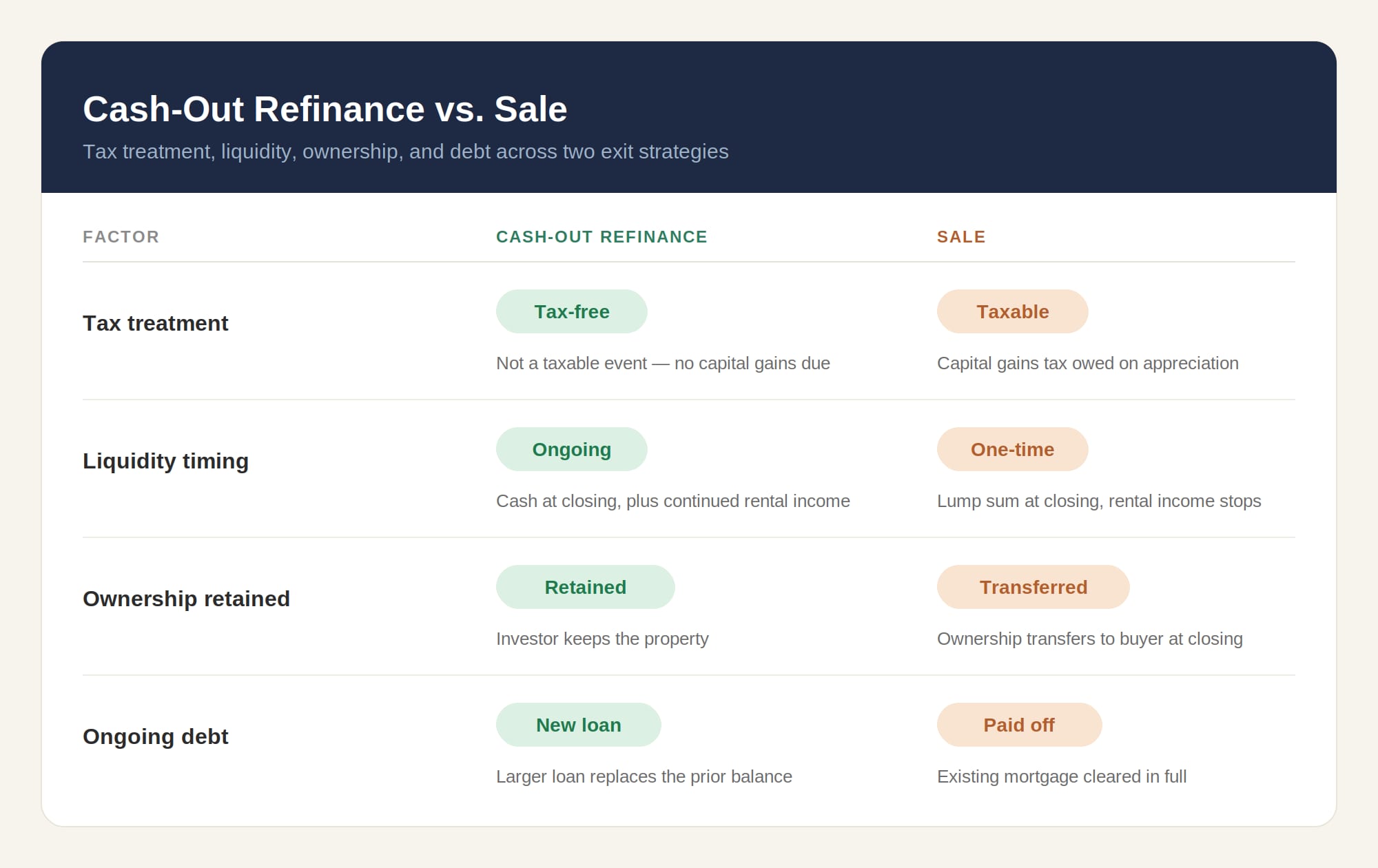
Selling immediately converts appreciation into a taxable lump sum, while refinancing converts it into tax-free cash now plus a new loan payment moving forward.
Despite the differences, the right move for each investor depends on whether liquidity is urgent or the goal is a longer hold. For example, a property purchased for $175,000 and later sold for $525,000 has $350,000 of gross appreciation before accounting for factors such as depreciation, improvements, selling expenses, and adjusted basis.
Running the same property through a cash-out refinance shows the other side of that tradeoff: assume that $175,000 purchase, now appraised at $525,000, carries a below-market remaining balance of $120,000 after about a decade of amortization on the original loan.
Investor-focused cash-out programs use a maximum loan to value (LTV) ratio around 75%, or roughly $393,750 in this example, although limits vary by lender and loan type.
After paying off the existing balance, the investor could access approximately $270,000 in cash before closing costs, with the loan proceeds generally not treated as taxable income. The new loan is priced at the current market rate, and the property still has to generate enough rent to cover the new payment under most lenders' debt-service coverage requirements.
Refinancing gives an investor access to cash today without the burden of a taxable event that same year. Investors can put that cash toward CapEx planning, another investment, or other priorities while taking on a new monthly loan payment secured by the property.
For investor-focused loans, the property's current performance can be more important to underwriting than the rate on the existing mortgage. Selling wipes away the debt entirely, because the mortgage is paid off at closing. This can unlock equity immediately, potentially reducing financial pressure from mortgage obligations.
However, the investor faces uncertainties, especially if reinvesting into a new property or market. That uncertainty is why refinancing is common in southeastern Wisconsin. Throughout the country, investors tend to take that approach. Cash-out refinances made up roughly 60% of all home loan refinances in the second quarter of 2025, according to the Associated Press.
What Makes a Rental Property a Strong Refinance Candidate?
Lenders favor properties with a documented rent-collection history and strong equity position over assumptions about the original rate. A property with years of verified performance can offer strong evidence of the asset's ability to support the new debt.
Properties with a proven track record of rent collection are regarded as a lower lending risk. Accumulating equity from years of appreciation creates room to borrow against. Alternatively, properties with limited equity have less room for significant cash-out refinancing. Here, the original interest rate takes a back seat, and performance becomes the driving force.
Lenders place high value on the reliable income the property produces today. For rental properties in markets with strong demand, such as parts of southeastern Wisconsin, a well-documented rent roll can help demonstrate the property's ability to support its debt.
Most cash-out programs cap the new loan at 75% of the property's appraised value. For many Debt Service Coverage Ratio (DSCR) loan programs, qualification focuses heavily on whether the property's rental income can cover its debt service. Minimum DSCR requirements vary by lender and program.
Lenders typically want to see around six months of ownership before approving a cash-out refinance based on the current appraised value, according to Lendmire, a mortgage broker describing wholesale DSCR loans.
When Should an Investor Refinance Instead of Sell?
Refinancing fits investors who want to stay invested, redeploy equity into new purchases, or hold for legacy planning. Selling remains the stronger choice for anyone prioritizing a full, immediate exit over continued ownership.
A cash-out refinance gives investors the opportunity to take out a new mortgage that pays off the original loan while pocketing some extra cash that can be used for other property investments. Investor-focused cash-out programs use maximum LTVs around 75%, although limits vary by lender, property type, and loan program.
Speaking with an industry professional about home value, equity, and current interest rates unique to southeastern Wisconsin can help determine whether a cash-out refinance makes sense.
The right conversation helps investors determine borrowing limits and new monthly mortgage payments after assessing their financial profile. Set aside time to speak with PAM for more information about refinancing.