How Do Wisconsin Property Managers Protect Investor Assets?
Successful property management requires avoiding worst-case scenarios: missed rent, fraudulent applications, mishandled payment transfers, or disputed lease terms. Each can cost an investor $1,500 to $8,000 or more. But despite their importance, the systems to prevent these issues are rarely discussed by managers, although they run throughout each lease.
These are the systems that rarely make it into a property management company pitch, because they're hard to summarize in a single stat, and they only become visible to an investor when something has gone wrong. Performance Asset Management (PAM) has been in business for 17 years, and that time has taught us to understand these issues and refine our safeguards.
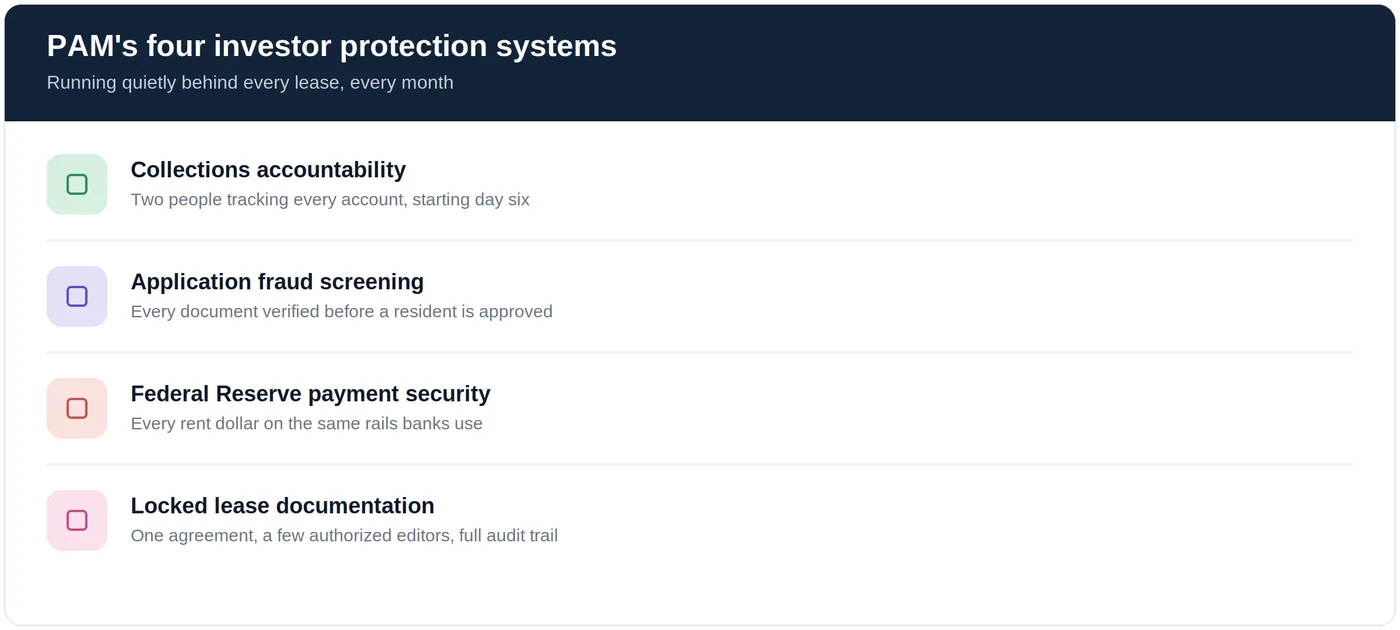
Our four systems that protect southeastern Wisconsin investors between the moment rent is due and the moment a lease ends fall into these categories: collections, fraud screening, payment security, and lease documentation. By supporting investors through the length of a lease, PAM can avoid exposing an investor to a level of risk they never agreed to take on. Keep reading to learn more about these systems.
What Systems Catch Missed or Late Rent Payments Early?
PAM's collections process triggers automatically on the sixth of every month, and every account is tracked by one team member who reports to a coach.
The two-person accountability structure is what keeps missed payments from quietly turning into bigger income losses for investors. PAM's own cutoff for on-time payment is the fifth of the month, so outreach begins the very next day, well ahead of the 5-day notice period Wisconsin Statute 704.17(2)(a) allows before a landlord can even begin the pay-or-vacate process.
Outreach starts immediately once a payment is confirmed missing or late. This provides financially struggling residents with quick access to assistance.
That early conversation often resolves the issue before it becomes serious, because two people watching the same list catch what one person might miss. And catching a missed payment on day six is what keeps a single late payment from becoming part of that $1,500–$8,000 range.
How Does PAM Protect Investors from Fraudulent Applications?
Fraudulent applications are a real and ongoing risk in the rental industry. PAM uses dedicated verification tools to catch them before a resident is approved.
Screening for authenticity protects investors from placing someone whose entire application was built on falsified information. Fake identification shows up regularly across the application process.
To prevent approving fraudulent applications, PAM verifies document authenticity before the income or background check even begins. Screenshots submitted by applicants get cross-checked against ownership and identity details. Names and addresses match across every document an applicant submits.
Verification tools quickly identify documents that appear to be edited, fabricated, or inconsistent. By catching fraud early, an entire placement built on false pretenses is removed from the process. False applications often exhibit much deeper signals of affordability issues that can arise during the lease period.
By implementing this verification step, which operates alongside affordability criteria, investors receive protection from day one, even if they are not aware of this crucial process. A fraudulent placement that slips through often ends up inside that same $1,500–$8,000 cost range. It just arrives as an eviction instead of a missed payment.
Where Does Investor Rent Money Actually Go After Collection?
Every dollar of rent and investor payment that moves through PAM passes through Federal Reserve-backed processing rails. That choice reflects a deliberate decision to prioritize protection over cost savings on payment processing.
Another reason PAM uses the Federal Reserve-backed processing rails is that it is the same infrastructure banks rely on for their security. This option is considered the safest and most expensive processing services FinTech makes available.
Every transaction benefits from the processing capabilities that FinTech provides, so investors never have to evaluate or manage this infrastructure themselves. Payment security operates behind every monthly rent cycle.
The invisibility is intentional, as good security shouldn’t require constant investor attention. Instead, it ensures that investors can focus their energy elsewhere.
Unlike a missed payment or a bad placement, a payment security failure isn't a cost that shows up in a typical range. It's the risk of losing an entire payment outright, and that is why PAM treats this system as non-negotiable rather than a place to cut costs.
How Does PAM Protect Investors from Disputes and Liability?
PAM uses one standardized lease agreement, executed through a digital signature system that only a small number of authorized team members can modify, with Jim Miller personally notified of every change.
Combined with digital rent tracking, this structure eliminates the "he said, she said" disputes that expose investors to unnecessary liability. This ensures PAM has a clear audit trail for every lease in the system.
Digital rent tracking removes any ambiguity about when a payment is posted, and residents can also log in and see exactly what PAM sees. Transparency reduces disputes regarding timely rent payments, minimizing legal risk and conserving staff resources. This documentation structure protects residents, investors, and PAM all at once.
Without that structure, a disputed lease term can turn into exactly the kind of legal problem that lands in the $1,500–$8,000 range. Except this time as an attorney's fee instead of a missed payment.
What Should Investors Look for in a Manager's Systems?
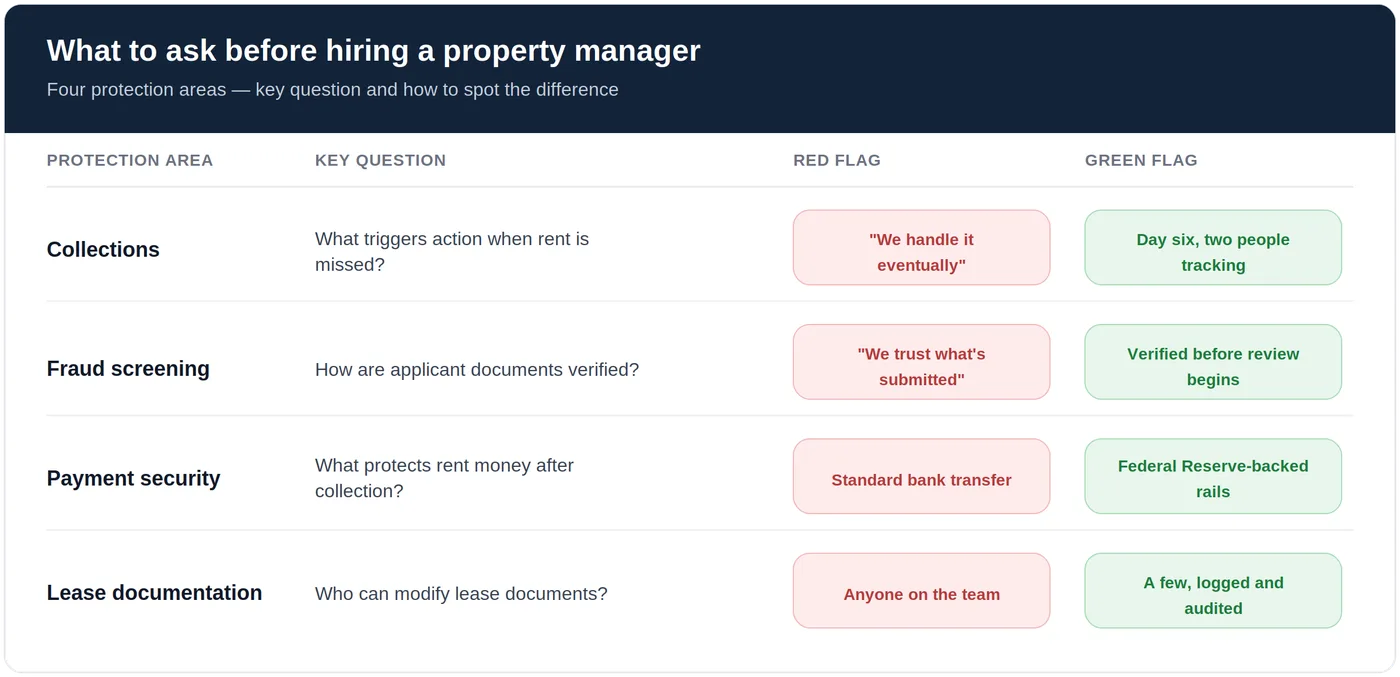
Investors should ask whether a property manager can clearly explain their collections process, fraud-screening steps, payment security infrastructure, and lease documentation controls.
A manager without clear answers in these areas is likely operating without a real system behind the scenes. A few specific questions include:
Exactly what triggers action the moment rent goes unpaid each month?
How do applicant documents get verified for authenticity before approval decisions?
What infrastructure protects rent money after it gets collected?
Who has the authority to modify lease documents, and how changes get tracked?
Hesitation on these questions is often a sign that the systems behind them haven't been fully built out yet. These four systems operate quietly, which makes them easy to overlook. Investors who ask early can avoid discovering painfully expensive gaps later on.
What Should Wisconsin Investors Take Away from This?
Protecting an investor’s income each month requires these four systems: collections, fraud screening, payment security, and lease documentation. That protection matters because the $1,500–$8,000 range these systems guard against could be the real cost of a missed payment, fraudulent placement, or a disputed lease.
The next time you evaluate your property manager, ask them the four questions above. For anyone ready to reach out and learn more about seeing them in action, schedule a meeting.