What Is the Koble Ruling and Why Did It Terrify Wisconsin Landlords?
In Koble v. Marquardt, the Wisconsin Court of Appeals ruled that a single incorrect clause could make an entire lease void. And landlords could owe double the rent for every month that the lease had been in effect. But Chapter 704 statutes prohibit landlords from changing a signed lease mid-term, until the Wisconsin Supreme Court stepped in.
On June 5, 2026, the Supreme Court of Wisconsin reversed the Koble v. Marquardt ruling, which threatened to make leases with a typo, outdated clause, or a missing notice a six-figure liability. In doing so, legal boundaries were restored that had governed landlord-tenant law for over 50 years.
Performance Asset Management (PAM) has been managing rentals in southeastern Wisconsin for over 17 years. And we believe this ruling offers three things every investor needs to act on: know what your residents are being charged, make sure your lease is current and legally updated, and understand that your property manager's mistakes are your liability. This article covers all three.
What Did the Wisconsin Supreme Court Decide in Koble?
The Supreme Court held that the Wisconsin Consumer Act does not apply to residential leases, and that a tenant cannot recover double damages without proving actual financial harm caused by the lease defect.
The Koble v. Marquardt ruling created significant uncertainty throughout Wisconsin's rental housing industry. Investors were concerned that tenants could potentially recover rent paid under leases containing prohibited provisions. In the 6-1 Supreme Court decision, several key points were clarified:
Tenants must prove actual monetary damages to recover compensation
A lease violation does not automatically entitle a tenant to recover rent paid
Tenants occupying a property under a void lease remain obligated to pay rent
Attorney fees and costs are generally not recoverable without proof of financial damages
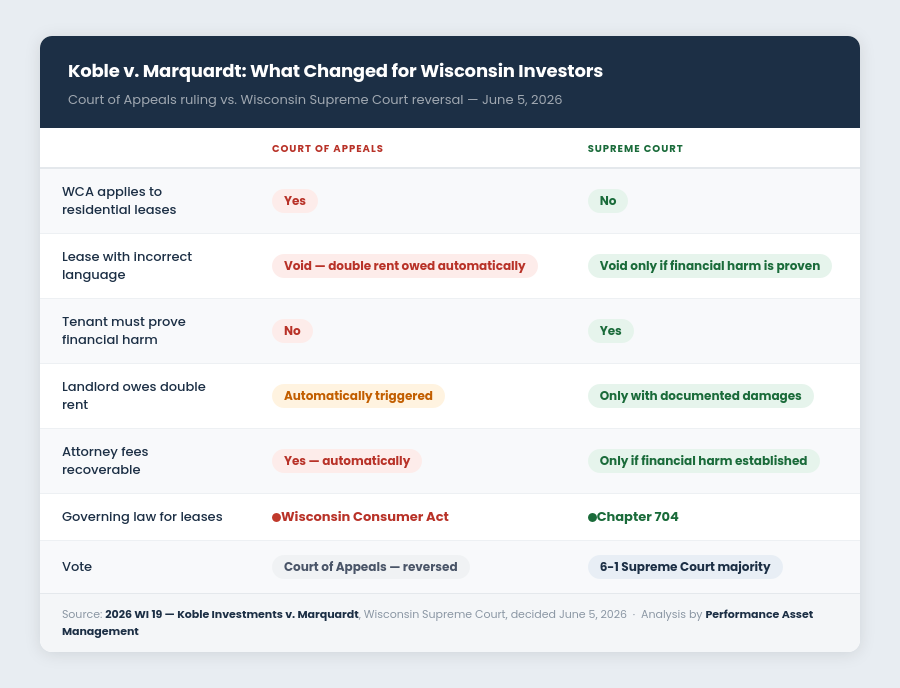
This decision was based on harm, instead of just legal language. The Wisconsin Consumer Act (WCA) is designed to regulate consumer transactions. The court of appeals had treated a residential lease as an installment contract, which the Supreme Court rejected. And Chapter 704, not the WCA, exclusively governs Wisconsin residential leases. This means that double damages under §100.20(5) require proof of actual pecuniary loss.
Because Marquardt received housing in exchange for rent, the Wisconsin Supreme Court ruled that this wasn’t a loss, so she wasn’t entitled to damages, costs, or attorney fees. Before the Koble v. Marquardt ruling, no court had applied the WCA to a residential lease for 54 years.
Why Couldn't Wisconsin Landlords Just Fix Their Leases When the Court of Appeals Ruled?
The court of appeals ruling created a conflicting situation: landlords needed to update defective leases immediately, but Wisconsin's Chapter 704 statutes prohibit unilaterally changing a signed lease mid-term.
In Wisconsin, a 12-month lease signed by a tenant and a landlord or their property manager is a legally binding contract. Wisconsin law generally prohibits one party from unilaterally changing a lease after it has been signed. Even when landlords and tenants both mutually agree, the amendments are heavily scrutinized, as courts prefer lease changes before signing.
This standard makes leases beholden to the home and signed term, instead of the preference of the property owner. For example, a property owner can’t sell the apartment they’re renting and expect a tenant to move before the lease expires. Residents have the right to stay at the rental throughout their lease end date, regardless of where the space has been sold.
The court of appeals ruling conflicted with Chapter 704 statutes. Investors were stuck with leases they couldn't amend. And tenants were attempting to use Koble to challenge leases and seek substantial monetary recovery, according to local industry attorneys. The Supreme Court’s reversal largely ended that wave of litigation and restored the legal footing investors had lost.
What Are the Biggest Takeaways from the Koble Decision?
Three actionable lessons every Wisconsin rental property investor should take from Koble: know exactly what your residents are being charged, use legally updated leases, and understand that you are liable for your property manager's lease language, even if you never see the fees.
Know exactly what fees your residents are being charged.
If a property manager hired by an investor charges residents unauthorized fees, the landlord is liable. Even if revenue bypasses the investor and flows to the manager, the property owner is still legally exposed in this situation.
Use leases that are legal, current, and Wisconsin-specific.
Investors need leases that are compliant with current law. An example of this is Wisconsin Legal Blank leases written by attorney Tristan Pettit of Pettit Law Group S.C., which is a Milwaukee law firm specializing in landlord-tenant law. Pettit's firm participates in Wisconsin's statute-building process.
The double-rent standard still exists, but it requires proven financial harm.
The double-rent standard still exists. But to trigger it, tenants have to prove actual financial harm occurred. The Supreme Court didn't eliminate the double-rent penalty. Instead, it repositioned it. Fees not codified in Wisconsin's Chapter 704 statutes are the most likely trigger, specifically risk mitigation fees, alternative security deposits, resident benefit packages, and move-in or administrative fees.
Several recent Wisconsin cases have scrutinized these fee structures, making them one of the highest-risk areas for landlord liability. If they appear in a lease, they represent documented financial harm and direct exposure to the double-rent standard.
How Should Wisconsin Rental Property Investors React to the Koble Ruling Right Now?
The Supreme Court delivered clarity. But it also signaled exactly where the next wave of landlord liability is headed, and that is property management junk fees.
The Supreme Court delivered massive amounts of clarity, as investors using leases free of unauthorized fee structures have little exposure. The ruling is hardly coincidental, as junk fees have become an industry-wide issue.
If your PM charges any of those fees, you are liable if a tenant sues. For out-of-state investors: work with a local manager who knows Wisconsin's legal environment. To stay further protected, review leases annually with legal counsel to capture a full year of court decisions.
What Koble Means for Your Rental Property, and What to Do Next
The Koble ruling confirmed that the Wisconsin Consumer Act does not govern residential leases, that double damages require proven financial harm, and that investors operating with clean, updated leases have little to fear from this decision. The three things worth acting on right now are the same three this article opened with:
Know what your residents are being charged
Make sure your lease reflects current Wisconsin law
Understand that your property manager's mistakes are your liability, regardless of whether that revenue ever reaches you
PAM has managed rental properties in southeastern Wisconsin for over 17 years. Our flat management fee is 8%, we publish every fee we charge on our website, and we review our lease annually with legal counsel. If you want to talk through what your current lease and fee structure look like in light of the Koble ruling, we're easy to reach.