Why Did PAM's Lease Renewal Process Get Stuck at 90%?
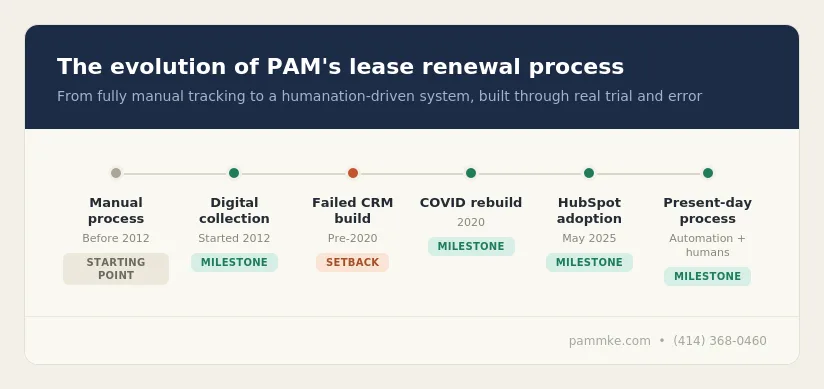
Before COVID-19 impacted the industry, Performance Asset Management (PAM) used an entirely manual lease renewal process. That setup worked initially, but growth exposed its limits. After working with a specialist, PAM created a seemingly wonderful workflow. But once it was activated, the system delivered less clarity than the process it was designed to replace.
That's often why rental renewals fail at scale: not bad residents, but a system that can't keep up. Growth and demand had outpaced what manual tracking could reliably accomplish. Too many renewals were quietly falling through the cracks each month. Internal adjustments helped, but performance plateaued at a stubborn 10% failure rate.
This translated directly into surprise vacancies and little advance notice. Surprise vacancies meant scrambling to relist. Southeastern Wisconsin investors got hit with rent-ready bills and vacancy news too late, damaging trust and straining relationships. Keep reading to see what it took: a fix that made things worse before one finally worked.
Why Did PAM's First Attempt at Renewal Automation Fail?
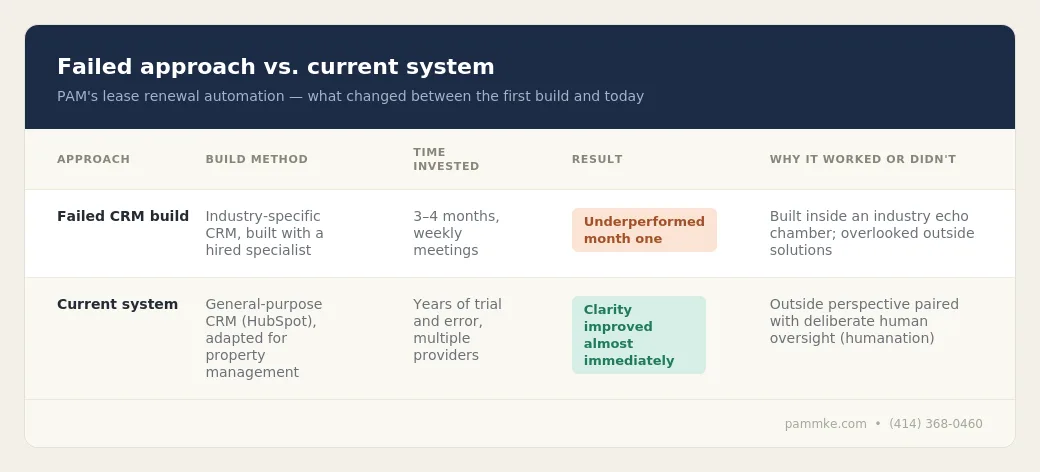
The property management automation failure stemmed from staying within an insulated industry echo chamber rather than looking to alternative solutions.
PAM hired a specialist from a property-management-specific CRM company, who had previously worked with a colleague to build a similar system that worked successfully. However, the finished system underperformed the old PAM manual process in its very first month.
The PAM team met with the specialist multiple times weekly for three to four months straight, but there was an almost immediate issue with a lack of clarity. Other issues soon followed, and the workflow never met the standards southeastern Wisconsin investors expected.
Industry conferences and peer groups had created a mindset that initially blinded the team to more advanced tools that existed beyond the property management industry. This same industry-insulated thinking was part of a broader pattern at the time, as there was a "ton of cultural toxicity," said PAM Founder Jim Miller.
How Did COVID Push PAM Toward a Better Renewal System?
COVID forced the final holdout residents onto digital systems and accelerated broader technology adoption. That shift created the opening PAM needed to begin building version 1.0 of its current renewal process.
PAM was the first company in Wisconsin to collect rent digitally in 2012, said Jim. He added that making that move early saved an enormous amount of time compared to fully manual rent collection. Still, almost 20% of residents preferred paying in person or by mail, according to PAM data.
COVID-19 removed that option entirely, forcing PAM's remaining in-person and mail-paying residents onto digital rent collection. That shift became an unexpected silver lining during a challenging time. It freed up time previously spent on manual rent processing, which facilitated rebuilding the lease renewal process.
At that time, cloud-based software solutions were also becoming standard across the industry, paving the way for Version 1.0 of PAM's current renewal process. That version needed heavy refinement, but it laid the right groundwork.
How Did HubSpot Change PAM's Lease Renewal Process?
PAM adopted HubSpot in May 2025, as their platform was outside the property management industry. That outside perspective, paired with human oversight, finally delivered clarity.
After several years of working with the wrong technology providers, HubSpot became the obvious choice. Its platform was built for broad business use, pairing automation with deliberate human intervention at key moments. Years of trial and error converged into a working solution that responds to the needs of residents and became known as PAM’s humanation approach.
National data backs up this claim. In Zillow's 2025 Consumer Housing Trends Report, 65% of renters who stayed cited liking their landlord or property manager as a reason, which was not far behind rental cost (75%) and quiet neighbors (71%). The Zillow report also stated that meeting or speaking with the landlord/property manager is essential for 47% of recent renters.
The PAM team was able to focus on outreach and support instead of manual data-tracking work, which automation now performs. Clarity around renewals improved almost immediately once the new system launched.
How Does PAM’s Property Management Process Help Investors?
The improvements to PAM’s lease renewal process matter as much as the eventual fix, because investors are getting a competent tech stack system that took time to perfect.
A big reason why PAM has a lease renewal process that works today is because of what failed, year after year. The poor CRM build, COVID-19 shifts, and the HubSpot pivot each shaped the current system. A failing lease renewal process can lead to surprise vacancies, rent-ready bills, and late notices that drain investor NOI.
The PAM system is more than just a series of processes. It is a culmination of lessons learned through trial and error. Investors who are in the market for a new property manager should ask: how did you get to your current lease renewal process? To find out more, read our article on what PAM's lease renewal rate means.
PAM's lease renewal team can walk any investor through how this process applies to their specific southeastern Wisconsin property. Schedule time with Jim to find out more.
Meet With Jim