What Is Variable Expense Ratio in Wisconsin Rental Property Management?
Imagine a $150 clogged drain turning into a $15,000 check. Without that $150 tenant charge written into the lease before the tenant signs, under Wisconsin's Chapter 704 statutes, courts tend to side with the resident. What started as a routine repair could become a five-figure penalty, and if left unmanaged, it could happen to any investor.
Variable expense ratio measures day-to-day maintenance costs as a percentage of rental income. Common examples in southeastern Wisconsin include clogged drains, running toilets, and seasonal repairs. It's distinct from CapEx (capital expenditures tied to asset age), income-driven expenses, and structural costs like taxes, insurance, and water.
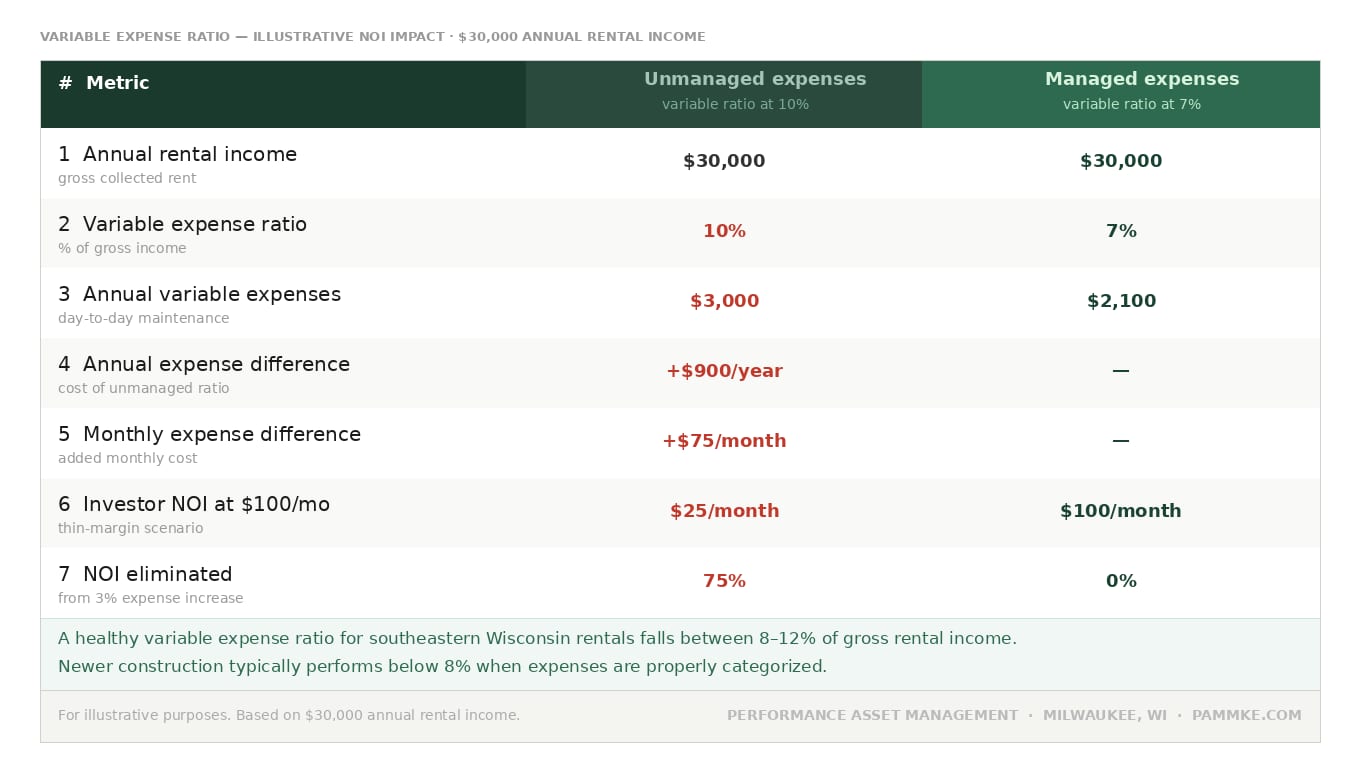
At Performance Asset Management (PAM), we isolate this ratio for our investors, as a healthy variable expense ratio falls between 8–12% of gross rental income. With the right data, we help push that benchmark lower. For Wisconsin rental investors, understanding and tracking this number is one of the most direct paths to protecting your Net Operating Income (NOI).
How Does Variable Expense Ratio Affect a Rental’s NOI?
Because variable expenses recur unpredictably, they quietly erode returns over time in a way that fixed costs don't. Investors who fail to track this metric separately often misread their property's true performance.
Small recurring expenses can be the most dangerous in a rental portfolio because they don't trigger the same attention as a roof replacement or furnace failure.
Whether it’s a property management company working for an investor or a DIY landlord, tenant satisfaction is directly impacted by maintenance responsiveness. When response times to maintenance requests are slow, they can turn simple repair costs into expensive turnover cycles or vacancies. The NOI impact becomes clear if you run the numbers:
On $30,000 in annual rent, a 3 percent increase adds $900 in yearly expenses, which translates to roughly $75 per month in additional costs for the investor.
If your NOI is $100 per month, that shift eliminates 75 percent of your profit.
When Do Variable Expenses Spike and How Can Wisconsin Landlords Predict Them?
Two predictable flashpoints drive variable expense spikes regardless of a property's age: the first 60 days after a new tenant moves in, and the lease renewal window.
When new tenants and current residents considering renewing their leases submit an increased list of maintenance requests, these periods can help property owners or their managers demonstrate their ability to respond to these requests quickly and thoroughly.
According to Jim Miller, owner of Performance Asset Management (PAM) in Milwaukee, the lease renewal window is the single best predictor of future variable expenses in today's market, more reliable than property age, tenant history, or seasonal patterns.
During the renewal process, tenants will want to report issues that they have been experiencing over time. While newer rentals or those recently remodeled will see smaller spikes, the timing pattern for older homes will remain consistent.
Investors who understand these cycles can plan reserves accordingly, as this timing is a strong predictor of future expenses. Planning accordingly for investors can involve allocating resources or setting up a clear, systematic communication plan, which can prevent a potential backlog of smaller issues from turning into something much larger.
Creating a communication process that responds to messages and communicates awareness will help tenants feel more supported. Similarly, communicating when non-urgent matters will be addressed can also help minimize frustration.
How Can a Lease Protect Investors Against Variable Expenses?
Creating a legally compliant lease is one of the more powerful ways to control variable expenses. Working with a property manager whose leases are built to this standard is one of the most direct ways to protect variable expense ratio.
Even small expenses can significantly reduce NOI over the long term, and in some cases, very quickly. Clearly defining for your residents what gets classified as resident charge helps to protect variable expenses and NOI. Wisconsin's Chapter 704 statutes require that tenant repair responsibilities be defined in writing, ensuring they are clearly stated before residents sign.
Specific dollar amounts for resident-caused repairs must appear in the lease before signing.
Charges for clogged drains, unshoveled snow, and uncut grass must be itemized specifically.
Leases must have clear definitions regarding resident neglect and normal wear and tear.
Property managers should be able to support all of these lease construction issues, especially with legal compliance. Leases missing this standard risk penalties of double the security deposit and double the rent. Wisconsin courts have become significantly more aggressive on this issue in the last three years.
How Should Wisconsin Investors Use Variable Expense Ratio to Evaluate a Property Manager?
Variable expense ratio should be reviewed by investors at a minimum twice per year, and investors should ask for a copy of every lease and review it before residents sign.
Start the conversation about variable expense ratio by asking whether your property manager isolates these expenses separately from other costs. Investors need to confirm that their leases include the specific dollar amounts for resident neglect charges.
By asking managers to see their lease renewal process, requesting data that supports their approach, and reviewing that data preferably every six months, investors can discern whether their management company is supporting their long-term goals. The right managers will share expense data, in addition to occupancy rate, lease renewal rate, and placement metrics.
How Should Wisconsin Rental Investors Use Variable Expense Ratio to Protect Their NOI?
Variable expense ratio is one of the clearest signals available to southeastern Wisconsin investors. After reading this article, you should know what to track, when expenses spike, and what your lease should say to protect you from absorbing unnecessary costs.
A $150 drain repair turned into a $15,000 penalty because of processes. By building the right systems in advance, such as a compliant lease, a well-structured renewal process, and transparent expense reporting, investors can protect their NOI and do it consistently.
Ask your property manager how they separate variable expenses from CapEx and structural costs, and confirm when they last reviewed your variable expense ratio with you. At PAM, we build the right lease language while tracking metrics that drive consistent NOI. To find out where your numbers stand, contact Jim Miller at PAM for a portfolio review.