What Is Occupancy Rate for Rental Properties?
Days on the market seems like a business performance metric. But it can be a warning sign. It could mean a property manager is filling units without screening residents, offering excessive discounts, or renewing leases at rates that are too low. Occupancy rates offer real insight into whether income is consistent. Unfortunately, too few investors ask managers to report it.
At Performance Asset Management (PAM), occupancy rate is defined as the number of paying units divided by the total number of managed units. After 15 years of supporting investors throughout southeastern Wisconsin, we differentiate occupancy rate from days on the market, which is the number of days a rental is listed for sale.
Too many managers promote days on the market, which only measures listing activity. And because fast placement and strong occupancy are two different concepts, investors benefit from understanding the difference. Continue reading to learn more about occupancy rates and understand how this percentage relates to net operating income (NOI), as declines in occupancy can signify real, compounding losses.
Why Should Wisconsin Investors Track Occupancy Rate Instead of Days on Market?
Occupancy rate reveals how consistently a property produces income over time, not just how fast a vacancy is filled. While low days on market may look positive, a strong occupancy rate helps investors evaluate lease stability, tenant retention, and long-term rental performance across Wisconsin investment properties.
Because tracking days on market only measures how long a unit appeared on a listing platform, a unit listed for 28 days can still show 98% occupancy with the right process, or a unit showing for 8 days on the market can still reflect an 84% occupancy rate. The scorecard metric that matters is days without income, instead of the number of days listed.
To provide another example, a building with 10 units where 9 of them are rented has an occupancy rate of 90%. 45 days listed doesn't mean 45 days vacant — and most investors don't know the difference. Here's why that matters for your returns.
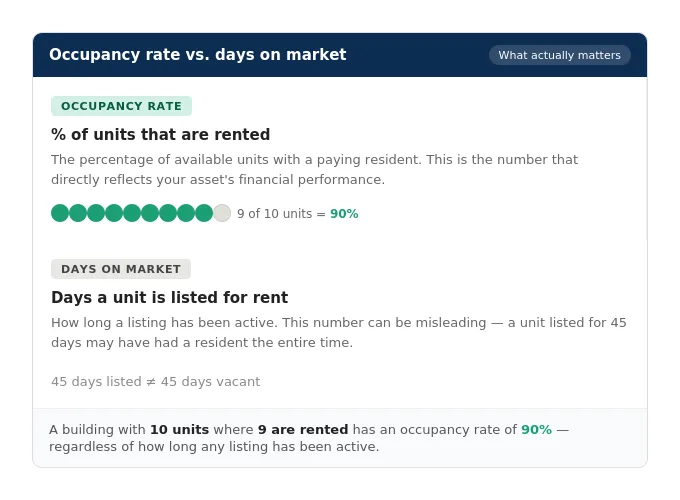
In short, it is the percentage of rental units currently occupied by tenants compared to the sum of rentable units.
An investor might see 45 days on the market, and while that is accurate, tenants were living there during that entire time. Investors are in a stronger position when they understand that placement performance is a better indicator of tenant retention than days on the market. Low days on market can actually signal an outdated or affordability-crushing pricing model.
How Do Property Managers Protect Occupancy Rates Between Tenants?
The most effective way to protect occupancy rates between tenants is to secure the incoming resident before the current lease ends, eliminating the vacancy gap entirely. PAM executes this through a back-to-back leasing model that begins the renewal process 120 days before a lease expires.
Because renewal conversations at PAM begin 120 days before leases expire, each resident has at least 90 days to review their offers. Every available unit is listed for rent no longer than 60 days before the lease ends, and if residents give early notice, the unit is listed that same day.
Executing this back-to-back tenant model helps to eliminate gaps between outgoing and incoming residents. Additional efforts that PAM implements to support increased occupancy rates include:
Installing luxury vinyl plank (LVP) flooring to reduce turnover time, as prospective tenants respond less positively to carpet and more positively to this floor option.
A dedicated leasing specialist personally responds to every rental inquiry received.
Smart scheduling lets prospective residents select the time and date for their showing.
What Occupancy Rate Benchmarks Should Rental Investors Expect?
Wisconsin investors should expect occupancy rate benchmarks to vary by market, property condition, pricing strategy, and resident retention performance. But consistently high occupancy often signals stable rental demand and effective property management.
PAM's portfolio targets a 98.5% occupancy rate across all managed properties, and the industry average occupancy rate typically falls between 85% and 93%, according to PAM data compiled over the last 15 years. Managers who report occupancy rates below 85% typically have a process breakdown in their pipeline.
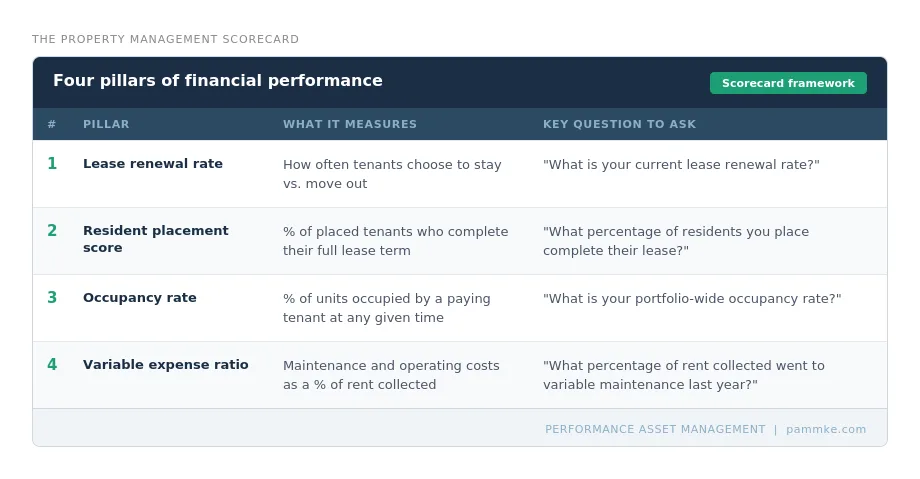
Examples of issues with processes include broken leasing, renewal, or screening processes, which can all impact occupancy rates. Investors searching for a property manager or evaluating their own should use a property management scorecard, which recommends asking companies for their occupancy rate, in addition to these other metrics:
Lease renewal rate: measures how often tenants choose to renew their lease rather than move out. This can lead to costly vacancies, turnover repairs, leasing fees, and lost rental income, reducing overall returns.
Resident placement: measures how effectively a property manager places qualified, long-term tenants who pay on time and care for the property.
Variable Expense Ratio: measures how much is spent on operating and maintenance costs, and a rising expense ratio may signal inefficient management, unnecessary repairs, or poor cost control, reducing profitability.
How Does Occupancy Rate Connect to Long-Term NOI for Wisconsin Investors?
Occupancy rate directly impacts long-term NOI, because consistently occupied rental units generate more reliable rental revenue while reducing vacancy loss and turnover expenses. For Wisconsin investors, stronger occupancy rates can support steadier cash flow, better property performance, and improved long-term investment returns.
There is a direct mathematical link between occupancy rate and net operating income. Every percentage point drop in occupancy represents real, compounding lost income days. Lower occupancy rates typically indicate higher turnover frequency, increased rent-ready costs, and greater legal exposure.
For instance, investors reviewing a 70% occupancy rate means more than just fewer tenants. It also means compounding losses, especially when projected over a 10 to 20-year investment period. Strong occupancy compounds into dramatically stronger long-term returns over time.
Holding companies accountable to all four categories, lease renewal rate, resident placement score, variable expense ratio, and occupancy rate, separates asset managers from rent collectors.
What Should Wisconsin Investors Ask Their Property Manager About Occupancy?
Wisconsin investors should ask their property manager for three numbers: portfolio-wide occupancy rate, lease renewal rate, and resident placement success rate. A manager who cannot answer all three is likely not tracking them — and investors pay the cost of that gap.
Occupancy rate is a clear indicator of income continuity, because each day your asset sits without a paying resident is a loss on returns. When compounded over time, this number can have a significant impact on NOI.
If your manager is pointing you toward days on market instead, that is worth questioning. Start by asking for these three numbers: occupancy rate, renewal rate, and placement success rate. PAM publishes all three numbers and benchmarks them against industry averages for Wisconsin investors. If you are ready to see where your portfolio actually stands, set aside time for a walkthrough with Jim, the founder of PAM.