What Is NOI Alignment and Why Should Wisconsin Rental Investors Care About It?
Shopping for property managers can be like choosing a restaurant while ignoring the service charge, minimum table spend, booking fee, holiday surcharge, or non-refundable deposit. Just like it’s preferable to choose a place to eat without surprise fees, a manager with a clear, transparent fee structure will better align with your goals as an investor.
At its core, Net Operating Income (NOI) for property investors is rent collected, minus expenses. That means a property manager is fully aligned with an investor when their revenue grows, alongside the property owner. Misalignment occurs when a manager creates separate revenue streams from a property. And it shows up in monthly numbers.
Those streams flow from residents or investors rather than performance. At Performance Asset Management (PAM), 17 years of experience taught us that southeastern Wisconsin investors who experience this in reverse fund a manager's growth while minimizing their returns. Learn to identify signs of misalignment in charges, fee structure, and contracts to keep your NOI aligned.
What Fees Do Wisconsin Property Managers Commonly Charge?
Many Wisconsin property managers charge junk fees to residents that never reach the investor.
Charges not codified in Wisconsin's Chapter 704 statutes may leave investors vulnerable to lawsuits from residents who were forced to pay hidden fees to property management companies. In Koble vs. Marquardt, the Wisconsin Supreme Court reversed a ruling stating that the Wisconsin Consumer Act governs leases.
In short, residents can seek double rent if they can prove to a court that there was actual financial harm. Hidden fees that appear in a lease can represent documented financial harm and direct exposure to the double-rent standard. That means even if a property manager wrote junk fees into a lease and collected on that income, the investor can be liable for illegal charges, such as:
Risk mitigation fees: run $60–$90 per month, charged directly to residents.
Alternative security deposits: these are never refunded, so they don't meet Wisconsin's statutory definition.
Resident benefit packages: bundle a furnace filter and renter's insurance for $20–$50 monthly.
Move-in fees and administrative fees: increase resident costs with no statutory backing.
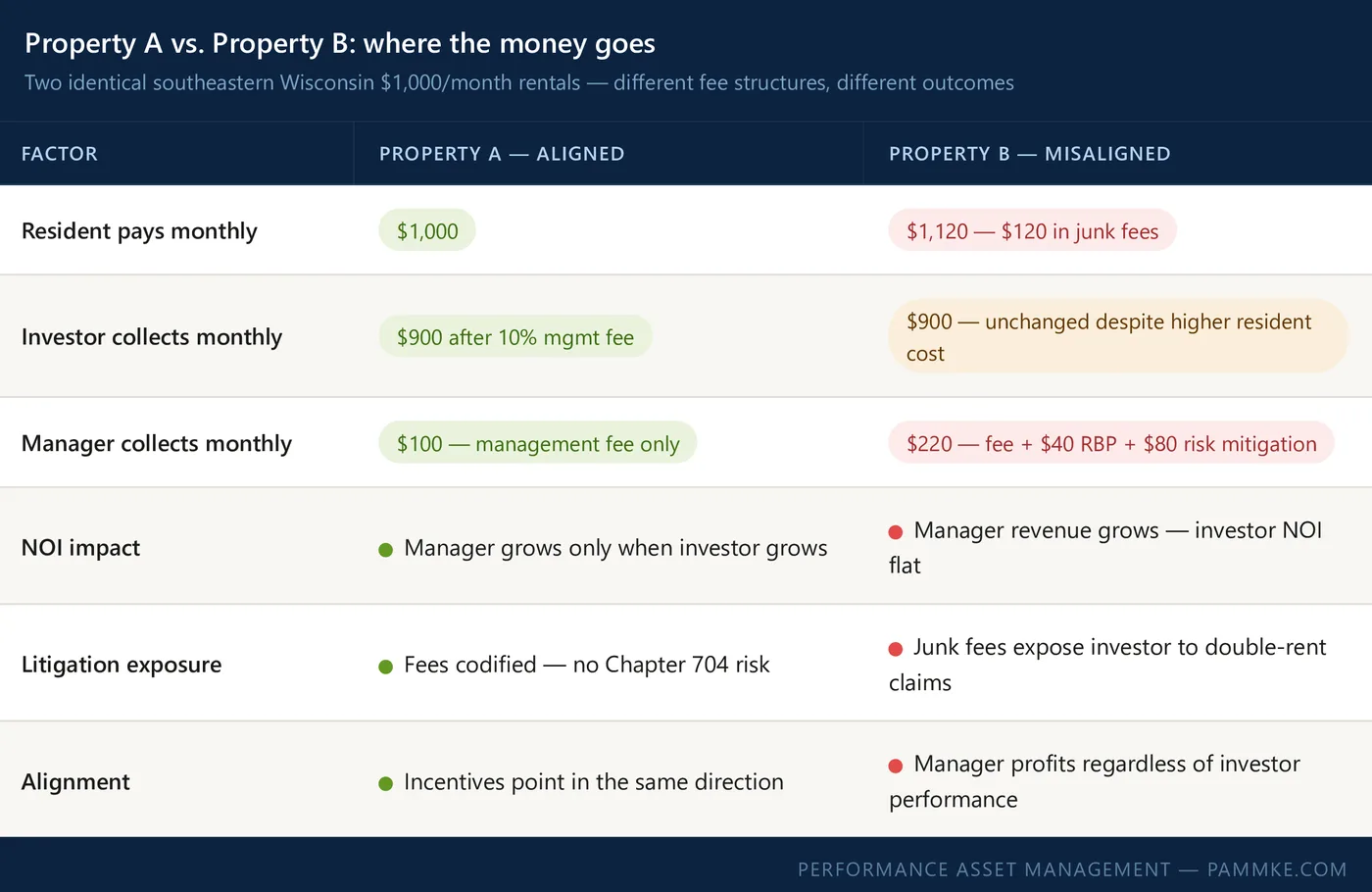
Residents view all of these additional charges as rent, since it’s what the unit costs them. However, money that could have been reinvested into the property is routed to a manager. Consider two identical southeastern Wisconsin $1,000/month rentals:
Property A: The manager charges only a transparent 10% management fee. The investor and manager both earn more only when rent increases, vacancy falls, and residents stay longer.
Property B: The manager charges the same management fee but also collects a $40 resident benefit package, a $80 risk mitigation fee, and a $200 move-in fee. The resident now pays $1,120 each month for what is still a $1,000 rental, yet the investor's NOI is unchanged. The manager's revenue grows without increasing the owner's income.
How Do You Calculate Whether a Property Manager's Fee Structure Is Hurting Your NOI?
Investors cannot evaluate property managers on their base fee percentage alone. The full picture requires different metrics, and each one connects to money saved or lost.
Add up all monthly fees charged to residents to calculate the amount of lost rent. Just like in the previous example, if an investor is losing $100 each month in resident fees, that totals $1,200 each year. To avoid misaligned NOI, investors should evaluate property managers by requesting the following three metrics upfront:
What is the Lease Renewal Rate of the Property Manager?
A single southeastern Wisconsin turnover costs approximately $5,000, according to PAM data. This number is the sum of cleaning, repairs, marketing, vacancy days, and leasing fees. However, a manager with a high lease renewal rate is saving the investor thousands in avoidable turnover.
Leading property managers report lease renewal rates of about 70% to 80%. But significantly higher numbers show that proven processes are in place, which is even better for NOI alignment and compounding returns over the long term.
How Does the Manager Measure Placement Success Rate?
Bad placements drive days without rent. During a vacancy, the mortgage, taxes, insurance, and bills continue to accumulate. Managers with an effective resident screening process can achieve a high placement rate. A high resident placement rate will be in the 80-90% range with 12 months of completed payments without damage to the property.
What Is the Occupancy Rate of the Property Management Company?
Days without rent is the single most important metric for protecting investor NOI. To track this information, investors can ask for the occupancy rate, which offers real insight into how much consistent income a unit generates under a property manager.
Unlike tracking days on the market, which only measure how long a unit appears on a listing platform, a high occupancy rate is a clear indicator of income. Each day a property sits without a resident is a loss on returns. The industry average occupancy rate typically falls between 85% and 93%, according to PAM data compiled over the last 15 years.
What Should Wisconsin Investors Look for in a Property Management Contract?
Wisconsin has no standardized property management contract. Fee disclosure fluctuates between managers. And the burden of fee transparency falls entirely on the investor.
Investors choosing the right property management company need to ask specifically: what fees do you charge residents, and where are they disclosed?
If a manager does not publicly share their fee schedule, it is reasonable to assume they may impose hidden fees, which could lead to legal action. Investors should specifically look for rent guarantees or resident protection products that the manager profits from. Also watch for vague contract language, such as “marketing relationships with preferred vendors.”
How Does PAM's Fee Structure Put Wisconsin Investor NOI First?
PAM charges an 8% management fee, which never exceeds $250/month. Fees are waived during vacancy, and there is a flat $1,500 placement fee or first month's rent, whichever is less. If a placement doesn't perform, PAM covers removal and replacement.
PAM does not charge risk mitigation fees, alternative security deposits, or resident benefit packages. Additionally, there are no move-in fees, administrative fees, or resident-facing charges outside of rent. For a full breakdown, see what investors should expect from property management pricing.
PAM also uses the following methods to continue adding to investor NOI:
The flat $1,500 placement fee was made possible by switching to AI-powered syndication.
RentEngine distributes listings to 50–100 platforms and delivers data-driven leasing insights.
PAM moved from commission-based leasing agents to an hourly model to reduce placement costs.
NOI alignment is the difference between a property manager who grows with you and one who grows at your expense. Southeastern Wisconsin investors who evaluate managers on base fee percentage alone are missing the metrics that actually protect returns: lease renewal rate, placement success rate, and occupancy rate tell the real story.
Junk fees and misaligned incentives supported by vague contracts hurt more than the loss of monthly cash flow. They produce losses that quietly compound over years, turning a high-performing asset into a subsidized revenue stream for someone else.
Over almost two decades, PAM has built a fee structure designed around one principle: investor NOI first. Schedule a conversation to see how PAM's approach compares to what you're paying now.