What Is PAM's Current Lease Renewal Rate and What Does It Mean for Your Portfolio?
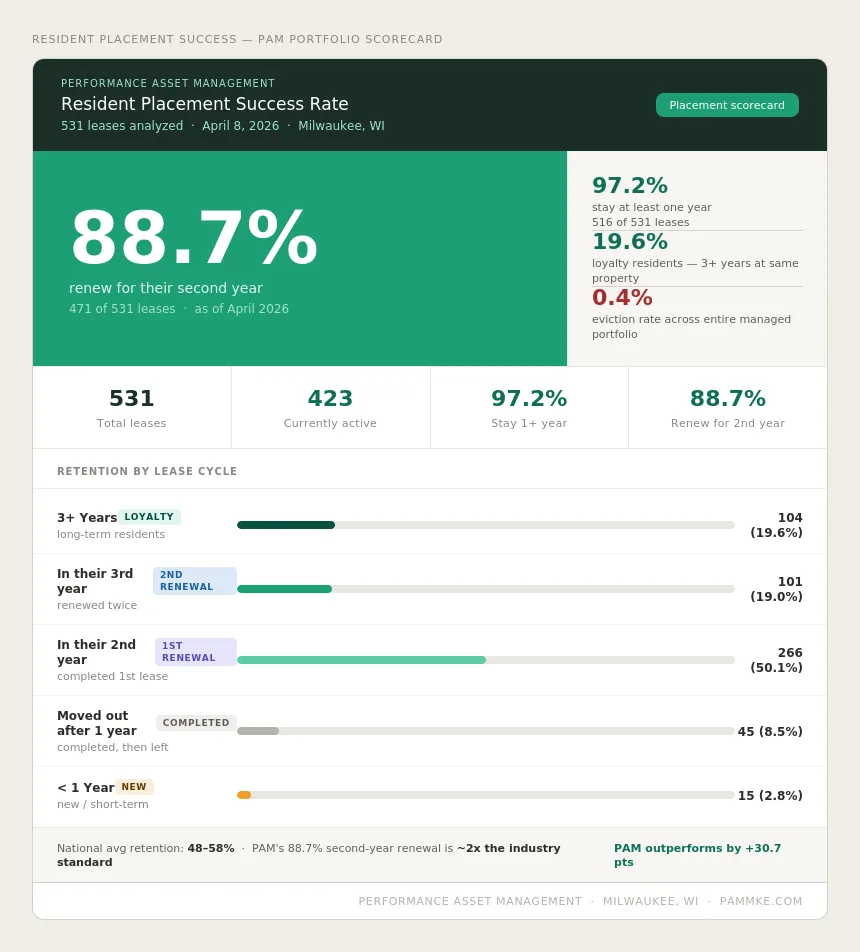
When Warren Buffett recommends index funds over actively managed stocks, the argument is less about returns and more about the expense ratio. Lower expense ratios mean more of your money is working for you. For property investors, lease renewal rate is the rental version of the expense ratio. As of May 2026, PAM's portfolio renewal rate is 88.76%.
At Performance Asset Management (PAM), our renewal performance puts us above the national industry average, which is in the mid-50% range. While leading property managers operate within a range of 70% - 80%, our significantly higher numbers indicate to our investors that strong processes are in place, distinguishing PAM from rent collectors.
The gap between PAM and average managers is measurable. And more to the point, macro conditions, such as inflation and affordability pressure, are currently pushing renewal rates up. Keep reading to learn exactly what an 88.76% lease renewal rate means for your investments.
How Much Does a Low Renewal Rate Actually Cost Wisconsin Rental Investors?
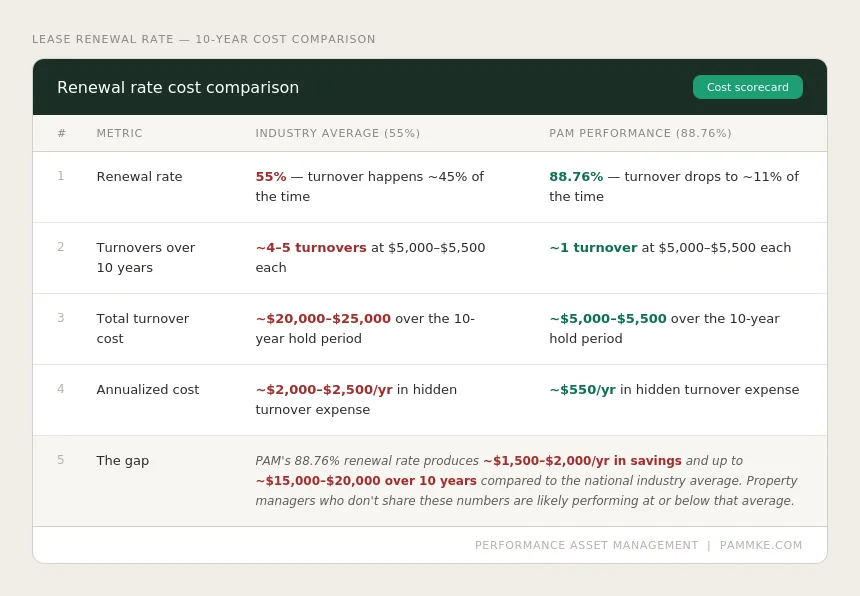
A $5,000 turnover cost, which is the average price for southeastern Wisconsin rental investors, usually arrives all at once in the form of placement fees, vacancy loss, cleaning, and repairs.
Because the math is already working against the investor at this stage, PAM's 88.76% renewal numbers reduce how often that bill shows up. At the industry average, it shows up roughly three times per unit over a 10-year hold. At PAM's rate, closer to once.
The chart below shows how even a modest improvement in renewal rates can reduce turnover frequency, lower hidden operating costs, and protect rental income over a 10-year holding period. The difference between the two levels is roughly $1,500 – $2,000 each year, which can add up to $15,000 – $20,000 in additional turnover costs over a 10-year holding period.
What Is the Difference Between a Rent Collector and an Asset Manager in Wisconsin?
In Wisconsin, a rent collector fills vacancies. An asset manager reduces how often vacancies happen.
Both a rent collector and an asset manager may charge the same management fee, which is typically 5% to 8% of collected rent in southeastern Wisconsin. Only one of these professionals actively works to increase their investors' NOI.
The difference shows up the moment you ask a manager for their numbers. There are roughly 30 to 40 property management companies operating in southeastern Wisconsin right now. But paying 8% to a rent collector and paying 8% to an asset manager are different transactions.
One maintains returns, at best. The other compounds them. The renewal rate is the clearest signal of which category your manager falls into, because managers who fail to report it are almost certainly operating without the process that produces it.
How Does PAM's Renewal Process Work to Protect Wisconsin Investor Income?
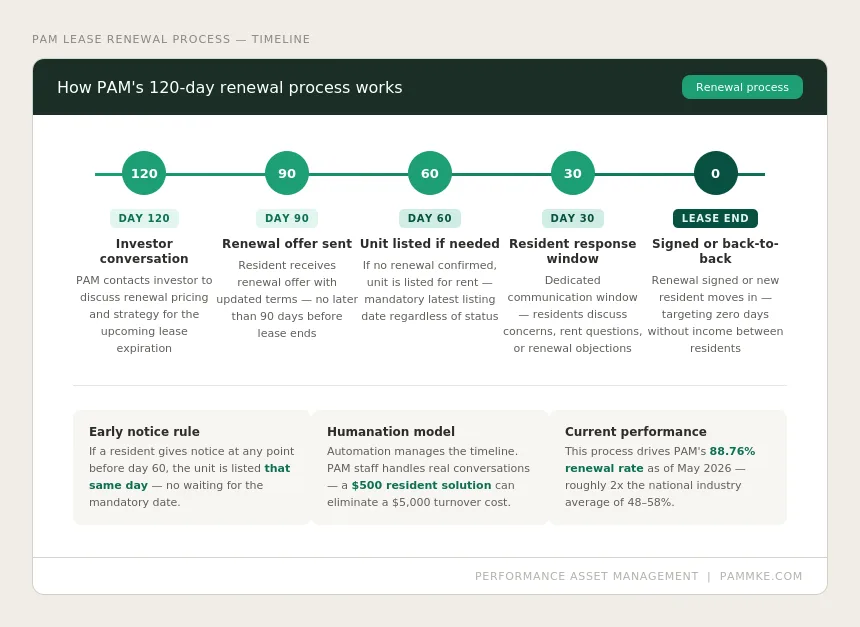
Using a model called “humanation,” PAM's renewal process safeguards Wisconsin investors by integrating automated timeline management with human interaction. This approach ensures that resident concerns are addressed before they lead to move-outs.
The process runs on a four-stage calendar built around the goal of eliminating days without residents, which translates to no income for our investors.
At day 120, PAM begins a pricing conversation with the investor and reaches out to residents by offering renewals. By day 90, the resident has an offer in hand. Day 60 is the mandatory listing date, which is the latest any available unit goes to market, regardless of where the renewal conversation stands.
If a resident signals at any point that they're leaving, the listing goes live that same day. This process relies on automation to handle timelines, send alerts, and process documentation so nothing falls through the cracks.
To further eliminate turnover, residents who haven’t paid by the fifth of the month receive a call from a PAM staffer. Instead of an automated reminder, they get a real conversation to understand the problem and find a solution.
Residents in southeastern Wisconsin don't leave properties they like. They leave managers who make them feel unseen. A $500 solution to a resident concern identified during the renewal window can eliminate a $5,000 turnover cost. That math is the result of humanation.
What Should Investors Do With Their Renewal Rate Data, Now?
Investors should view their lease renewal, occupancy, and resident placement rates as a GPS. These three numbers, when read together, tell investors exactly where their portfolio performance is headed before expenses appear.
At PAM, we provide our investors with the specific data points to not only connect the dots but to go a step further. Our investors are encouraged to use their occupancy rate, which confirms how many days an asset is generating income right now. And then their placement success rate predicts how often new residents will complete their full lease term.
When combined with their lease renewal rate, PAM investors can use these three metrics as a probability index for evaluating NOI performance. PAM tracks and reports all three numbers across your portfolio on an ongoing basis. If your current numbers don't match what you expected, that variance is worth understanding.
The goal isn't just to report performance, it's also to reverse-engineer gaps and close them. Let’s better understand that variance for you, as a Wisconsin rental investor. Then, we can establish guardrails, implement changes, and align your actual NOI with its achievable potential, based on our projections. Contact PAM to review your portfolio scorecard and see exactly where your numbers stand. Then let’s go a step further.