What Is the Difference Between a Lease Break and an Eviction in Wisconsin?
When a southeastern Wisconsin resident broke their lease in River West, the unit was immediately relisted. There were zero days of lost rent, and once the current resident's obligation ended, it opened the door to reprice the rental at market rate. Despite $2,000 in deferred maintenance, the lease break benefited the investor, which is what managers strive for.
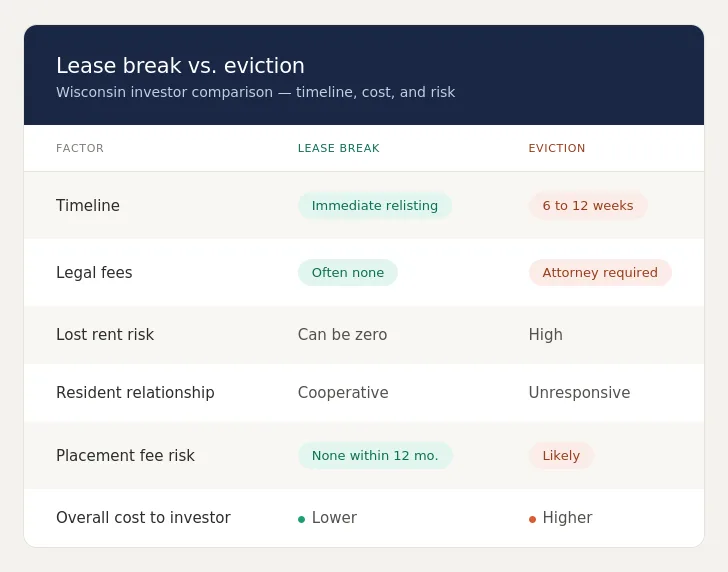
In property management, a lease break occurs when a resident chooses to end their lease, while an eviction occurs when a tenant stops paying rent and becomes unresponsive. Over 17 years of managing rentals, Performance Asset Management (PAM) has learned that both scenarios can result in lost rent. But one offers more opportunities for mitigating the damage.
In the River West case, PAM had to mitigate losses from day one. Reducing the damage of an eviction requires more attention, as legal fees, lost rent, and other costs quickly add up. Below, we break down what separates lease breaks from evictions, what each one costs, and how to tell if your property manager is set up to handle both well.
How Does PAM Handle a Lease Break, Step by Step?
PAM immediately relists the unit, assigns a leasing agent, and notifies the investor within days of notice.
Lease breaks usually occur due to life changes, such as job relocation, family additions, military service, or relationship breakdowns. While the reasoning may vary, PAM takes the same steps, which are as follows:
Find out how long the resident is staying and communicate with investors
Send the resident their lease responsibilities according to Wisconsin statute
Relist the property for rent immediately at the existing rate
Assign a leasing agent to manage showings while the resident finishes their stay
Notify investors with updates in the process so they can plan accordingly
Once a resident gives notice, PAM also manages their move-out obligations directly by confirming utility shut-off dates, verifying the unit is left in its original condition, and collecting forwarding information needed to process the security deposit. This keeps the transition compliant with Wisconsin Statute 704.28, which sets a 21-day deadline for returning a security deposit. Before the unit is marked vacant, PAM confirms:
- Utilities closed and paid in full before key return
- Unit condition verified against original move-in state
- Forwarding address and deposit details collected for the 21-day statutory deadline
- Keys confirmed received before the unit is marked vacant
PAM communicates urgently with investors to quickly confirm details regarding the relisting decision. At times, an investor may want to sell the property, which impacts the resident and their obligations.
To prevent unexpected breaks, PAM avoids large rent increases when it's time for a lease renewal. A resident staying at a place who gets hit with a $350 increase is likely to leave, creating an unnecessary lease break. However, at turnover, similar to the River West resident, once the current resident has finished their lease, full market pricing is fair game.
What Does the Eviction Timeline and Cost Actually Look Like?
Wisconsin evictions typically take six to twelve weeks and include legal fees, lost rent, and rent-ready costs that lease breaks often avoid.
While the lease-break process can vary, the eviction process is more set in stone. The process begins when an investor or their property manager sends a five-day notice demanding payment. That notice should be sent via certified mail to create legal proof that meets Wisconsin court requirements.
If the resident fails to respond, an attorney files the formal eviction. Courts then issue a writ, which takes two to six weeks. After that, the sheriff schedules the move-out within two to seven more business days. Then the sheriff meets PAM at the property to enforce the move-out. Lock changes and possession of the property trigger an immediate leasing and rent-ready inspection.
The total time frame for an eviction runs six to twelve weeks from the notice to the vacancy. During that time, investors are responsible for legal fees, lost rent, resident placement, and rent-ready expenses. Alternatively, lease breaks often skip legal and placement fees entirely.
Can a Lease Break Benefit a Property Owner?
Lease break outcomes fall into three categories: negative, neutral, or beneficial. When timed with a full marketing window, a lease break lets owners reprice a unit to market rate with zero lost rent days.
Repricing only works safely once the current resident has moved out. Otherwise, residents have legal grounds to move out without fulfilling their lease obligations, since Wisconsin Statute 704.03 treats a signed lease as binding for its full term, meaning rent can't be changed until the lease ends.
Statewide statute allows a shorter replacement lease term instead of a new 12-month term. However, PAM prefers to replace lease breaks with a resident who signs a full-year contract. The River West case shows how this worked in favor of an investor, because the resident communicated their move-out timing so it overlapped perfectly without a vacancy.
Once the departing resident's obligation ended, the timing worked in the investor's favor. Even with the $2,000 in deferred maintenance and flooring work, which needed to be done, the investor has the option to absorb the cost or defer it.
How Can Wisconsin Owners Reduce Their Eviction Risk?
Rigorous income screening and a lease compliant with Wisconsin's 704 statute are the two strongest defenses against eviction.
Rising financial strain among households nationally, including declining ability to cover a month of expenses, helps explain why rent non-payment has become a growing concern for property owners, according to the Consumer Financial Protection Bureau (CFPB).
However, a rigorous screening process can help discern which residents can comfortably afford rent, and a lease that is in alignment with Chapter 704 statutes can significantly reduce legal risks.
While small errors like a wrong name on a notice may seem semantic, these kinds of issues can create real legal problems. Additionally, certified mail provides essential proof for every legal notice sent, because state compliance forces the judge's ruling to follow the same statute.
A way to identify residents who may have issues is through habitual late rent payments, which can signal early unmanageability before bigger problems. Owners considering self-management should consult an attorney before sending any notice.
Those same attorneys should run the lease through AI review before filing any legal notice. On a whole, catching lease problems early saves owners both time and legal costs.
How Does PAM Maintain an Eviction Rate of Less Than 1%?
PAM's eviction rate stays under 1% because every resident goes through a rigorous screening process before move-in, not just a lease compliance review after problems start.
After 17 years of experience managing residents throughout southeastern Wisconsin, PAM understands that lease breaks and evictions require different strategies, timelines, and cost expectations. Owners who understand both processes make faster, more confident decisions.
Strong screening and compliant leases remain the best prevention available. Investors who want to learn more about how partnering with an experienced manager minimizes both risk and lost rent can schedule a call with Jim Miller, PAM founder.