What Do Investors Typically Misunderstand About Bad Resident Placement?
Property owners in Mequon, Wisconsin, recently made headlines for all the wrong reasons. Their home was damaged to the tune of $30,000. Insurance isn’t covering it, and the managers who placed the tenants offered little more than an apology. This is bad resident placement. Just like this hard-working married couple with five kids didn’t see it coming, you might not either.
Because bad placement costs can arrive in waves, across different timeframes, it can be easy for many investors to underestimate and lose track of how much a bad placement really costs. Many investors assume that placing the wrong tenant will only eat up a little more than one mortgage payment. In southeastern Wisconsin, the real figure is 3-5 times that estimate.
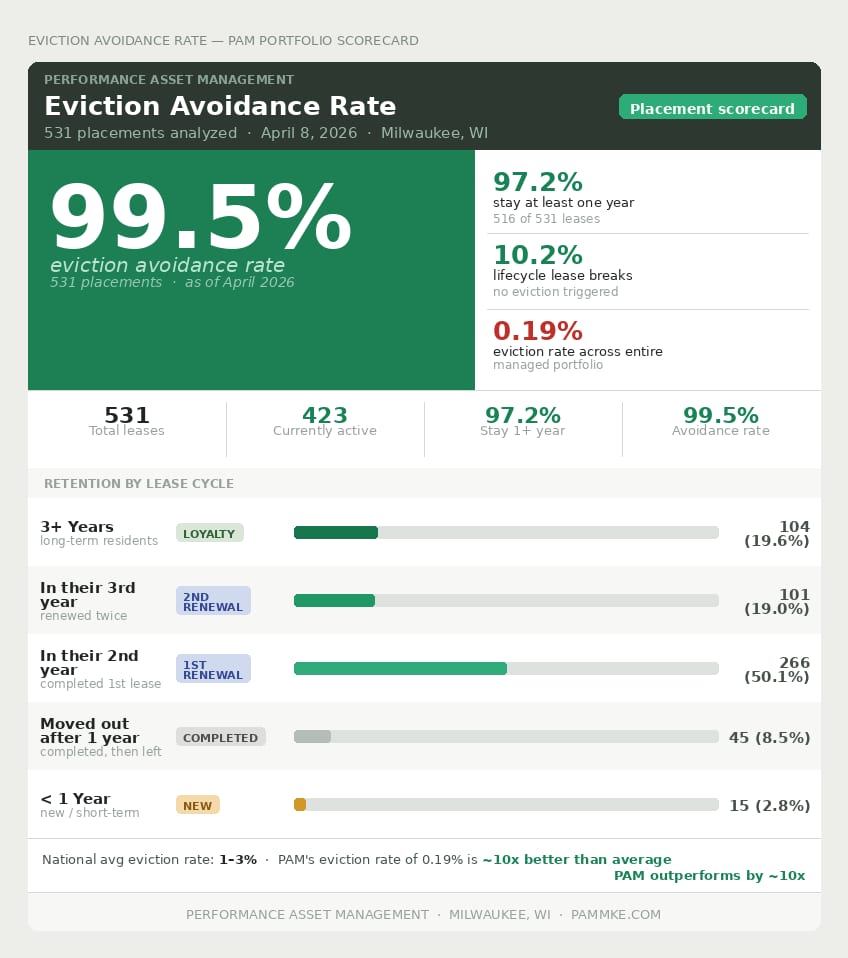
The four cost categories triggered by a bad placement are measurable, along with the direct impact the wrong tenants can have on long-term rental property value. Performance Asset Management has spent the past 17 years helping Wisconsin investors understand both. We also have a 99.5% eviction avoidance rate. Keep reading to learn why that’s important.
What Are the Cost Categories Triggered by a Bad Placement?
Bad resident placement in Wisconsin typically triggers four measurable cost categories: lost rent, legal fees, construction, and resident replacement.
Lost Rent or Days Without Income
This typically costs southeastern Wisconsin approximately 1x–4x monthly rent. The lower number assumes there was a clean lease-break. The higher end assumes there was no process at all, and a full eviction took place.
In Wisconsin, an investor needs a minimum of 60-75 days to regain possession of the unit due to legal proceedings. The investor needs to start the eviction process by submitting a five-day notice to the tenant. Preferably, there should be proof from a third party to corroborate the dates.
After the letter is sent, there are court calendar dates and times that a sheriff spends processing a writ. Then the investor still has to rehab and re-lease the unit. By the end of the process, three to four months without income is the realistic range.
Legal and Related Fees
Working with a lawyer costs about 0.5x–1x the monthly rent. In southeastern Wisconsin, an investor should budget $400–$800 for an eviction attorney.
Itemized amounts include about $23 for certified mail on the five-day notice, about $175 court filing fee, and a flat-rate attorney fee that sometimes includes the filing. Choosing a professional who specializes in civil removal avoids hiring a more costly general counsel who bills hourly.
Construction and Rent-Ready Expenses
This costs roughly 2x monthly rent, as homes where tenants have been evicted rarely come back move-in ready. Expect a full paint and deep clean, which is a minimum of $500 on its own. If there is carpet replacement or LVP conversion that also adds to the sum.
Resident Replacement
Finding a new tenant will cost around 0.75x–1x monthly rent. A good property management company will absorb this cost if they made the original placement. But not all property managers make this commitment. Those that try to offer eviction insurance products can perform at less than 50% of their stated value.
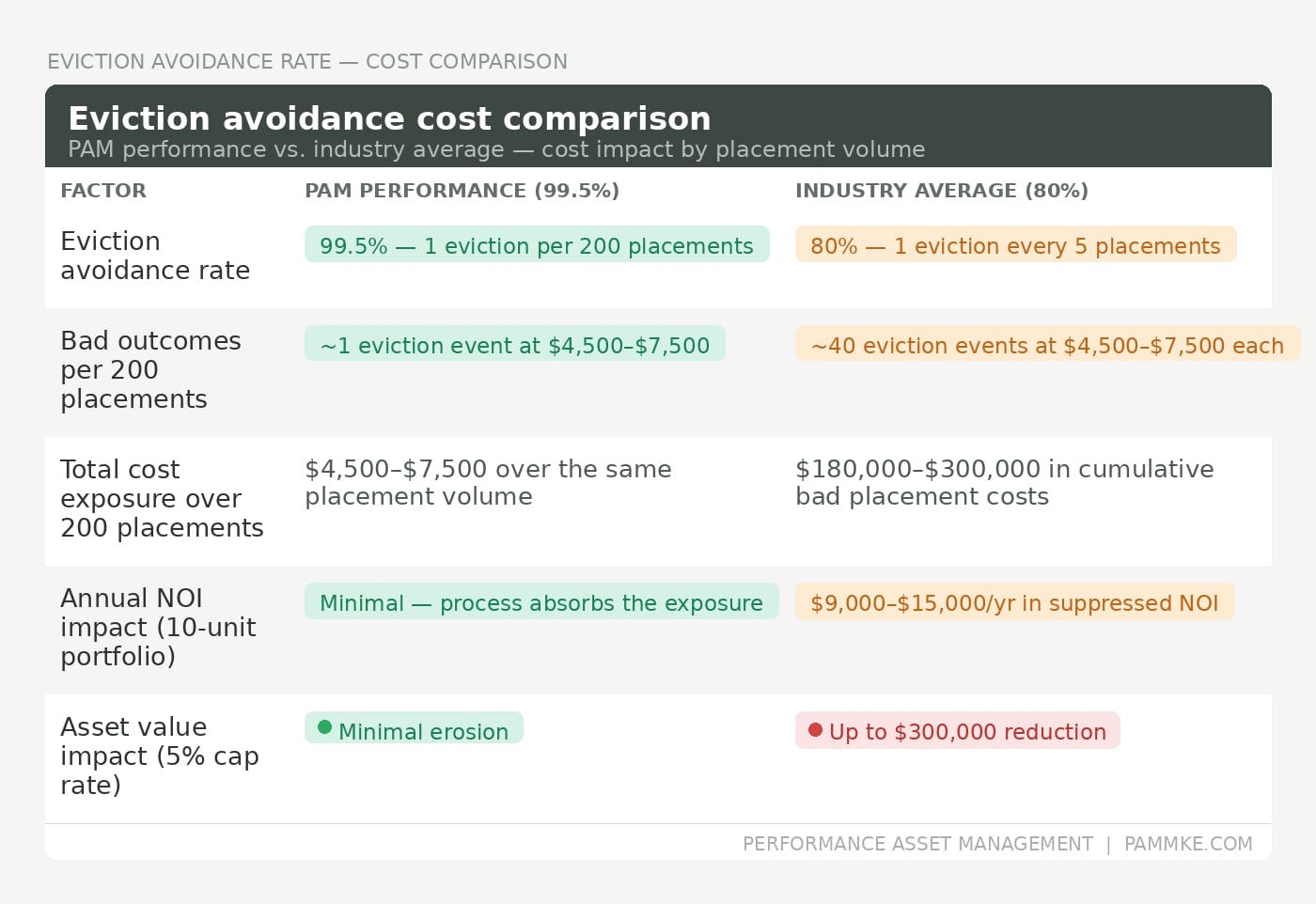
At $1,500 per month for rent, a full eviction scenario totals roughly $4,500 on the conservative end (3x) to $7,500 on the high end (5x). And that's before accounting for any compounding from a management company without a process.
How Does a Single Bad Placement Affect Long-Term Value?
A single bad resident placement in Wisconsin triggers measurable losses across four cost categories. Each one compounds directly into NOI, cap rate performance, and long-term rental property value.
A documented change in circumstances and not an eviction determines which costs apply and by how much. A property management company that reports a 99.5% eviction avoidance rate vs. one with an 80% rate compounds into very different financial trajectories:
At 80%, an investor absorbs one bad outcome every five placements, compared to once every 200 placements at PAM's 99.5% rate.
Residents can leave without triggering the four cost buckets during a lease break. A tenant might leave due to a job relocation, a divorce, or a home purchase. None of those examples reflects a failure in the original placement.
Similarly, to best understand the factor that drives NOI, property managers should examine days without income, which keeps investors hyper-focused on performance. That phrase captures what investors actually care about: the business had zero income today. The question isn't the cost of one event, it's what your process produces.
Do DIY Investors Pay More for a Bad Placement Than Investors Using a Manager?
For Wisconsin rental investors, the total cost of a bad placement is roughly equivalent whether you self-manage or work with a property manager. The difference is that DIY investors pay in labor hours rather than dollars.
The person or company running the asset needs a documented process for minimizing days without income to ensure the cost of each bad resident is minimized.
How Does Performance Asset Management Protect Wisconsin Investors From Bad Placement Costs?
PAM protects southeastern Wisconsin rental investors from bad placement costs by guaranteeing resident placements, absorbing legal and replacement fees, and maintaining a 99.5% eviction avoidance rate across its Milwaukee-area portfolio.
Bad resident placement can cost southeastern Wisconsin investors between $4,500 and $7,500 per eviction event. And that's before the costs compound across multiple placements or a management company without a process.
Regardless of whether the investor does the resident placement work themselves or hires a manager, without a process that reduces unnecessary evictions, there will be a financial drag that many investors will never fully account for.
Understanding the difference between lease breaks and an eviction is also important because investors who understand the difference can protect their returns instead of absorbing preventable losses.
Headquartered in Milwaukee, we at PAM have spent the past 17 years building the processes that keep Wisconsin investors off that list. With a 99.5% eviction avoidance rate across 200 placements, PAM absorbs legal fees and resident replacement costs when the original placement is ours and charges nothing for lease breaks resolved within the first 12 months. Learn more about how PAM protects your investment.
Schedule a Call