What Does Resident Placement Success Actually Mean?
Think back to 2007 and imagine sitting in a Milwaukee County courtroom waiting for a judge to preside over six eviction cases at properties you own, as the housing market was literally collapsing. The hard lesson that Jim Miller learned twenty years ago was simple: the screening model property managers in Wisconsin typically used was quietly destroying investor returns.
Back then, Jim wasn’t the owner of Performance Asset Management (PAM). His company hadn’t managed thousands of investors throughout southeastern Wisconsin. He was an investor like the people he works with today, who try to set a little aside to put a son through college and feel confident about retiring. At that time, three different property managers were running his portfolio.
All three managers used the same screening model: first month’s rent and a security deposit. Nothing more and nothing less. Two of those companies are out of business today. Of the six evictions, the judge granted each a three-week extension, costing Jim thousands of dollars. But the experience didn’t just drain his funds. It taught him to rethink his resident screening process.
That afternoon in court became the foundation for how PAM measures resident placement success. The root cause wasn’t bad residents. It was that managers were using a model that failed to measure up. Keep reading to learn the current model PAM uses and find out how to make sure your current manager is up to par or that your DIY system actually works.
Why Is Affordability the Core of PAM's Resident Screening?
Affordability drives PAM's screening process because the top reason residents miss rent is financial hardship, so PAM underwrites net take-home pay, not gross income, to confirm a resident can realistically sustain payments.
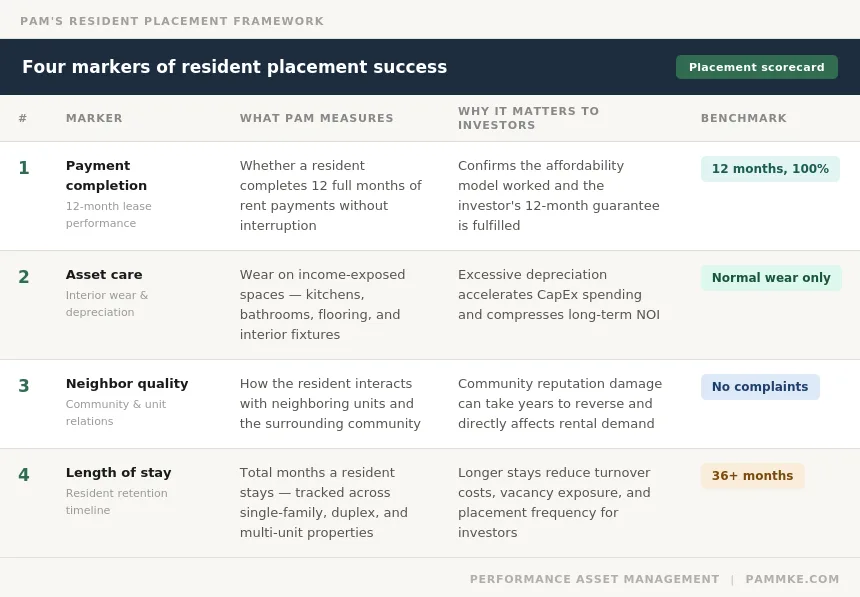
There are property managers throughout southeastern Wisconsin who simply define successful resident placement as getting a tenant in the property as quickly as possible. PAM defines success differently, starting with 12 months of completed payments without damaging the premises, and asset care that involves the wear on income-exposed areas of the property.
Neighbor quality matters, regardless of whether the space is a single-family, duplex, or four-family, as a decline in a community’s reputation can last for years or even a decade. The length of stay of each tenant is more of a scoreboard metric with 36-plus months as the benchmark. Overall, getting placement right means 80-90% of yearly property performance is already won.
To reach those numbers, PAM places affordability as the core of our screening process. While things like misunderstandings in terms of leases and internal fraud can happen, the top reason that tenants miss rent payments is due to financial hardship, according to the Consumer Financial Protection Bureau.
When Jim was juggling six residents citing emergency assistance filings, the common thread was affordability, instead of flaws in the characters of each tenant. But that proceeding showcased that the first month screening model confirms if tenants have a month or two of rent upfront, but it fails to do any real legwork to corroborate whether or not the resident can keep making payments.
What Data Does PAM Use to Evaluate a Resident Application?
PAM evaluates every application on three data points: 24-month rental payment history, verified net income, and bank account balance to confirm a resident can sustain payments when life gets expensive.
24-Month Rental Payment History
Analyzing 24 months of rental payment history is the strongest placement predictor because it shows how a resident handles financial stress without missing rent payments. Nowadays, rent payment history includes a timestamp, which enables precise third-party verification.
Net Income
PAM focuses on net (or take-home pay). This number is the amount that actually enters a resident's bank account each pay period after child support, student loans, healthcare, retirement, and related expenses. This lets us analyze the available cash flow to actually cover rent. For instance, take two tenant applications where both households earn $80,000 per year:
Prospective tenant A is a single person with minimal tax holdings and little retirement contributions, who may bring in $5,000 each month.
Prospective tenant B is a person with a family, high health insurance premiums, and aggressive retirement contributions, who might only bring in $4,000 each month.
Research from the Urban Institute has shown that residual income and post-expense cash flow are often stronger indicators of housing stability than gross income alone, especially for households carrying childcare costs, healthcare expenses, or student debt obligations.
Bank Account Balance
A healthy bank account balance can help discern whether a tenant is more likely to pay, since people with assets can be more aligned with the type of property performance a good manager seeks. The logic is that a person who has $4,000 in the bank is more likely to make rent payments than someone who has a $0 balance.
Negative life events can and will happen. Tenants who have trouble with their car, expensive medical bills, or who get laid off from work for a short time but have padding in their bank account don't need to choose between an emergency payment and paying rent.
What Metrics Should Wisconsin Investors Use to Evaluate a Property Manager?
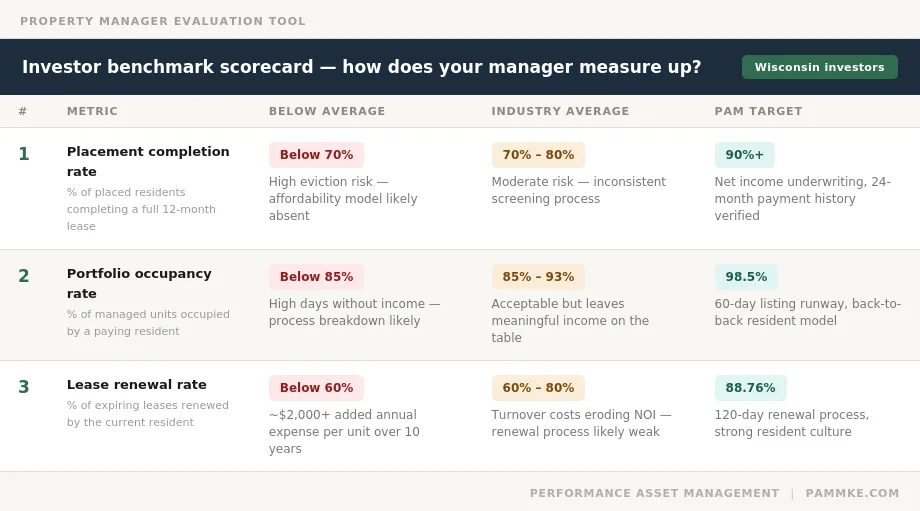
Wisconsin investors should ask: what percentage of placed residents completed a full 12-month lease, and what is the portfolio-wide occupancy rate? A manager who can't answer both is likely operating without a repeatable screening process.
Asking what percentage of placed residents completed 12 full months of rent will provide insight into how much consistent cash flow, maintenance costs, turnover frequency, and legal exposure an investor will encounter.
New tenants carry real financial risk: a poor placement can cost between $5,000 and $25,000 in vacancy, legal fees, property damage, and lost rent. A manager with a high placement completion and renewal rate poses significantly less of that risk than one operating without a repeatable screening process.
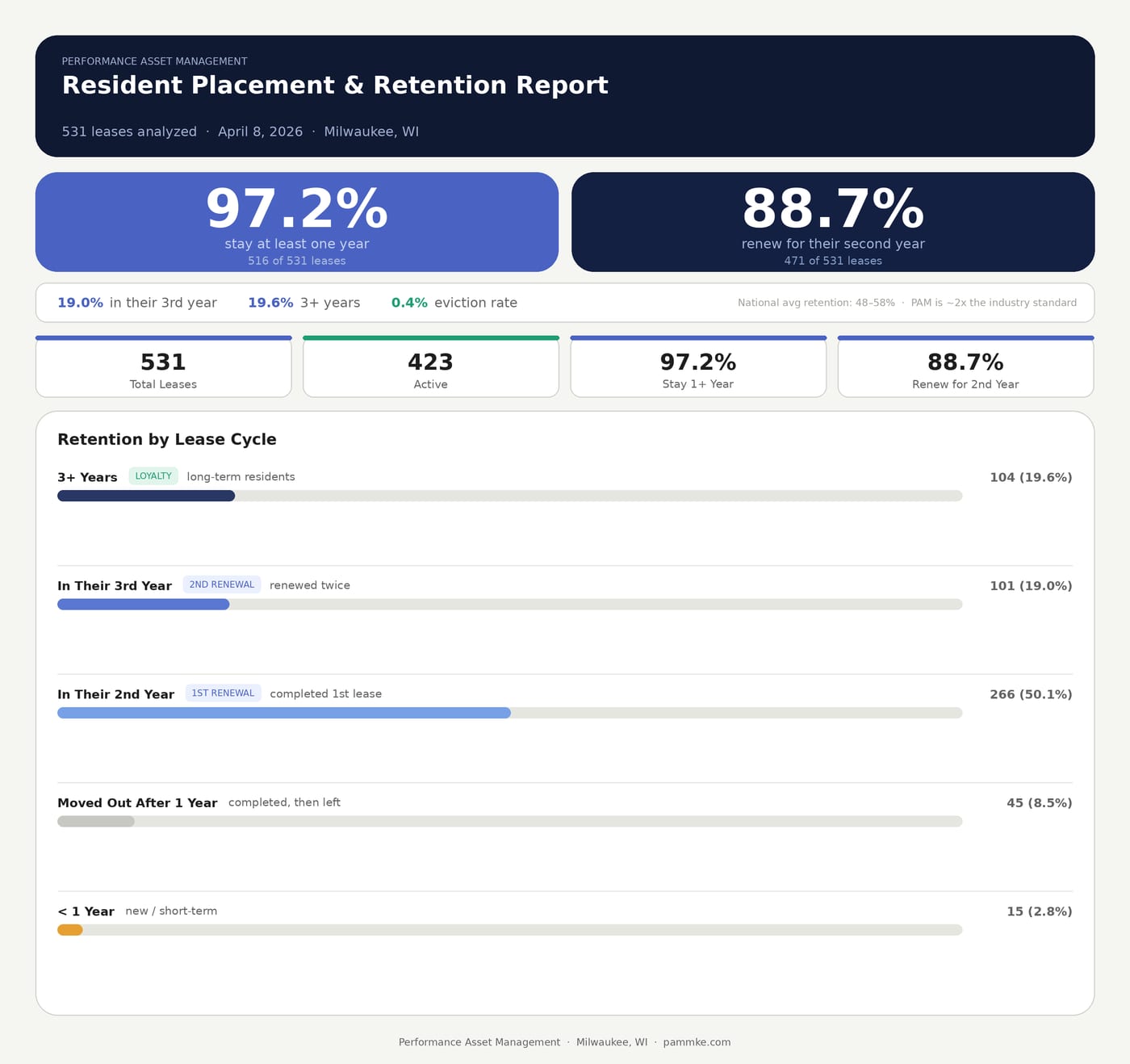
For example, of 531 leases analyzed, 97.2% of PAM residents stayed at least one year, compared to a national average of 48–58%. That's nearly twice the industry standard. PAM's current lease renewal rate is 88.7%, verified across 531 leases. Only 45 of 531 residents left after completing their first lease, and 38.6% have renewed more than once.
The National Apartment Association’s Survey of Operating Income & Expenses identifies turnover, vacancy loss, maintenance, and make-ready expenses as major operational costs for rental providers. Industry benchmarks show that resident turnover can create thousands of dollars in direct and indirect losses before a new lease begins generating revenue again.
Investors with a manager or those screening a potential company should also ask for their portfolio-wide occupancy rate. While some managers may reference days on the market, distinguish between the two. Occupancy rate measures how many units are occupied. Days on the market is the number of days a rental is listed for sale.
A high number of days on the market with tenants living there the entire time could represent a strong property management company, as a building with 10 units and 9 of them are rented has an occupancy of 95%. A rental listed for 45 days doesn’t imply that it was vacant the entire time. In fact, placement performance is a better indicator of tenant retention than days on the market.
Lease renewal rate is the strongest indicator of resident culture — and the cost gap between an average manager and a high performer compounds fast.
The difference between a 60% and a 90% renewal rate works out to roughly $1,500 per year per unit, or up to $15,000 over a decade. For a detailed breakdown of how that math plays out over a 30-year hold, see what lease renewal rates really cost Wisconsin investors.
How Does PAM's Placement Process Reduce Vacancy?
PAM minimizes vacancy by opening renewal conversations 120 days before lease-end, listing available units by day 60, and targeting a back-to-back placement model so incoming residents move in as outgoing residents move out.
The reason PAM starts the renewal process 120 days prior to a tenant potentially leaving the rental is to get renewal offers to residents no later than 90 days before the lease ends. In the event that a resident gives notice early, the unit is listed for rent that same day.
Each available unit is listed no later than 60 days before the lease expires to create time for PAM to carefully screen new residents without rushing the analysis. Smart scheduling lets prospective residents choose their own showing day and time, and a dedicated leasing specialist personally responds to inquiries about rentals.
LVP flooring has replaced carpet across units in PAM’s portfolio, which cuts turnover time and protects the back-to-back timeline that supports investor income.
What Should Wisconsin Investors Do Next to Protect Their Returns?
Resident placement success is far from accidental. It is built on process, and the four markers that PAM uses provide measurable, repeatable results: Payment completion, asset care, neighbor quality, and length of stay, with affordability as the foundation beneath those markers.
Investors evaluating southeastern Wisconsin managers should ask for those numbers.
The same model that emerged from that Milwaukee County courtroom is still driving results today. Ready to see how your current process measures up? Contact PAM to find out.