How Does Property Management for Realtors Work, and Why Does It Matter?
A realtor has a reputation that extends beyond closing a deal. Instead, it follows their performance on every investment property they place. When supporting an investor with a rental, property management for realtors goes beyond a referral. It’s a reputation decision. But how do realtors know which tools a property manager can offer to support better investments?
Realtors increasingly work with investors, and strong partnerships depend on transparency, communication, measurable processes, and clearly defined expectations. Over nearly two decades, Performance Asset Management has specialized in creating successful partnerships with investors and realtors by focusing on long-term financial performance.
For realtors, property management done right is one of the most powerful tools for protecting client relationships long after a deal closes. Investors expect data-driven guidance, fast communication, and proactive support from property managers.
Realtors who protect clients by understanding the value managers can bring set themselves up to make successful referrals. Keep reading and learn to achieve both objectives using appropriate referral criteria to promote long-term alignment.
What Does a Property Manager Actually Do to Improve Investor Returns?
A property manager improves investor returns by systematizing resident screening, maintenance planning, and lease renewals. The three operational areas are most likely to erode rental income when left unmanaged.
Property management requires specialized systems, operational discipline, and legal knowledge. Without those, it is easy to underperform and create risk for an investor. Understanding what those systems look like in practice helps realtors refer with confidence rather than make assumptions.
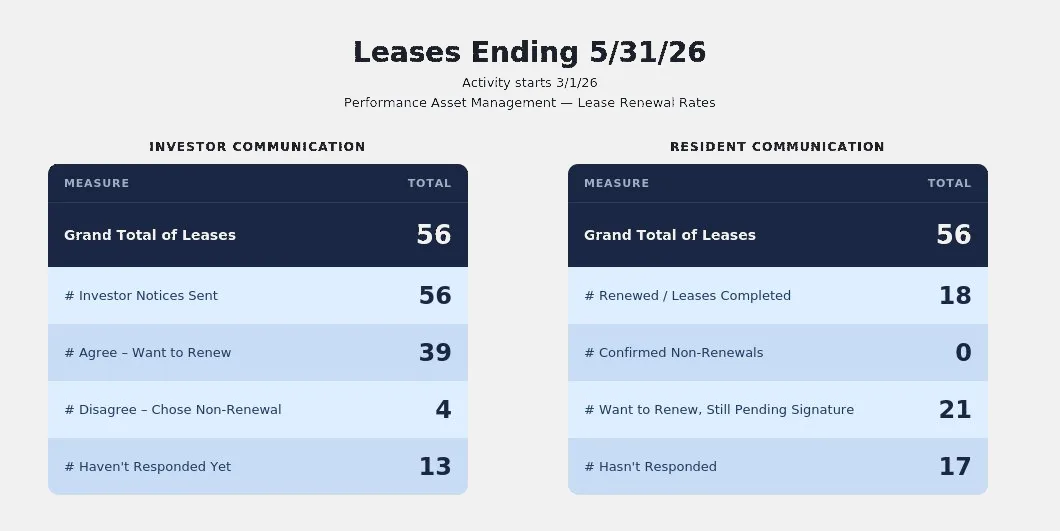
At PAM, those systems run on defined timelines and measurable benchmarks. Renewal outreach starts 120 days before the term of the lease ends. Resident screening uses a proprietary algorithm that delivers a 97.2% rolling 12-month placement success rate. This is backed by a guarantee covering replacement, legal, and removal costs if a PAM-placed resident fails to perform.
Maintenance response speed is tracked as a core metric because slow repairs are the leading reason residents in southeastern Wisconsin choose not to renew.
How Do Property Managers Reduce Vacancies Through Better Resident Retention?
Property managers reduce vacancies by using predictive screening to place higher-quality residents from the start, then addressing concerns quickly enough that residents choose to renew rather than leave.
Professional property management companies specialize in resident placement, as poor standards in this area frequently create evictions. Modern screening programs will use predictive data instead of outdated approval methods that lack performance accuracy.
Transparent managers should openly share their placement success rates and renewal statistics. These operational benchmarks will help realtors attempting to evaluate managers, as data directly impacts investor satisfaction. And process-driven companies create more predictable financial outcomes for both investors and referral partners alike.
More specifically, a manager operating at a 85%-90% resident placement success rate places better residents from the start. That company reduces the friction, complaints, and early move-outs that drive dissatisfaction before a lease renewal conversation even begins.
By promptly addressing resident concerns, managers can avoid adversarial relationships that are common in the industry. Speaking with residents directly helps evoke empathy and understanding, while being available creates openness.
What Does Tenant Turnover Actually Cost a Real Estate Investor?
According to PAM's data from the southeastern Wisconsin market, each tenant turnover costs an investor approximately $5,000, which includes placement fees, vacancy loss, cleaning, and maintenance, making lease renewal the most controllable expense.
Turnover translates to losing thousands in potential net profit. National estimates put the average turnover cost at $1,000 to $5,000, according to research published by Apartments.com, a range PAM's own data confirms for the southeastern Wisconsin market, because of the following expenses.
Placement fee (one month’s rent): ~$1,500
Vacancy loss (½ month average): ~$750
Turn cleaning (market expectation): ~$400
Maintenance and turnover repairs: ~$2,200
This puts the total average cost per turnover at roughly $5,000 per unit every time a resident leaves. Minimizing this expense by understanding residents, working to find reasons to help them renew leases, and informing investors throughout the process ensures the manager is actively managing the risk of vacancy rather than passively measuring lost rent.
What Is CapEx Planning in Property Management, and How Does It Protect Investors?
Capital expenditure (CapEx) planning in property management is a forward-looking process that helps investors anticipate major repair and replacement costs, such as a roof or HVAC system, to make financially informed decisions, instead of reactive ones.
Property managers can also help eliminate confusion in terms of major replacement decisions. With capital expenditure (CapEx) planning, investors know exactly when to repair or replace systems through a comparative analysis that factors in the costs of repairs, along with the condition, usage, and failure patterns of specific systems.
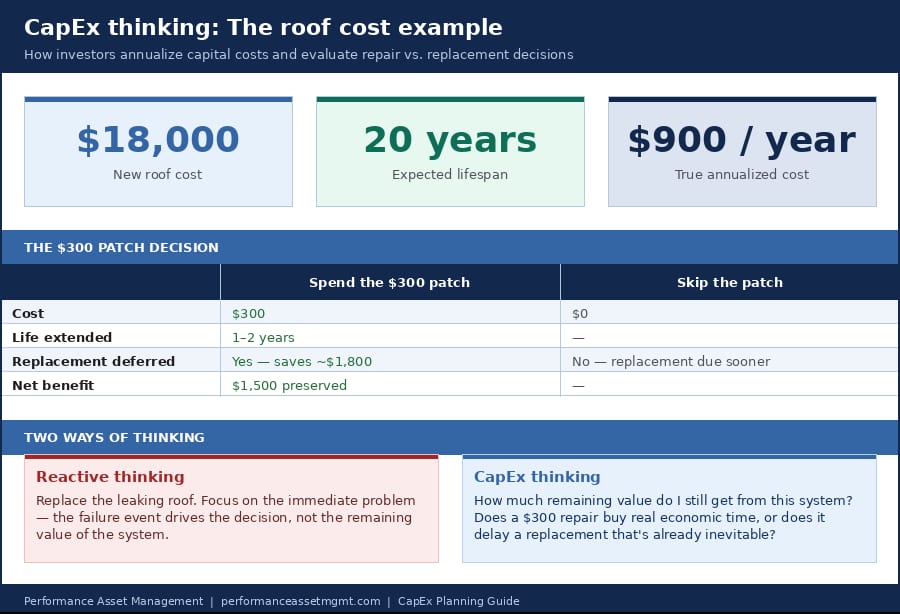
This more thorough approach can change the approach of just patching a leaky roof. Instead, investors work with managers to perform CapEx planning so they know whether small repair buys real economic time or delays a known replacement.
Consider a roof, which costs about $18,000 and has a 20-year cycle. With CapEx planning, investors understand that the roof costs about $900 each year over its lifespan to maintain. That means, if a $300 roof patch that extends the life of the roof by 1-2 years, it increases the spend. But it potentially avoids $1,800 in near-term replacement costs.
How Do Property Managers Protect Investors from Legal, Financial, and Liability Risk?
Property managers protect real estate investors by maintaining legal compliance with federal and state housing laws, enforcing standardized maintenance schedules, and confirming that the correct insurance coverage is in place before a claim is ever needed.
The relationship between realtors and property managers can be symmetrical, where both parties work with an investor during different but highly involved stages in the lifecycle of a property. Realtors generate investor relationships, while property managers control long-term asset performance. The overlap creates shared influence, but not always shared incentives.
Because of the symmetry, a growing number of realtors are stepping into property management by offering to manage properties for their investor clients. For that relationship to be mutually beneficial, it takes a full commitment, which can inspire realtors to find a trusted manager.
To ensure the relationship works, realtors and property managers have to operate within defined roles to avoid misalignment, performance gaps, and damaged client trust. Strong relationships happen when realtors find managers who offer the following support:
Standardized maintenance: Property managers can protect against physical neglect of a property that could otherwise turn into expensive concerns. Regularly scheduling maintenance, preventative oversight, documentation trails, vendor compliance, and work order repairs are all examples of ways that managers ensure property issues never become lawsuits.
Legal compliance: Federal and state housing laws are complex and frequently change. These laws require objective written criteria for tenant screening, lease enforcement, and accounting procedures to avoid serious penalties, including hefty fines.
Liability coverage and insurance: Managers can act as gatekeepers for liability standards. Confirming that investors have the correct insurance and that it covers the appropriate amount ensures the correct party pays for damages in the event of a fire or a bathtub overflowing.
How Can a Property Management Partner Help Realtors Generate More Referral Business?
A property management partner protects a realtor's future business by committing in writing to refer investors back to the originating realtor for future purchases and sales, turning a one-time transaction into an ongoing client relationship.
Successful partnerships between realtors and property managers have defined expectations regarding referrals, communication, and responsibilities. For example, a management company that involves investors early in a 120-day lease renewal process, encouraging pricing discussions, can minimize the risk of residents leaving while increasing renewal rates.
Managers can guarantee that referred investors return to their original realtors by creating contractual agreements to strengthen trust between investors, managers, and realtors.
Ongoing conversations create additional conversations for future purchases, sales, and portfolio expansion that can benefit all parties if the alignment works from the beginning. Realtors can remain involved in the relationship without personally handling the operational responsibilities, where property managers offer expertise.
What Should Realtors Look for When Choosing a Property Management Company?
Realtors should look for a property management company that offers transparent performance reporting, a signed referral agreement, measurable renewal and placement rates, and access to investor tools, such as CapEx planning and IRR calculators.
One of the most tangible benefits of a strong partnership is access to reporting tools that realtors can share with their clients under their own name. Rental analyses, CapEx and IncomeEx inspections, and internal rate of return (IRR) calculators give realtors hard data,
They can use that information to advise investors on whether to rent or sell, when to buy additional properties, and how a specific asset will perform over time, which supports the realtor as a long-term strategic advisor.
At PAM, we provide realtors with those tools, a signed referral contract, and a $500 referral fee for each client who signs a management agreement. Schedule a conversation to learn how property management can protect your clients and grow your business.