What Is CapEx Planning in Property Management, and Why Do Investors Get It Wrong?
Consider choosing between an $800 furnace repair and a $3,500 system replacement. While the cheaper option may feel right, the system age, failure signals, and remaining lifespan can tell a different story. Here, the repair would only buy two more years. This decision to repair or replace is exactly where investors struggle with capital expenditure (CapEx) planning.
Instead of structured, data-driven CapEx planning, property owners often use rough timelines. The common mindset in the industry, particularly in the Midwest, where winters are harsh, is that older systems fail primarily due to their age. So, it’s time to budget once the furnace gets 12-15 years old.
While this line of thought may be the norm for more traditional investors, our decades of experience working with property owners in Wisconsin taught us differently. At Performance Asset Management (PAM), we recognize that a comparative analysis of costs and repairs, considering condition, usage, and failure patterns, provides a more thorough approach.
This article explains how CapEx planning for rental properties works in practice and how data-driven decisions replace the guesswork that costs investors money. Through real property scenarios, we explore how data, age, and condition affect replacement decisions. Gain a framework for predicting major expenses before costly failures happen.
How Can Data and AI Improve CapEx Decisions for Rentals?
Investors can use data and AI to evaluate repair costs, remaining lifespan, and risk exposure, turning guesswork into informed, financially optimized decisions.
For investors new to CapEx, in terms of property management, it is the capital that property owners allocate to major systems to keep rentals running smoothly. Common examples include roofs, HVAC systems, plumbing, and major appliances. It differs from routine maintenance or small repairs by involving preparing for major replacements that will eventually happen.
Considering a real furnace helps illustrate how data supports deciding between repairing and replacement. Serial numbers and installation dates reveal system age and expected life cycle.
According to the International Association of Certified Home Inspectors' home life expectancy chart, furnaces generally last 15–25 years, asphalt shingle roofs about 20 years, and water heaters roughly 10–15 years. These benchmarks help investors identify properties that may be approaching major capital expenditures.
When combined with AI tools, investors can analyze failure codes and then recommend diagnostic steps or solutions by entering these kinds of prompts:
How old is this furnace based on its serial number and installation data?
What lifespan should I expect from this type of furnace at this age?
Does this failure code indicate anything about the motherboard or internal components?
If I replace the motherboard, what other furnace components are likely to fail next?
What is the estimated total cost if I only complete the repair?
How often do these furnaces fail after year 15?
What additional repairs will be needed within the next 12–24 months?
These prompts can identify secondary components that will most likely fail after repairs. Investors can use this information to compare repair costs against full replacement to reduce uncertainty.
When Should Investors Start Planning and Tracking CapEx?
CapEx planning for rental properties should start during acquisition, using detailed system data to identify potential future costs, rather than relying on generic inspections. Effective CapEx forecasting requires standardized data collection, structured reporting, and continuous updates.
CapEx planning should start before the acquisition. Investors who start after closing on the property miss out on high-level, often specific investment-level detail. Property inspection and evaluation documents tend to be cautious, supporting legal defense instead of making decision-focused evaluations concerning repairs versus replacement. Some examples include:
Home inspection reports (most common example)
Pre-purchase property inspection reports
Third-party inspection summaries (roof, HVAC, plumbing, etc.)
General condition assessment reports during acquisitions
Insurance or compliance-related property inspections
Early warning signs such as visible wear, leaks, and recurring maintenance are key indicators for CapEx planning. However, running data from property inspection reports and related evaluations can jumpstart the process of understanding realistic future capital exposure. Understanding these signals allows investors to proactively plan instead of reacting later.
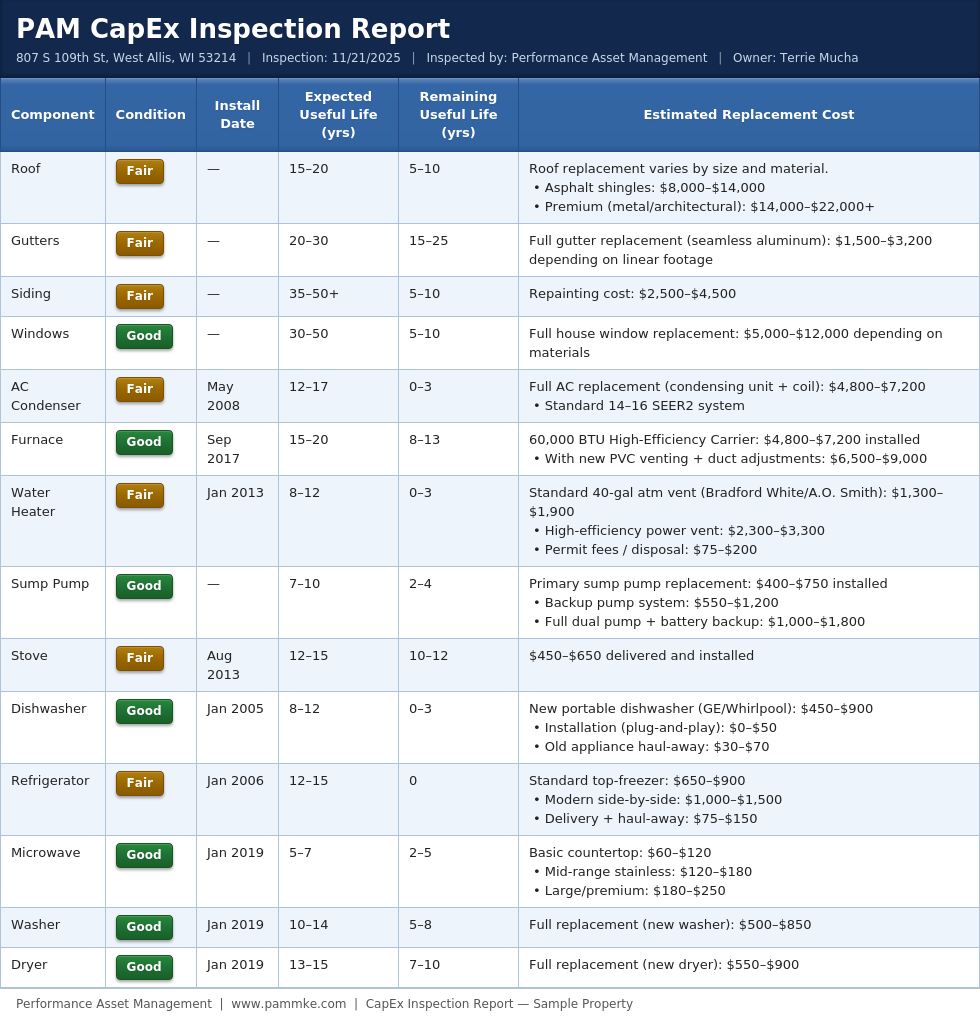
Over time, investors should perform CapEx-focused inspections, which serve as working documents for budgeting and long-term planning decisions. Capable property managers can also perform this type of structured data collection, which can ensure consistent property comparison.
Property management reporting systems can provide one-page summary sheets to help investors quickly understand their total capital exposure. With regularly scheduled follow-ups, forecasts are more likely to remain accurate, as conditions change over time, prompting strategic decision-making conversations.
How Does Poor CapEx Planning Impact Investor Returns?
Poor CapEx planning disrupts cash flow, increases vacancy risk, and can force asset sales — all of which compound into significantly lower long-term returns.
Poor CapEx planning disrupts cash flow and reduces overall investment performance, as unexpected repairs can lead to increased vacancies, costly fines, or forced asset sales. Investors who underestimate capital expenses during acquisition and underwriting fail to create a rental property budgeting strategy that provides a clear map of financial exposure and risks.
Errors in CapEx planning can unnecessarily diminish long-term returns. And while market conditions can absorb CapEx costs, that rarely happens consistently over a 20 or 30-year investment period, which is common in property ownership.
However, these costs are only part of the picture. Long-running housing data from the Wisconsin Realtors Association shows that median home prices in Wisconsin have increased by more than 50% between 2014 and 2024, reinforcing real estate’s role as a long-term appreciation asset despite short-term cost volatility.
That context matters when evaluating small repairs, because rational improvements can efficiently extend the life relative to cost. This applies when:
The system still has meaningful remaining life
The repair actually delays replacement in a measurable way
You are not just repeatedly delaying an inevitable full replacement
A widely cited industry benchmark recommends reserving 5–10% of gross annual rents for capital expenditures, with the higher end applying to older properties or those with aging systems.
For example, a new roof costing about $18,000 has about a 20-year life cycle. That means the roof costs about $900 each year to maintain. Instead of thinking about the cost of the roof, with CapEx planning, investors think: this roof costs about $900 each year over its lifespan.
In relation to repairs, a $300 roof patch that extends the life of the roof by 1-2 years increases the spend. The maintenance costs become spending $300, but potentially avoiding $1,800 in near-term replacement value.
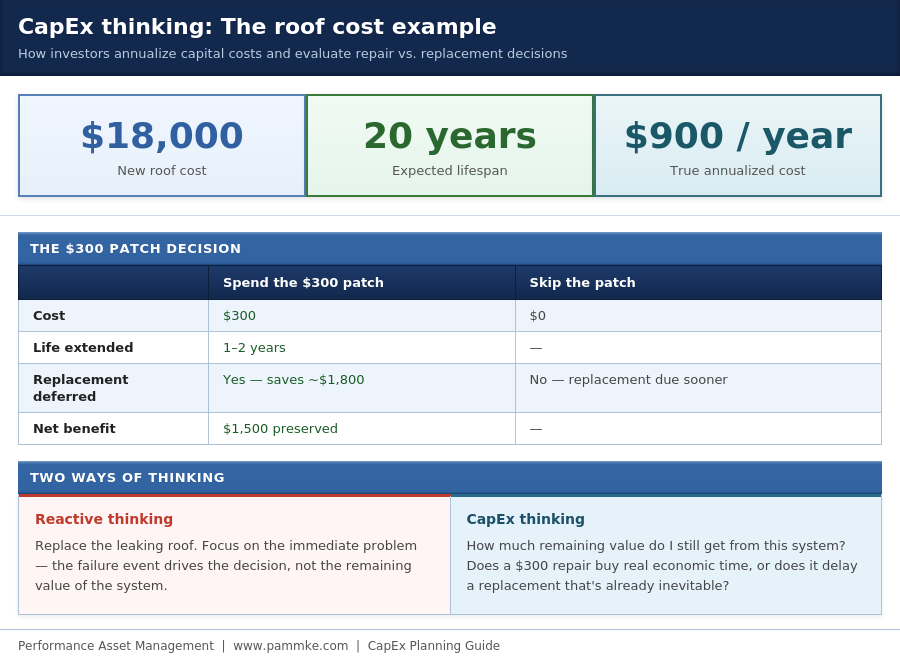
Reactive thinking translates to replacing a leaking roof with a focus on the immediate problem. CapEx thinking asks “how much remaining value do I still get from this system?” or does a small repair buy meaningful economic time? The question is whether a small repair buys real economic time or delays a known replacement.
What Does a Structured CapEx Planning System Look Like in Practice?
Structured CapEx planning replaces reactive spending with financially defensible decisions, and it starts with consistent data collection across every property.
CapEx planning and decision-making depend on data, conditions, and risk analysis. This article illustrates how successful investment decisions, such as choosing between an $800 furnace repair and a $3,500 replacement, require that investors minimize total cost and risk over time.
Building a structured system for tracking asset age, performance, and exposure requires using consistent data to improve forecasting accuracy while reducing reactive, costly investment decisions. The end goal is to move past or completely avoid guesswork to create repeatable, financially defensible CapEx decisions.
Structured CapEx planning for rental properties starts with consistent data that replaces reactive spending with financially defensible decisions. PAM tracks this data for every property it manages. To see what that looks like for your portfolio, let us walk you through it. Schedule a CapEx session to develop a more planned approach to maintaining your investment.