What Does a Vacancy Really Mean for Investors?
Vacancy isn’t just a number on a spreadsheet—it’s a silent threat to property investors, if left unchecked. Though vacancy rates can make or break an investment, it’s often because they get mismanaged. The key is to go beyond just attempting to fill empty units by taking a proactive approach that may require more deliberate planning and discipline for the average investor.
So, you just rented your investment property, and for one reason or another your property becomes vacant. At that moment, as an investor, you’re likely scared wondering how you are possibly going to find someone to rent your property, and after all, isn’t your property management company supposed to help with this?
Performance Asset Management (PAM) actively manages vacancies, rather than passively measuring lost rent. For almost two decades, we’ve been applying data-driven strategies that maximize returns, minimize risks, and strengthen long-term performance. Vacancy is treated as an actively managed performance variable, instead of an unavoidable cost of ownership.
Taking on these responsibilities can be challenging for a lone investor. In this article, we break down the process of measuring and managing vacancies to help investors understand their impact on cash flow, asset stability, and long-term wealth. With that information, you can determine if a property manager is the best route for handling vacancies.
When Is Vacancy a Strategy Problem Versus a Market Reality?
A vacancy is a strategy problem when pricing, positioning, or execution decisions push the unit out of alignment with the market because of a decision made by an investor or property manager, as opposed to external market factors.
In most stabilized rental markets, a prolonged vacancy is rarely random. It's usually caused by pricing, positioning, or execution misalignment. In other words, if the rent is too high compared to properties offering the same amenities, the vacancy isn’t due to market forces—it’s because of a deliberate pricing decision.
A strategy-driven vacancy that can be corrected occurs when:
Rent is priced too high in comparison to spaces with the same or very similar amenities
Exposure is weak, such as too few showings, a small number of applications, or poor online engagement from potential renters
Delayed maintenance causing tenants to sign elsewhere, late renewal offers, or a lack of communication with residents
A market-driven vacancy is outside of the control of an investor, such as:
A rental resident moves out to take on a mortgage and buy their own house
Seasonal periods where renters are less active, such as winter months in Southeastern Wisconsin where temperatures drop below 0 degrees
Demand shifts in the short term sparked by local employment, construction supply, or affordability pressure
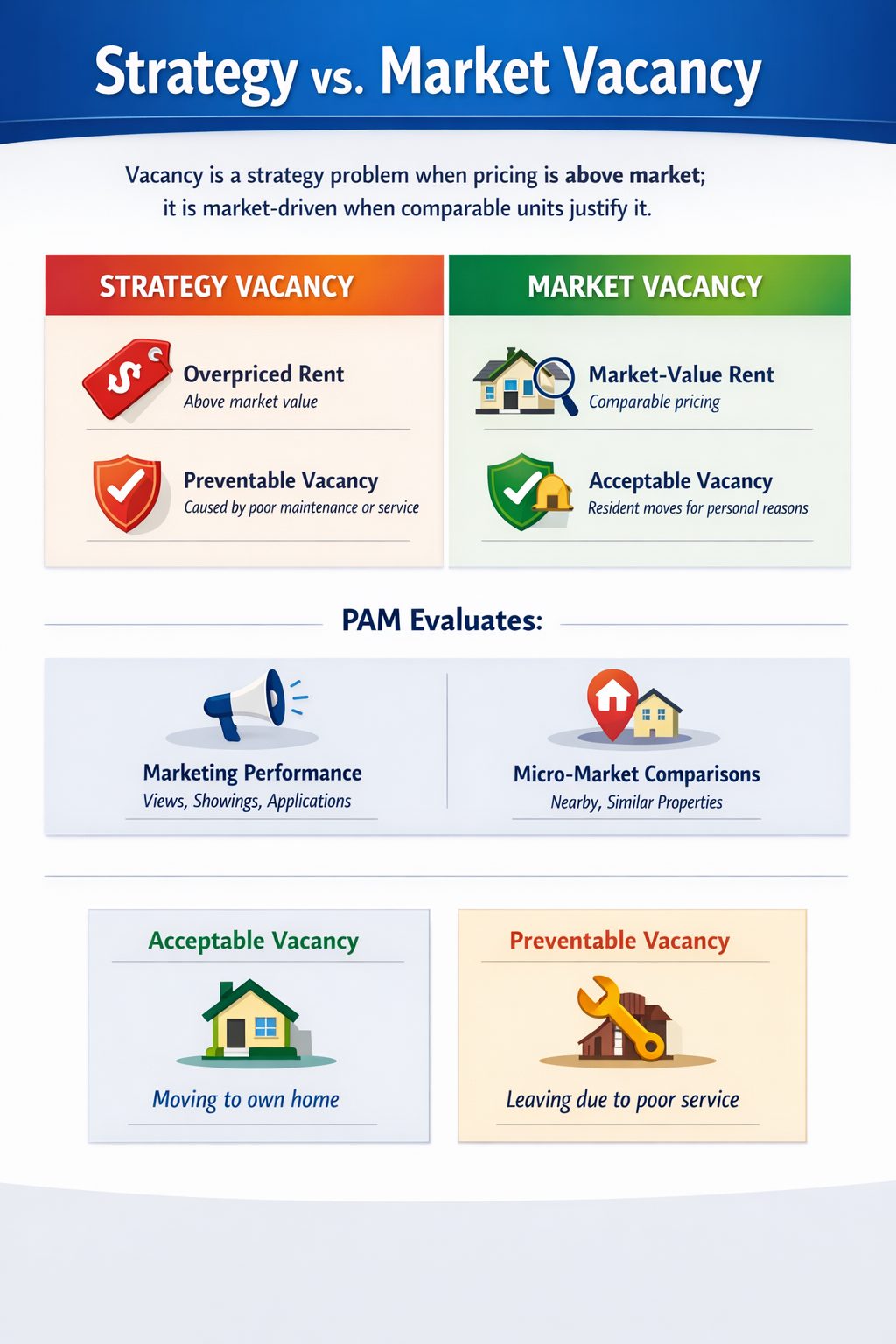
How do vacancy risks affect investor planning and decisions?
In stabilized, functioning markets, vacancies driven by market factors tend to be short-lived and resolve within a relatively small window. In select micro-markets, disciplined price testing can validate demand, but prolonged vacancy more often reflects strategic misalignment rather than external market conditions. When vacancy risks start to increase, it’s important to focus on market activity by asking pertinent questions:
Are we getting people to attend our showings?
Are people submitting a lower-than-average number of applications?
How is digital engagement?
The decision to adjust a price comes down to distinguishing between market-driven and strategy-driven vacancies. If activity is low, the problem usually points to pricing or marketing. After confirming that online advertisements are functioning and showings are accessible, adjustments can be made—usually price reductions—based on hyper-local market data.
If data shows strong engagement but slower leasing due to timing or seasonality, holding firm on price may be the best decision to protect returns. If engagement is weak, the issue is strategic, and the solution is more likely to be realigning pricing before vacancy erodes cash flow.
What Data Signals Help PAM Predict and Manage a Vacancy?
PAM predicts and manages vacancy by tracking leading data signals, not just days without rent.
This data-driven approach allows PAM to identify vacancy risk early, adjust strategy quickly, and protect long-term asset performance—especially in Southeastern Wisconsin and similar rental markets. At PAM, there are essentially two types of vacancies that need to be managed:
The first happens during the lease renewal process—if a resident doesn’t renew, we start a preemptive vacancy period to fill the unit before it officially becomes vacant. This usually starts about 60 days out, giving us time to list the unit, perform pricing tests, and generate showings.
The second occurs in units that are already vacant. Here, we monitor activity closely, analyzing applications, showings, and digital engagement. If activity is low, we evaluate pricing, the tech stack, and local micro-market conditions to determine why prospective residents aren’t engaging. For investors, this approach ensures we’re actively managing the risk of vacancy rather than passively measuring lost rent.
Vacancy risk can often be forecasted when pricing deviates significantly from market value. For example, if a unit could rent for $1,500 but we attempt $1,800, the market signals the challenge immediately. This predictive insight allows investors to anticipate vacancies before they occur.
How does PAM communicate vacancy risk to investors?
Investors can react emotionally to vacancy, particularly when bills for expenses continue regardless of whether or not a tenant is paying rent. While newer investors tend to focus exclusively on cash flow, seasoned investors may take a more measured approach, weighing long-term performance versus short-term gains.
Our role is to contextualize the numbers and show the broader financial picture. To do that, we educate investors about macro trends, such as affordability pressures or regional market shifts, and adjust expectations based on data. During transitional periods, we also monitor micro-market conditions closely to inform pricing and leasing strategy.
How Should I Evaluate My Current Vacancy Strategy?
Now that we’ve identified how property managers should help fill your vacant property, the next step is evaluating whether or not your current property manager is doing the job correctly or if you need additional support.
The key takeaway for investors is that vacancy isn’t just lost rent, it’s lost income for you as an investor that can diminish long term investment potential.
For support with reviewing your current vacancy strategy, schedule a free session with one of our advisors and learn To calculate how many days your unit can stay vacant before you start losing money, review our vacancy loss calculator for more information. If you’re ready for conversation with one of our experts schedule a session.