How Do Lease Renewal Rates Impact Property Investors in Southeastern Wisconsin?
For investors who plan to own a rental property for 30 years, how many different residents do you expect? And what impact does low renewal rates have on your returns over that time? Investors who fail to ask that question lose tens of thousands. Keep reading to get this answer and learn how to evaluate renewal rates when choosing the right property manager.
Jim Miller started Performance Asset Management (PAM) after being fed up with property managers as an investor. Property management companies were settling for only about half of the residents renewing. Common causes were poor maintenance, slow responses, and toxic relationships. Those low renewal numbers weren’t good enough then, and they aren’t today.
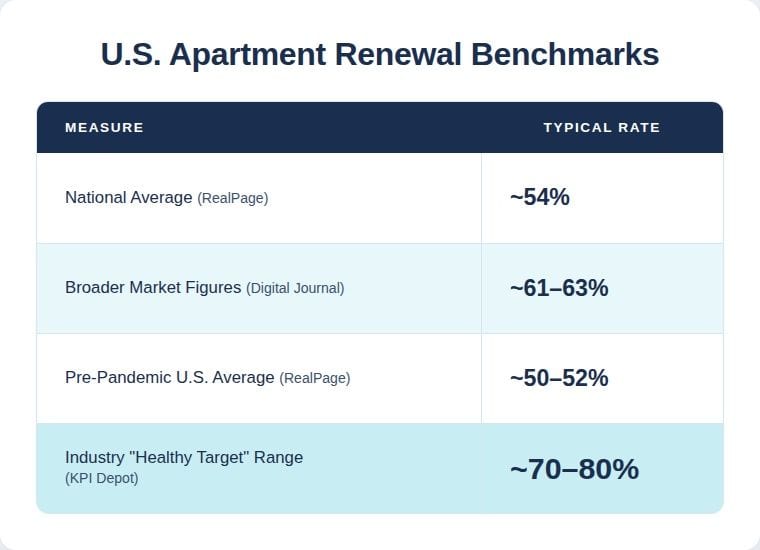
In housing markets across the United States, renewal rates are reportedly around the mid-50% range. Leading operators perform within a range of 70% - 80%. PAM’s renewal performance is approximately 85 - 90%. These significantly higher numbers are because of our repeatable processes, transparent communication, and human follow-up.
Most property managers accept vacancies as inevitable. But empty rentals cost money—to the tune of thousands annually. At PAM, we’ve cracked the code. Treat our Wisconsin residents like valued customers to turn turnovers into renewals. Learn our approach to resident retention and repeat our success. Explore how to evaluate property managers based on their retention rates and why retention matters for every investor.
What Separates PAM as a Top-Performing Property Manager?
PAM’s renewal performance is typically about 85 - 90%. These significantly higher numbers are because of repeatable processes, transparent communication, and human follow-up.
Average property managers have issues with cultural toxicity and a lack of resident-focused processes. Top-performing property management companies do just the opposite. By prioritizing resident engagement and responsive maintenance workflows, PAM can retain residents over the long term. PAM achieves 85–90% renewals through:
Modern technology
Faster maintenance response times and automated lease tracking translates to fewer residents feeling ignored. And that means fewer vacancies draining your returns.
Digital rent collection and integrated property management systems can reduce operational burdens. Automated tools can help provide clarity, consistency, visibility, and timing. Technology helps ensure that important issues get attention and staffers can focus on resident engagement.
For example, automated pricing recommends rent increases based on comparative data. Software like Rentvine and API integrations track lease expiration dates and trigger alerts in advance. Technology helps turn large amounts of information into clear, data-backed decisions. And this gives us time to evaluate whether a rent increase aligns with certain conditions.
Culture of Accountability
When residents decide not to renew, PAM finds out why. Changing that decision saves investors roughly $5,000 on the spot. Our team takes pride in building strong relationships with residents and investors. Transparent communication and early intervention are key differentiators that guide our focus on resident satisfaction.
For every renewal request, residents can provide feedback or decline the renewal. Our team reaches out to understand why residents decide not to renew. And we work to find solutions that satisfy tenants and investors. Throughout the process, investors receive comparative market data and potential cost impacts of losing a resident to help them make informed decisions.
“Humanation” Approach
Property managers who only rely on automation are missing out. PAM combines technology with human outreach. A staffer who catches a frustrated tenant earle can prevent turnover costs before they happen.
At PAM, we proactively address resident concerns in an attempt to avoid adversarial relationships that are common in the industry. Reaching out to speak with residents directly helps evoke empathy and understanding. And being available anytime creates openness.
Processes combine expertise from staffers with industry-leading systems. We call our approach “humanation,” as it utilizes technology for support with tasks, timelines, and responsibilities. An example would be manual lease renewal systems. However, a staffer contacts unpaid residents after the fifth to confirm payment plans to solve operational and relationship problems.
What Costs Do Investors Avoid with Higher Resident Retention?
Higher retention reduces turnover costs such as placement fees, rent-ready repairs, and lost rental income, which average about $2,000 - $5,000 per unit.
Once landlords consider vacancy loss, leasing fees, cleaning, and maintenance costs, turnover translates to losing thousands of potential net profit. On average, a turnover in Southeastern Wisconsin costs:
Placement fee (one month’s rent): ~$1,500
Vacancy loss (½ month average): ~$750
Turn cleaning (market expectation): ~$400
Maintenance and turnover repairs: ~$2,200
Total average cost per turnover: $4,850 — nearly $5,000 every time a resident leaves. These figures reflect PAM's internal data based on average turnover costs across our Southeastern Wisconsin portfolio.
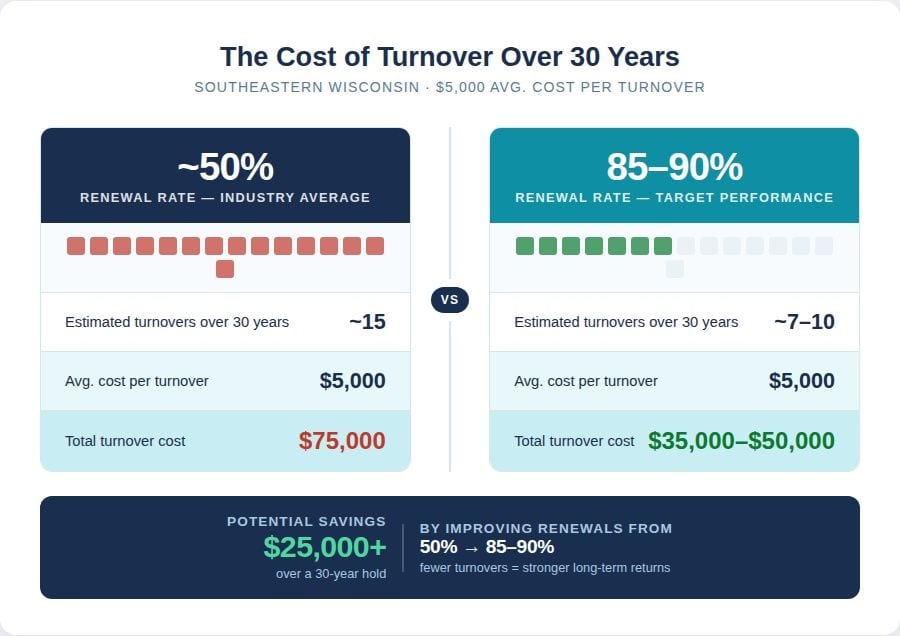
If an investor plans to hold onto a property for approximately 30 years to maximize returns, increasing the average renewal performance to an 85% - 90% renewal rate should improve short and long-term investment performance. Take a look at this cost breakdown:
Over a 30-year hold:
At a 50% renewal rate (industry average), you might turn a property ~15 times = $75,000 in turnover costs.
At an 85 - 90% renewal rate, turnover frequency drops significantly. This can potentially save over $25,000 throughout the life of the asset.
Depending on turnover frequency, the savings range from $25,000 to $40,000 or more over the life of the asset — with $25,000 representing the conservative estimate. For investors with three or more properties, that savings compounds to $75,000 or more over the same period.
Beyond direct savings, fewer turnovers translate to increased, stable net monthly profit. It also means reduced operational volatility, which minimizes expensive surprises from last-minute leasing. The question isn't whether turnover costs money. It's whether your property manager is doing everything possible to prevent it.
How Should Investors Evaluate Renewal Rates When Choosing a Property Manager?
Investors in Southeastern Wisconsin should evaluate renewal rates by asking property managers for historical data and comparing it to industry averages, as high lease renewals indicate strong resident retention, stable net profit, and effective practices.
Property managers who prioritize lease renewals get a win-win. Residents stay happy and benefit. That means, investors seeking a property manager should ask for renewal rates. If a manager doesn’t know their rate, they’re likely closer to 50–60%.
Lease renewals are typically the largest rental expense and impact many other parts of the business. A strong process and awareness around it are critical for superior returns. Taking the time to evaluate renewal rates helps with predicting occupancy stability, net profit, and ROI. High renewal is a strong indicator of operational discipline and resident-focused culture.
Many companies focus solely on automated workflows, while our team engages directly with residents to resolve concerns and create mutually beneficial outcomes. Our follow-up is unique because it’s proactive, personalized, and collaborative. Here’s a few questions and answers investors can use to spot potential managers with red flags:
Q: What is a good lease renewal rate for a property manager?
A: Industry average is around 54%. Top performers reach 70–80%. PAM achieves 85–90%.
Q: How much does tenant turnover cost in Wisconsin?
A: On average $4,850 per unit, including placement fees, vacancy loss, cleaning, and repairs.
Q: How do I know if my property manager has a good renewal rate?
A: Ask them directly. If they don't know their rate, they're likely closer to 50–60%.
Q: When should a property manager start the lease renewal process?
A: At least 120 days before the lease expires. Starting later leaves little time to retain residents who are on the fence.
Q: What is the long-term financial impact of high renewal rates?
A: Over a 30-year hold, improving from 50% to 85–90% renewals can save an investor $25,000 or more per property.
Your Next Step to Better Resident Renewal Performance in Wisconsin
PAM delivers far above the industry standards in terms of achieving 85–90% lease renewals. This matters because high resident retention reduces costs associated with turnover while stabilizing cash flow and maximizing long-term returns.
Investors with property managers should use this information to evaluate whether or not their company has high renewal rates. Additionally, ask about lease processes and resident engagement strategies.
If you're not sure what your current property manager's renewal rate is, that's worth a conversation. Schedule a 15-minute call with Jim Miller to find out what PAM's renewal process could mean for your Southeast Wisconsin portfolio.