What Does “Good Communication” Mean in Property Management?
The Amazon Effect has increased consumer expectations, forcing business owners to respond quicker than ever before, and property ownership is a prime example. Due to the availability of communication methods like texts, emails, and social media, landlords are expected to take action without delay while complying with legal statutes. As a result, finding the right ways to communicate with residents has become a significant challenge for investors.
For the past 15 years, Property Asset Management (PAM) has operated at the intersection of human behavior, legal compliance, and mechanical systems. We provide comprehensive and competent solutions to serve investors and residents, rather than promising instant answers.
Achieving this requires incorporating tools that facilitate the communication process, setting realistic expectations, and meeting contractual agreements by promptly responding to emergency requests and addressing complex long-term investment questions.
Take a close look at how PAM structures and executes its communication process. Learn how PAM structures resident and investor communication, what response standards matter most, and how to evaluate whether your current property manager’s communication practices protect your assets.
Managing Resident Communication vs. Responding with Speed
Almost by design, communication in the residential property management industry is complex. In both emergency and non-emergency situations, residents and investors benefit from property managers with clear response plans who are prepared to reduce damages and protect tenants.
Online portals are a convenient way for residents to report issues, improving overall tenant communications, as the system categorizes them by urgency. Residents can report emergencies at any time and expect same-day action.
Investors are notified through the portal when emergency work orders are opened and again when they are resolved, supporting transparent property management reporting.
For example, within the Southeastern Wisconsin area, where temperatures drop to subzero temperatures during the winter, burst or frozen pipes are a major concern that requires rapid response. Since some situations require a same-day response while others mean postponing until set business hours, an effective communication policy prioritizes categorizing issues.
What is the Communication Policy at Performance Asset Management?
PAM’s communication policy prioritizes competence, clarity, and risk management over constant availability for investors and residents across Southeastern Wisconsin.
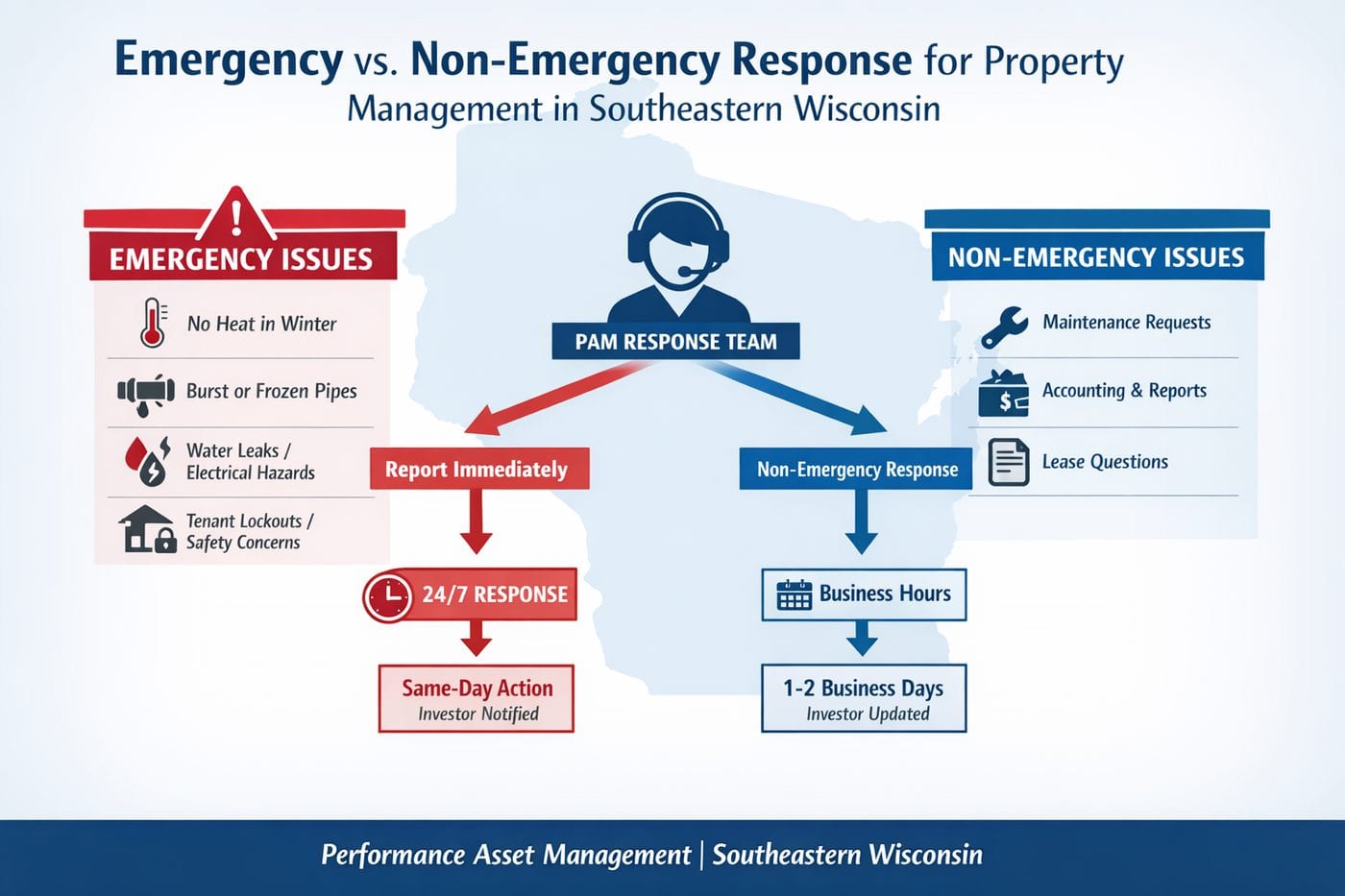
Emergencies that impact resident safety, property integrity, or legal compliance are addressed immediately. Staffers are available 24 hours a day, seven days a week, to respond to emergency requests, even if proof of investor approval isn’t required or feasible.
Residents can report emergencies at any time and should expect a same-day response. Investors are notified via the portal when emergency work orders are opened and again when they are resolved. A list of emergency issues where we provide same-day response:
No heat in winter
Frozen or burst pipes
Active water leaks
Electrical hazards
Lockouts that prevent access to the unit
Situations involving personal safety
Non-emergency requests are handled during normal business hours. The goal is same-business-day acknowledgment, but answers are not rushed, and investors receive information they can rely on. Our goal is to resolve these issues in one to two business days, as additional review or third-party input may be needed. Common non-emergencies include:
Routine maintenance requests
Financial or accounting questions
Lease interpretation or compliance questions
Security deposits concerns
Monthly statements and reports
CapEx planning and budgeting
How Resident and Investor Communication Evolved at PAM
Setting clear expectations for investor and resident communications requires delivering competent responses rather than overpromising immediate answers. This strategy establishes a consistent and reliable tone while addressing the need for quick responses.
An example of our effort to avoid unnecessary industry trends is our move away from property management software. Because those platforms were built primarily for accounting and operations, instead of communication, visibility, and control, they caused various pain points.
The main problem was fragmentation, as traditional property management software often relies on multiple phone numbers, inboxes, portals, and message threads. The tools struggled to communicate effectively, resulting in numerous channels to monitor, inconsistent visibility, and loss of information.
It was difficult to discern who was reaching out, when contact was attempted, what channel was used, and what had actually been said. PAM moved to a communication-first CRM to gain centralized message tracking, timestamps, ticketing, and workflows.
With these tools, we have been able to streamline communication between investors and residents across Southeastern Wisconsin using a single system. This has consistently improved our response time to emergencies, enhanced our ability to manage non-emergency requests more effectively, and facilitated more informed, data-driven discussions with investors.
PAM’s Approach: Human Communication Supported by Automation
Providing 24/7 availability is increasingly common due to market pressures. However, property managers must evaluate whether this approach is practical or if it compromises their ability to offer the most effective responses to investors and residents.
At PAM, the goal is to manage expectations, instead of chasing the communication-related trend to be always available. Our communication is divided into the following categories:
Fixed communication: automation (lease renewals, rent status, work orders)
Variable communication: human problem-solving
For example, PAM’s lease renewal process combines automation and human touch. The system manages renewals 120 days in advance, which sends out timely reminders and investor updates. However, there are multiple points where staffers check in with residents and investors personally to ensure efficiency without sacrificing a genuine connection.
By utilizing automation for routine tasks, PAM can minimize over-communication or notification spam that overwhelms investors with too many updates. That said, investors have different preferences when it comes to information about their property.
Some want frequent updates that cover every operation. Others only prefer to hear issues impacting material events, such as maintenance over $500, lease renewals, or monthly investment reports.
Investors can use the maintenance portal to select their preferred method of receiving notifications, either via text or email. Emergency maintenance triggers automated notices, but non-emergency communication is intentionally limited.
This approach provides investors with personalized visibility, rather than a one-size-fits-all broadcasting method. And during onboarding, investors are instructed on how to schedule optional conversations.
How to Evaluate a Property Manager’s Communication Policy?
Investors conducting a property manager evaluation ask whether there are clear tenant communications, robust property management reporting, and data for investor oversight.
Competent communication should provide meaningful updates at logical steps, such as when maintenance begins and is completed, rent delinquency updates, or weekly activity summaries. Alternatively, lower value notifications include constant lead view alerts, excess showing reminders, or minor operational updates, which fail to help investors make informed decisions.
Effective communication strikes a balance between residents and investors. PAM is dedicated to delivering timely, meaningful updates while focusing human attention on the jobs that need it. If a property manager is sending too many alerts or there’s not enough high-level information, book a free, no-obligation discovery call to learn how a structured, investor-focused communication policy can enhance your experience as an investor.