What Is a CMA and Why Do Wisconsin Investors Need It?
When an experienced Wisconsin investor raised the rental price on his cottage too high, the place sat empty for two months. With a Comparative Market Analysis (CMA), he identified competitive trends and comparable properties. Within one week, his property received multiple applications. But without guidance, he risked continued vacancy, lost rent, and financial stress.
This story highlights why strategic CMA reports are crucial for new and seasoned property investors. Two months of vacancies cost him income he could never recover. By chasing a price the data didn't support, he learned firsthand how quickly overpricing could erode annual returns.
At Performance Asset Management (PAM), we understand the financial consequences of unwanted vacancies in the southeastern Wisconsin rental market. We have reviewed thousands of CMAs with investors, providing them with a snapshot of rental income potential and trends.
Property investors rely heavily on CMAs to set competitive rents, reduce vacancies, and make data-driven decisions. These reports go beyond the generic online rental tools to ensure realistic and profitable rental expectations. By the end of this article, you’ll know more about the insights these reports can yield and determine if working with a professional would help you.
How Can CMAs Prevent Costly Property Investor Mistakes?
CMAs prevent costly mistakes like mispricing, over-improving, or ignoring local market trends. They provide investors with actionable, data-backed insights to protect rental income and avoid unnecessary property expenses.
Mispricing is a common financial error that investors make, resulting in vacancies, and even a one-month vacancy can outweigh net profits. If an investor overprices by $100/month, but it takes an extra month to lease, the lost rent outweighs the small premium.
Even worse is when vacancies can lead to emotional decision-making, such as accepting unqualified tenants, creating a cascade of issues. A thoughtful, strategic CMA helps prevent these mistakes by identifying appropriate rent ranges, preventing underpricing or overpricing.
For instance, for a three-bedroom duplex in Milwaukee's 53207 zip code, Wisconsin investment property pricing requires more than picking a number. If the CMA suggests a range of $1,595 – $1,795 per unit and an investor insists on the top range without considering comparable properties’ amenities, the unit could remain vacant for months.
By combining software to track listings and detect when a property is “at risk,” a property manager can suggest price adjustments, preventing lost income. PAM's listing-at-risk software monitors weekly engagement metrics, including views, showing requests, and applications, automatically flagging properties that aren't gaining traction so price adjustments can be made before vacancy becomes costly.
Since duplex rental prices began flattening in August 2024, timing and accurate pricing have become even more critical for southeastern Wisconsin investors. Predictive CMA data also helps plan for seasonal slowdowns and market fluctuations.
For instance, the April 1st rental window closes around tax day, and by mid-March, the market has already pivoted to May 1st rentals. Real-time updates are available to reduce financial risk caused by sudden rental market shifts.
Data shows which property features influence tenant interest the most, protecting investors from making decisions based on intuition or assumptions. With a disciplined CMA process, a property manager can help investors manage rental vacancy risk in Wisconsin and avoid:
Overpricing, which translates to vacancy loss
Underpricing that can lead to lost revenue
Over-improving tasks that waste capital
Emotionally driven leasing decisions detracting from long-term goals
What Sets PAM's CMA Apart from Generic Manager Reports?
PAM’s CMA is more detailed and market-driven than generic CMAs, integrating real-time rental trends and predictive analytics. This ensures investors make smarter, faster, and data-backed decisions that pertain to the Southeastern Wisconsin rental market.
Here is a quick, side-by-side breakdown:
Generic CMAs pull data from public databases without context, may include comps from outside the relevant market area, and offer no follow-up
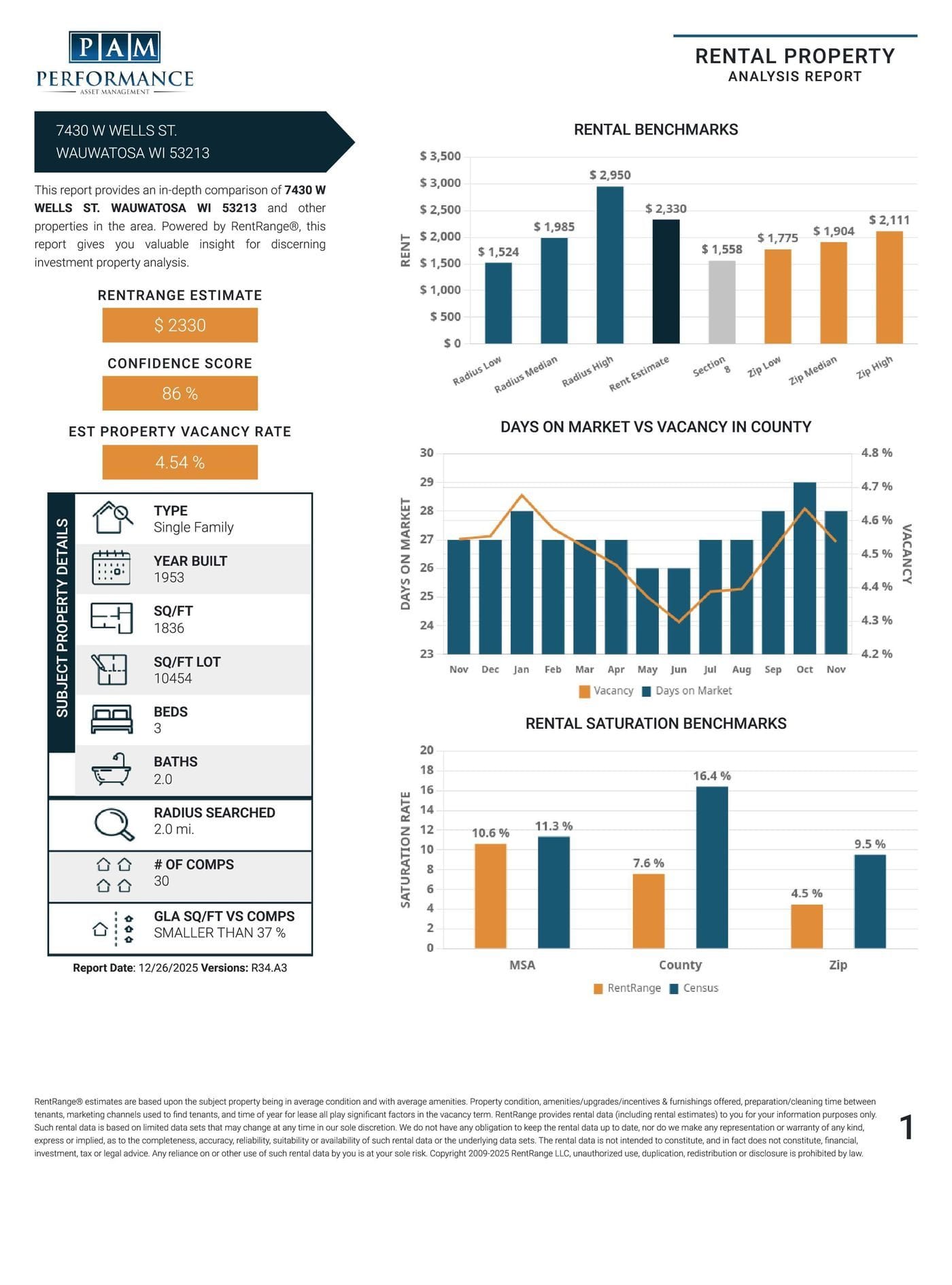
PAM's CMAs manually review comps for amenity matching, limit searches to a half-mile radius, include days-on-market performance data, and involve a two-step collaborative process with the investor
Additionally, most CMAs provide a snapshot of properties at a moment in time but fail to account for how renters filter by price, amenities, or location on platforms like Zillow or Apartments.com. In southeastern Wisconsin, Zillow is the primary platform driving renter search, with Apartments.com a close second. This means a listing's visibility and pricing on these platforms directly determine how quickly a unit gets rented.
Our CMA process considers the renter’s search behavior to ensure pricing and features align with what the market is actually showcasing.
One of the biggest challenges with CMA reports in Milwaukee and southeastern Wisconsin is that most are built on the same mapping technology, which can sometimes produce inaccurate data. The key section to focus on is the comparative assets—specifically, whether the comps match the property in square footage, bedrooms and bathrooms, and the amenity package.
Amenities like off-street parking (slab versus garage), central air, in-unit laundry versus basement laundry, and pet policies can significantly impact rent. Outdoor features like green spaces, grilling areas, or fire pits matter to prospective residents. The CMA is a starting point. However, human review is critical to ensure accuracy and relevance to a specific marketplace.
What Should a Wisconsin Investor Do After Reviewing a CMA?
After reviewing a CMA, the most important question an investor can ask is whether their listing is generating showings — and if not, why not.
Wisconsin investors have the insights to determine next steps after gaining CMA insights. Whether it’s through reviewing weekly leasing activity to confirm that enough eyes are viewing the rental, or whether the price should be adjusted, and why.
At PAM, the process doesn’t end with the CMA. Investors get weekly reports that offer information about eyeballs, showings, applications, cancellations, and comments from tenants.
Renting involves emotional discipline that matters just as much as the data itself.
When a property sits vacant longer than expected, the temptation to accept an unqualified tenant or make a reactive price decision can be strong. PAM's approach is to prepare investors for worst-case scenarios from the start — defining the floor before the property ever goes live — so that decisions are driven by strategy rather than stress.
Investors are advised to cross-check MLS listings with CMA insights before setting rental rates, in addition to leveraging property-specific details like amenities and unit upgrades to differentiate from competitors. Working with an experienced property management company is also helpful for ongoing market analysis and pricing adjustments.
Ready to Maximize Your Wisconsin Rental Property Returns?
The CMA process at PAM gives Wisconsin investors a data-backed framework for pricing. It also supports reducing the risk of vacancies, along with making confident, disciplined decisions. Additionally, our CMAs can identify which property upgrades will yield the best ROI efficiently. Our data shows the impact of property improvements on potential rental income.
Because each month that a property sits vacant is income that generally cannot be recovered, a profitable rental requires discipline when it comes to pricing and market awareness.
If you’ve ever worried about overpricing, long vacancies, or missing out on potential income, you’re not alone. These are common risks that can significantly impact your returns. Now that you understand how a well-executed CMA helps you avoid costly mistakes and make data-driven decisions, you’re better equipped to protect and grow your rental income.
If you want more accurate, market-driven insights tailored to your specific southeastern Wisconsin property, the next step is to explore how PAM’s CMA process works. Find out how our team can help you maximize your rental property’s performance. Reach out today to start making smarter, data-driven decisions for your rental portfolio.