Why Realtors Need a Framework for Evaluating Property Managers
Realtors operate within a defined transaction window, while property managers handle the same assets but over the long term. When these roles align, it sets the tone for how an investment performs over time. For that reason, realtors need a framework to evaluate property managers that protects outcomes, preserves reputations, and meets expectations.
Realtors determining whether a manager supports a long-term investor relationship will want to know how that professional performs processes that protect investors. At Performance Asset Management, our 17 years of experience and hundreds of clients, including realtors, give us a unique perspective on what separates strong partnerships from misalignment.
As property managers transition away from rent collection and move toward asset management, the gap between average and high-performing managers continues to widen. Realtors who know the difference and operate with a clear evaluation standard can reduce risk, strengthen relationships, and make referrals based on performance, processes, and aligned incentives.
What Criteria Should Realtors Use to Evaluate Property Managers?
Evaluate property managers across three criteria: fee transparency, process documentation, and performance metrics. Each one reveals something different — fees show how they operate day-to-day, processes show whether systems protect investors, and metrics show whether results are real or claimed.
A strong partner can expand the realtor’s toolkit. Realtors can use these tools, often branded as their own, to help clients make better decisions. Examples include detailed reports such as rental analyses, capital expenditure planning, income projections, and internal rate of return calculations. That elevates the realtor from a transactional role to a strategic advisor when working with investors.
Realtors should also ask: Does the manager put the realtor's future client referrals in writing? This is the first question a realtor should ask, as it helps to cement the relationship. A good property manager protects the client relationship through a signed contract, rather than a handshake. This guarantees future buying and selling referrals go back to the originating realtor.
Next, the manager and realtor can discuss whether or not a referral fee exists. When one agent refers their clients to a trusted property management company, that realtor gets a flat fee when their client signs a management agreement. This incentive can help both parties strengthen their client relationships.
What Fees Should a Property Manager Charge, and What Are Red Flags?
A transparent property manager clearly discloses all fees upfront and does not charge for basic administrative functions. Monthly management fees should cover rent collection, standard communication, and routine reporting.
Fee transparency is the baseline for evaluating how a management company operates daily. Realtors should want to know the services included in the monthly fee and how rent collection is handled. Asking fee transparency questions should also uncover hidden fees, such as:
Unnecessary administrative fees
Fees to process rent payments to the owner
Posting notices, reminders, or warnings
Monthly statements or reports
Ambiguous charges with no defined service
Activating rent collection accounts
What Processes Should a Property Manager Have in Place?
Process transparency means a property manager can show exactly how they handle contract termination, maintenance workflows, lease enforcement, and investor reporting.
Processes matter just as much as prices, as they serve as crucial indicators of whether a manager prioritizes the interests of investors. Specifically, realtors should ask questions about contract termination, flexibility, and timelines, as property management is an operating business driven by systems that can empower investors.
Confirm documentation exists and is provided to the investors, which can prevent hundreds of thousands of dollars in liability issues. Transparency should come from real-time data, not promises. Whenever there is a lack of transparency, risks increase for the investor and the referring realtor.
What Performance Metrics Should Realtors Use to Evaluate a Property Manager?
Realtors should evaluate property managers on three performance metrics: lease renewal rate, resident placement performance, and communication responsiveness. Each metric is measurable, and strong operators can provide data for all three.
Confident clients are not created by chance. Instead, they are built through clear processes and proven performance. Successful performance in property management requires following specific processes. When realtors can present strong rental data and performance projections, it gives realtors and their clients a clear path that helps them make informed decisions.
With modern technology, property managers should be able to provide clear performance scorecards that show how their processes impact investor returns, as the industry is shifting away from simple rent collection toward full asset management. By knowing what criteria to look for, realtors can determine whether or not managers are producing real results:
What Is a Good Lease Renewal Rate for a Property Manager?
A lease renewal rate measures how often tenants choose to stay rather than vacate. Property managers who produce numbers above the industry range in their area can save investors tens of thousands over a 20–30-year investment.
One of the most important pieces of criteria that realtors can look for is a lease renewal rate.
National rental housing data from firms like RealPage shows lease renewal rates commonly ranging around 60% or higher depending on market conditions, making resident retention one of the clearest indicators of operational performance.
Within Wisconsin, renewal rates typically fall in the mid-60% to low-70% range, according to PAM data. Managers who fail to provide that data are likely to fall within that industry baseline.
Company A: Industry Average (~70% Renewal Rate)
Turnover costs nationally are estimated to range between $1,000 - $5,000, according to Apartments.com. In southeastern Wisconsin, turnovers cost roughly $5,000 - $5,500 when you factor in vacancy, placement fees, and rent-ready work, according to PAM data.
So, a 70% renewal rate means turnover happens 30% of the time. For a single rental unit with average turnover costs at around $5,500:
Total turnover cost during ten years: $16,550
Annual turnover cost: $1,650
Company B: High-Performance (90% Renewal Rate)
However, a company with a higher percentage of lease renewals, that operates at a 90% renewal rate, means that turnover drops to about 10%. Over the same 10-year period, that results in just 1 turnover for a single rental unit.
Total turnover cost during ten years: $5,550
Annual turnover cost: $550 per year
The difference between these two companies is:
~$1,100 per year
~$11,000 over 10 years
Lower lease renewal rates produced a noticeable gap. Property managers who fail to share those numbers are likely meeting the industry average, costing investors tens of thousands.
What Is Resident Placement Performance and Why Does It Matter?
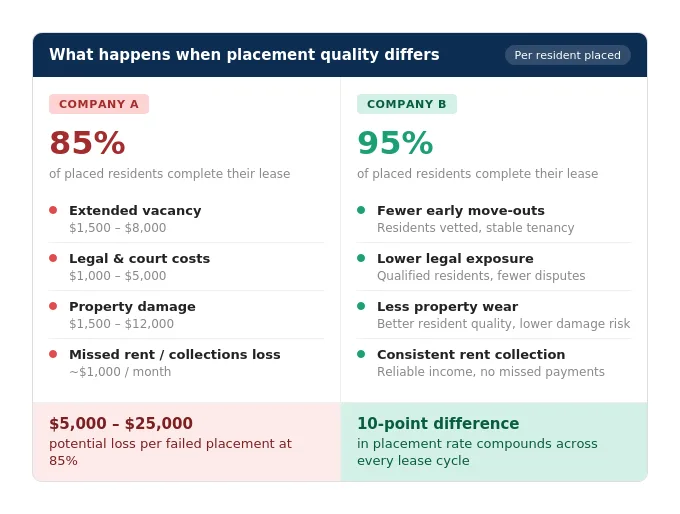
Poor resident placement is one of the most expensive and preventable risks in property management. A single failed placement can cost an investor between $5,000 and $25,000 in extended vacancy, legal fees, property damage, and lost rent.
Another critical metric is resident placement performance. Poor placement leads to evictions, lost income, and unnecessary expenses. Many managers still rely on outdated screening methods that are not predictive of long-term success. Strong operators invest heavily in better screening systems and track their results closely.
Each new tenant represents risks, as problematic residents can cost:
Extended vacancy: $1,500–$8,000
Legal and court costs: $1,000–$5,000
Property damage: $1,500–$12,000
Missed rent or collections loss: $1,000/month
Poor resident placement can cost owners between $5,000 and $25,000 in losses while creating safety, legal, and neighborhood reputation risks. Research from the Eviction Lab at Princeton University and industry organizations like the National Apartment Association continues to show that evictions create substantial financial and operational costs for housing providers.
A manager with a 95% placement success rate poses less risk of capital loss compared to one with an 85% success rate.
How Should a Property Manager Communicate with Investors?
Effective property manager communication follows a defined process rather than reacting to problems as they arise. Realtors should look for managers who proactively contact investors at key intervals — such as 120 days before lease renewals — and who give investors control over how they receive updates.
Communication is another major factor, and realtors evaluating a property manager should look for professionals with a clear, responsive communication process. If possible, find managers who offer an automated but people-focused workflow to fully support investors.
For example, a lease renewal process can combine automated tools and human intervention. The system can manage renewals 120 days in advance, sending out timely reminders and investor updates. To provide additional support, there can be multiple points where staffers check in with residents and investors to ensure efficiency without sacrificing a connection.
Additionally, property managers who communicate with investors using portals can give their clients the opportunity to select their preferred method of receiving notifications, either via text or email. Emergency maintenance triggers automated notices, but non-emergency communication is intentionally limited. This offers a personalized level of visibility.
How to Choose a Property Manager Worth Referring?
Realtors who apply a consistent evaluation standard built around fee transparency, documented processes, and measurable performance metrics can reduce risk for their clients and protect their own professional reputation.
Realtors considering working with property managers should now know that an aligned relationship can improve client outcomes. When evaluating managers, look for professionals who can showcase their lease renewal rates, resident placement outcomes, and clear communication processes.
Additionally, realtors should steer clear of managers with hidden fees or unclear processes. Because the best property managers demonstrate performance through measurable results rather than promises or general claims, strong partnerships allow realtors to extend client relationships beyond transactions into long-term investment strategies.
At PAM, we provide realtors with the data, contracts, and tools to make evaluations straightforward. Our 88.7% lease renewal rate and automated, people-focused communication process exemplify our performance standards. To learn how we work with realtors, including our $500 referral program, schedule a conversation with our founder.