Why Do Two Property Managers with Similar Fees Deliver Different Results?
Anyone who has eaten a hamburger at a fast-food stop knows that a burger, priced similarly but from a diner, is a different experience. Just as a diner might use fresher ingredients and take more time to prepare the meal, two property management companies may advertise similar services for fees. But the impact on the investor can be dramatically different.
Performance Asset Management (PAM) operates like a diner using local ingredients from a market. Then we dedicate extra time to the craft. We have worked with residents in Southeastern Wisconsin for almost twenty years. And we found that lower fees rarely lead to better long-term returns, especially when performance is lacking in important areas.
This article is for investors seeking long-term financial alignment. Learn to better compare and evaluate property management companies. Understand how pricing works and know what performance metrics to look for. Ask the right questions. Measure ROI more effectively. Above all, avoid focusing only on monthly pricing after applying the content from this article.
What Do Property Management Fees Typically Include?
In many markets, full-service property management fees typically range between 8% and 12% of collected rent, although the exact structure depends on the services included and the operating model of the company.
Investors looking into property management pricing often find three main fee structures. The three most common fee structures each come with tradeoffs depending on your property's occupancy rate and average rent.
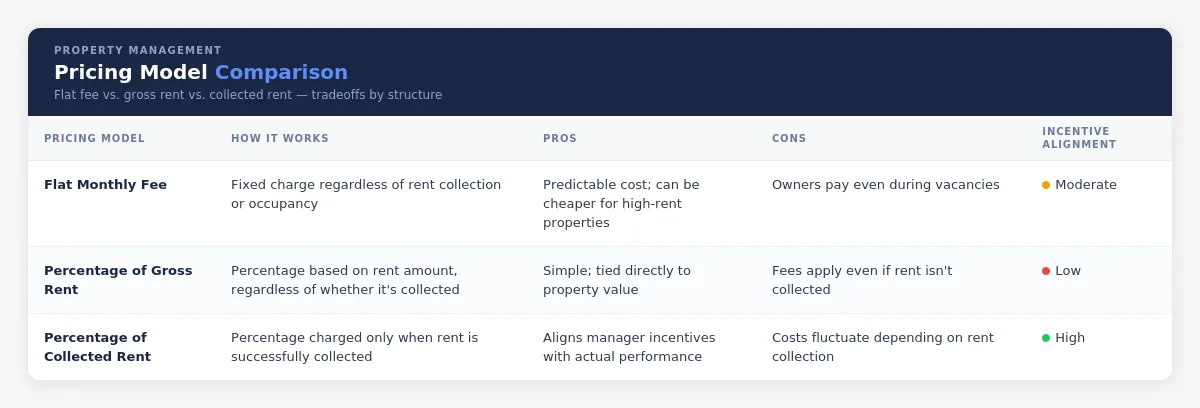
Many companies adopt a hybrid pricing model that combines fee structures. For example, combining a base fee with additional charges for services. Specific instances include tenant placement, lease renewals, or maintenance coordination. Regardless of the fee structure, investors should assess pricing models in conjunction with performance.
Investors should verify which services are included before comparing management fees between companies. Ask about lease renewal percentages. Renewal rates can show how well a property management company supports resident satisfaction.
Many stabilized rental portfolios target renewal rates of 55–65%. According to RealPage market analysis, this range aligns with the current national average of 55%. This strategy is essential for performance because, as the National Apartment Association notes, turnover costs can easily exceed $3,800 per unit, directly impacting your property’s long-term profitability.
What Services Are Typically Included in a Property Management Fee?
Compliance
Property management fees usually cover legal compliance. That support typically includes federal, state, and local rules. These requirements have become increasingly more complex. Housing laws and regulations continue to expand across regulatory levels.
Rent Collection
Standard property management services should include a monthly rent collection. Processing payments from residents should also be included. This approach is designed to create a buffer between the property owner and tenants. But it also helps ensure rent is collected on time. And it can help minimize late payments and legal issues.
Managing Residents
To support resident satisfaction and reduce unnecessary turnover or vacancies, property management companies should handle communication with residents regarding leases, questions, and service requests. While managing residents, property managers typically coordinate lease renewals. They also negotiate updated rental pricing with residents.
What Extra Property Manager Fees Investors Should Expect?
Beyond the base fee, investors may encounter renewal fees, leasing fees, and maintenance coordination fees.
Additional fees tied to specific services occur in property management. However, those fees should be clear and transparent. A common additional fee is for lease renewals. When residents resign, investors avoid turnover costs and prevent vacancy. Turnover tends to be the largest operational expense that property owners face outside of large-scale improvements.
Depending on repairs, cleaning, marketing, and vacancy time, a single turnover can cost investors roughly $1,500 to $5,000 per unit.
Another common charge is leasing or resident placement when a new tenant is secured. Placement fees compensate property managers for marketing, screening, and onboarding qualified residents. These efforts can impact long-term property performance and stability.
Coordination fees are also common. Maintenance work orders may require scheduling and oversight. Investors should carefully consider whether or not each additional fee brings value to the investment over the long term.
For instance, a company offering low placement fees may perform less work when it comes to screening or analyzing applicants. Investors should understand the depth of screening, instead of selecting companies based solely on price.
Property managers in Southeastern Wisconsin do charge residents monthly fees beyond rent. That money could have been used for rent or property improvements. Investors should ask: Why is my resident paying money that's not going into the investment?
Knowing what to watch for can protect your investment before you sign anything. Red flags in property management fees typically fall into four categories.
What Are Red Flags in Property Management Fees?
Unusually low placement fees: could signal cutting corners on screening
Percentage of gross rent vs. of collected rent: managers who charge based on gross rent gets paid whether the unit is occupied or not, which means misaligned incentives
No clear contract or vague fee disclosures communicates disorganization or intentional confusion – both of which are problems
Lack of performance reporting: failure to share occupancy rates, renewal rates, or maintenance response times lacks a system for tracking and cannot improve
What Should Investors Know About Maintenance Costs, Vendor Fees, and Markups?
Maintenance decisions should take realistic budgeting into account. Have a vendor strategy capable of supporting resident service.
Understanding maintenance costs starts with recognizing the age of the property. Also, be aware of its current condition. Oftentimes, older homes need higher maintenance budgets. It tends to cost more to keep tenants safe in these environments.
Neglecting these expenses can lead to declining property performance. It can also cause issues with compliance risks and more extensive repairs.
Check that the maintenance budget matches the national average for similar-aged properties. An investor with a property that's 70 years old or older should know the average maintenance budget for those homes. They need to check if their investment model matches this reality. This helps avoid relying on wishful thinking.
Property owners also need to understand the maintenance model the property manager uses. Relying on in-house maintenance might cause problems with delivering a five-star resident experience.
Multiple times each year in Wisconsin, natural events cause property damage. In these cases, it's too much for a small in-house team. Examples include snowstorms, flooding, furnaces failing during cold snaps, and frozen pipes bursting after consecutive freezing days.
All of those situations require bandwidth. Oftentimes, it’s too much for an in-house technician or small team. A good maintenance model includes:
in-house maintenance
third-party vendors
specialty vendors when needed
Additionally, a property will require specialists for certain jobs. When a sewer lateral backs up, an investor will want a vendor with a camera. That type of equipment can determine if the problem is roots, grease, or a collapsed lateral. Sending the wrong person with the wrong equipment can turn a manageable issue into a $15,000 to $20,000 repair.
Choosing the wrong person for the repair leads to poor outcomes. That common mistake in real estate puts stress on investors and residents. Ultimately, bad vendors diminish the overall experience.
How Should Investors Compare Property Management Companies and Measure ROI?
Investors should compare transparency, performance metrics, and long-term financial alignment when choosing a property manager.
Evaluating a property management company and its pricing should include reviewing contracts. Read them carefully to verify that fees are fully disclosed. Maintain transparency regarding the fees and charges residents pay. Investors should also consider whether management incentives align with their long-term financial goals.
Ask whether the manager earns when the investor earns. This helps ensure the management team is motivated to perform well. Overall, this article should help investors understand how fees connect to investor performance.
Understanding pricing structure helps investors avoid low-cost options that may initially seem appealing. Oftentimes, these companies conceal hidden fees or weaker performance models. Reviewing transparency, renewal rates, vacancy performance, and maintenance quality can protect long-term profitability.
Request complete contracts. Verify disclosed fees. Evaluate management models based on their actual performance to help you make informed decisions.
At PAM, our fee structure is based on collected rent, as our incentives are tied to our investors. And we back every management agreement with transparent agreements and communication. PAM’s renewal performance is approximately 85 - 90%, based on PAM’s portfolio, these high numbers are because of our repeatable processes, communication, and human follow-up.
If you’re comparing property managers and want help evaluating your options, we’re happy to walk through your current setup or review a proposal, no pressure. Or, if you’re ready to explore working together, you can speak with our team.