What Is the Purpose of Onboarding at PAM?
The biggest mistakes investors make with property managers don’t happen years later—they happen during onboarding. Because this is such a complex business, onboarding with a performance management company helps you account for the many moving parts, including federal, state, and local housing laws that have serious consequences.
At its core, onboarding at Performance Asset Management (PAM) is about alignment around communication, goals, and expectations. After 15 years of managing properties across different markets, our process includes a discussion about investment goals and motivations, assessing the condition of the property to identify disruptions to income while also highlighting maintenance needs, and discussing long-term objectives.
PAM uses onboarding to define the relationship with each investor, confirm that parties are aligned, and establish communication milestones, performance priorities, and expectations from the beginning, rather than discovering misalignment later. For investors seeking that level of transparency, learn what to look for during onboarding to best serve your investment.
By the end of this article, you’ll know what effective onboarding should include, what red flags to watch for, and how to determine whether a property manager is positioned to protect and grow your investment from day one.
What Does the Onboarding Process at PAM Look Like?
Onboarding at PAM involves a structured kickoff call, property review, data collection, market analysis, rent-ready planning, and performance alignment to identify risks early, clarify expectations, and establish measurable performance benchmarks.
Here’s how that process takes shape in practice, beginning with the kickoff call:
A kickoff call to establish alignment
Clarifying goals, timelines, and expectations allows us to understand how each investor defines success while establishing communication preferences along with decision-making cadence.
Data collection and document setup
Covering lease details, tenant ledger, maintenance history, property documents, and access information reduces gaps that create delays, confusion, or compliance risks in the future.
A property review to identify immediate performance risks
Evaluating the property’s current condition identifies issues that could disrupt income, create resident complaints, or trigger emergency repairs. Here, we surface maintenance needs early and separate urgent items from planned upgrades.
Market positioning and rent strategy
Completing a Comparative Market Analysis confirms where the property should be priced and positioned based on real comps, instead of assumptions. This also ties the property’s condition and rent strategy together to reduce vacancy risk.
Rent-ready or stabilization plan
Outlining the timeline required to deliver a rent-ready and ultimately move-in-ready unit, which involves setting expectations for cleaning, repairs, vendor coordination, and target dates to avoid leasing delays.
Performance expectations and reporting setup
Establishing the benchmarks that matter beyond monthly rent, such as renewal strategy, maintenance planning, and long-term performance measures, gives investors access to how reporting works and upcoming metrics.
Execution handoff and ongoing communication cadence
Transitioning into day-to-day execution by providing the types of updates required for approval, setting expectations for investor awareness, and explaining how decisions will be handled going forward.
What Risks Does PAM Identify During Onboarding?
During onboarding, PAM identifies regulatory, financial, structural, and expectation-based risks that can undermine long-term investment performance.
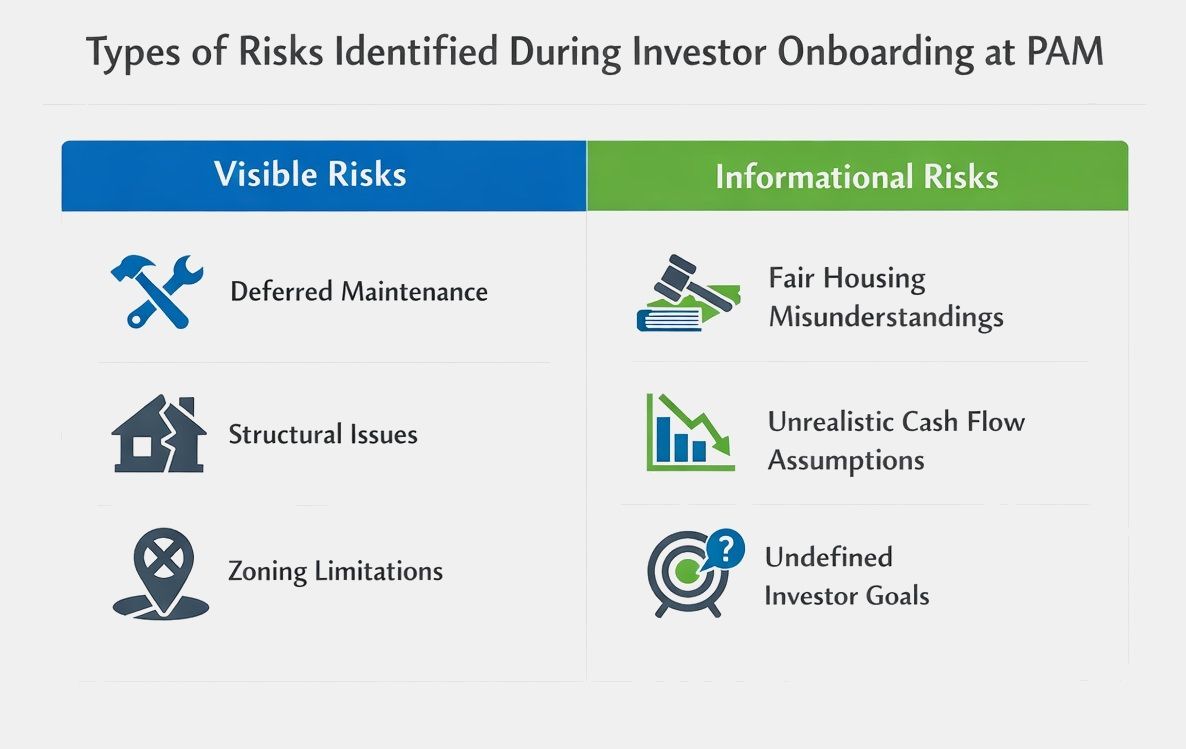
Some of the risks that PAM identifies are tied directly to the property itself, while others stem from misaligned expectations and regulatory misunderstandings. Property-level risks that can impact future performance include:
Failing roofs
Foundation concerns
Aging mechanical systems
Deferred maintenance that must be addressed
Location constraints that limit rent growth
Zoning restrictions
While these issues are real, they’re also highly visible. The other risks that PAM typically encounters are informational, which relate to knowledge about industry matters. While not as obvious, these risks are just as important.
The goal is to identify these issues early—before they lead to legal or financial problems and protect investors from these potential blind spots. Common informational problems include:
Regulatory misunderstandings
A common example of regulations affecting investors is that federal fair housing laws prohibit denying occupancy based on the presence of properly documented emotional support animals. Other regulatory issues include requiring all applicants to have perfect credit or blanket bans on housing vouchers. All of those misunderstandings can expose an investor to draining legal risks.
Unrealistic expectations around cash flow
Most alignment issues arise when there’s a disconnect between long-term objectives and short-term cash flow assumptions. If those two things aren’t clearly understood and aligned, performance expectations can drift quickly.
Lack of clarity around investor goals
Investor goals need to be defined during onboarding, as decisions can be made without the same standards for success in place. For instance, clarifying that the goal is long-term appreciation rather than simply expecting a monthly cash flow aids both parties in understanding performance frameworks.
How to Tell If a Property Manager Is the Right Fit During Onboarding
Onboarding lets investors and property managers resolve issues upfront. Signs of alignment—or friction—throughout those early interactions are key.
Below are recognizable signals that indicate strong alignment during onboarding:
Investor goals are explicit and measurable: performance benchmarks are established beyond monthly income, with acceptable variations to support long-term objectives.
Performance is discussed in long terms: extending beyond short-term ROI to include long-term modeling, turnover, retention, and planned maintenance instead of reactive fixes, fostering an understanding of compounding performance.
Communication expectations are defined: clarity is provided in terms of which information requires action from the investor, and the proper channels to use for emergency and non-emergency issues are identified.
Inspection findings are discussed: inspection results are collaboratively reviewed, used for planning instead of assigning blame, and executed for the long-term strategy.
Realistic cash flow expectations are set: incorrect assumptions are adjusted based on hard data, trade-offs that occur between income and stability are identified, and the monthly cash flow is viewed as only one metric that doesn’t distort long-term decisions.
Property managers are engaging: conversations spark thoughtful questions from investors, and answers are followed up by thorough explanations—the process is a planning stage rather than an administrative hurdle.
Technology is aligned: expectations are met for investors from different backgrounds or comfort levels with systems, portals, and communication tools, which avoids friction.
Property management exists at the intersection of the investor-resident relationship, requiring a shared understanding. Income goals, maintenance planning, and communication expectations must be understood collectively. Goal achievement isn’t accidental—it’s the result of planning.
What Data Matters Most at the Beginning of Onboarding?
In the same way that inspections provide information about the foundation of a home, hard data and financial reports highlight parts of a long-term plan that may need attention. Our onboarding conversations are grounded in math, instead of assumptions, to build accountability. Specific data-related areas covered during onboarding include:
Investors are introduced to or become more familiar with a Comparative Market Analysis. This confirms that the price of the unit is the current market price, instead of vague assumptions based on a quick Zillow search of properties in the area. Reviewing this data also elaborates on the sustainability of income decisions.
Regarding expenses, inspection data, such as property condition reports, help identify immediate and future maintenance needs. Expenses can be thoughtfully planned and proactively addressed, reducing budgeting issues and protecting long-term value.
To help tie these elements together, IRR analysis evaluates how income, expenses, turnover, and reinvestment decisions interact over time. Unlike short-term ROI calculations, IRR analysis offers context for short-term fluctuations and helps investors influence long-term outcomes.
Run the NumbersAdditionally, our communication data clearly documents where to find information, what requires action, and what is shared for awareness. This clarity helps prevent confusion and keeps investors focused on decisions that impact performance.
How can PAM’s onboarding impact long-term property investments?
At PAM, the onboarding process addresses long-term performance issues by reporting hard data, clearly communicating, and defining how performance will be measured.
This approach helps investors understand what success looks like over time by focusing on key factors such as resident retention and stable asset performance. We utilize strategic meetings and tools to foster a relationship based on alignment, rather than relying solely on an administrative checklist.
If you’re evaluating a new property manager or considering a change, pay close attention to the onboarding process. The right partner will prioritize alignment, transparency, and long-term performance from day one. To learn more about PAM’s approach to investor onboarding and asset performance, explore our resources or start a conversation with our team.