What Happens When a Vendor's Marketing Doesn't Match Reality?
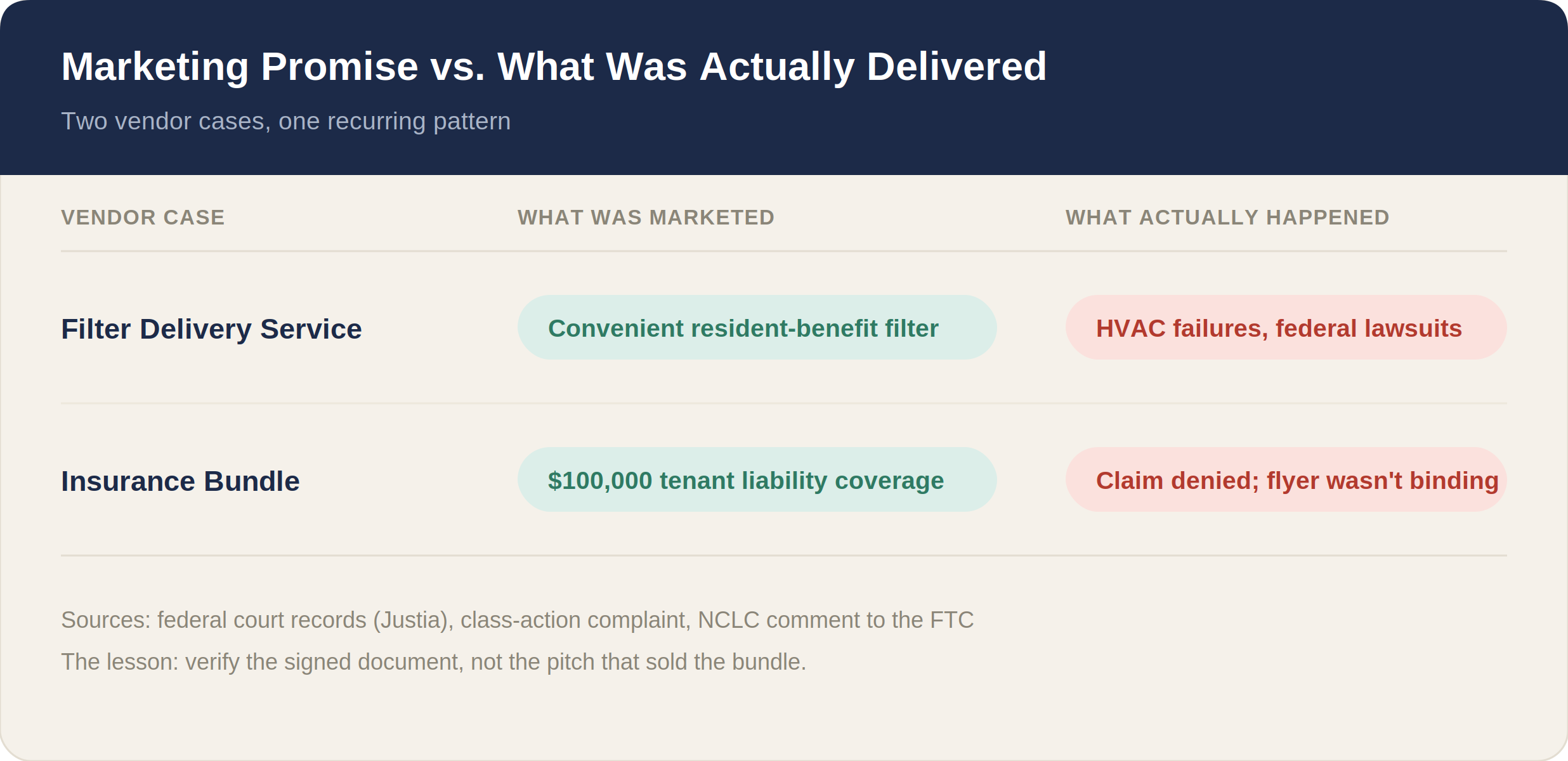
Property management companies can work with vendors who offer defective products or policies that differ from their marketing promises. Recently, a national filter delivery service was exposed for shipping defective products that caused HVAC systems to malfunction, with one contractor blaming it for a system overheating.
Jim Miller, founder of Performance Asset Management (PAM), held a competitor's benefit package filter in his hands and decided on the spot never to use one in a furnace for a property he managed. At the time, he wasn’t reacting to complaints from residents or national litigation. He drew his conclusion from the quality of the product he was holding.
It turns out that a thread on the property management platform Crane confirmed his instinct on vendors supplying faulty filters but with a different company: Second Nature. And the forum complaints were the smaller version of the story. Second Nature’s Resident Benefits Package, the same bundled filter program, is the subject of multiple federal class-action lawsuits.
Earlier this year, the National Consumer Law Center (NCLC) cited that same program by name in a formal comment to the Federal Trade Commission (FTC). Similarly, insurance add-ons, protection plans, and resident benefit packages can carry the same gap between marketing promises and what a signed contract delivers. Investors need to know the difference.
Why Did Second Nature's HVAC Filters Raise Flags for Property Managers?
Multiple property managers reported HVAC systems malfunctioning after using Second Nature's shipped filters, and the underlying Resident Benefits Package model is now facing multiple federal class-action lawsuits.
Complaints show that a vendor-supplied product marketed as a convenience can create both maintenance liability and legal exposure. In short, much of the litigation questions whether renters were obligated to pay fees, particularly for defective filters. Multiple property managers in an online industry forum reported HVAC systems failing after filter changes.
While the HVAC vendor for one property manager said a specific brand caused the refrigerant to overheat, another manager confirmed two HVAC systems malfunctioning after using the same filter delivery service. The high-MERV filters they used were marketed as a convenient resident benefit, making it an add-on. But the product restricts too much airflow for older furnaces to handle.
As a result, the property owners had to cover the unexpected HVAC repair bills. On a related note, renters filed multiple federal class-action lawsuits alleging the same bundled fee was mandatory when it should have been optional.
“Many landlords carefully design 'fee programs' to generate significant income at tenants' literal expense,” according to the NCLC in an April 2026 comment to the FTC. What started as a maintenance complaint turned into a documented legal and regulatory concern. And the entire story has an important takeaway for property owners: confirm whether filters come from a national delivery service or an in-house standard.
How Does This Same Gap Show up with Insurance and Protection Bundles Marketed to Property Managers?
A property manager recently discovered that a marketing flyer describing $100,000 in tenant liability coverage wasn't actually part of the signed policy.
The vice president of the insurance company that managed the policy admitted in writing that the flyer "does not constitute an offer of coverage." Because of that logic, an insurance company denied a tenant-caused fire claim, even though the flyer said tenant liability covered up to $100,000, including that type of damage.
The VP also stated that the coverage document was a “flyer” that had only been used for less than a month. Another property manager discovered that the insurance company had a live application featuring outdated policy details.
Although this case is documented through only one property manager's account and lacks broader litigation, the lesson remains the same: verify the actual contract. Avoid relying on the insurance policy bundled and sold under a branded name, such as protection plus, resident benefits package, or landlord protection plan.
How Can Property Investors Tell the Difference Between Marketing and Actual Contract Terms?
The signed application, quote, or policy document is the only enforceable record. Investors should request the underlying document and compare it line by line against whatever marketing led them to the vendor.
The lesson is similar in both cases: a marketing flyer that describes $100,000 in coverage and a filter marketed as a resident convenience both failed the same test.
Property investors must independently determine if a property management fee is mandatory or optional. Additionally, it is important to check whether the coverage limit mentioned in a flyer matches the text in the signed policy. Investors also have to make sure an effective date has actually been updated since the product changed hands.
Vendors who fail to produce an underlying document are a red flag. With the filter, Jim instinctively decided not to trust the product. The same principle applies: judge the product in your hands instead of placing faith in a sales pitch.
What Questions Should Investors Ask Before a Vendor’s Product or Service is Allowed on Their Property?
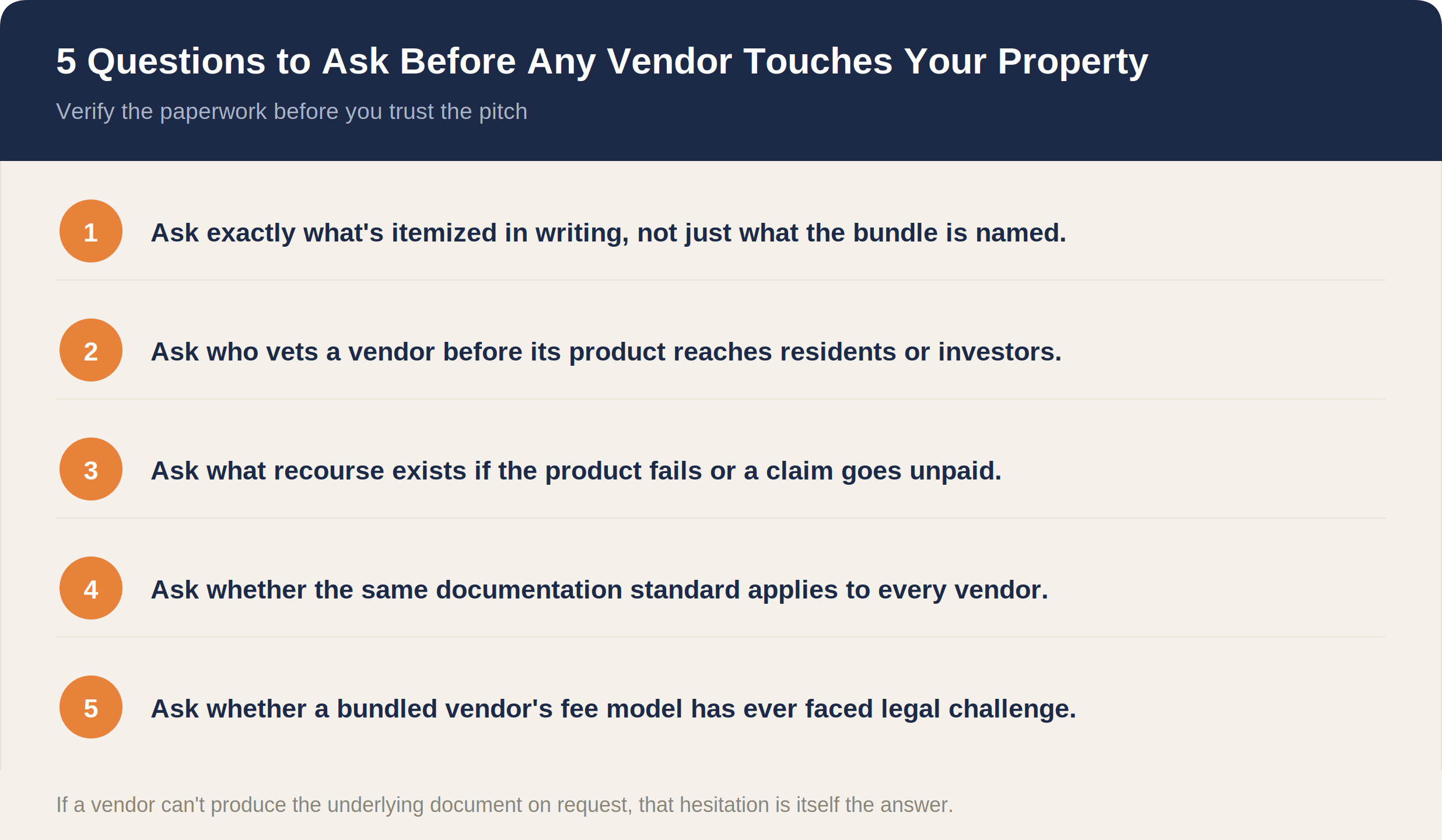
Investors should ask what's itemized in writing, who vets the vendor, and what happens if the product fails, which is the same standard PAM applies to trade contractors.
The Second Nature filters and one insurance flyer both promised more than what their contracts actually delivered. Despite subtle differences, the takeaway is that the paperwork trumps the pitch. Turn that lesson into questions before signing a contract.
Unverified vendor products expose investors to serious risks in terms of unexpected repair bills, denied insurance claims, and disputes over fees that were never truly optional. Because investors rarely interact with vendors and depend on vetting, asking the right questions can prevent a five-figure surprise:
Ask exactly what is itemized in writing, not simply what the bundle is named.
Ask who vets a vendor before its product reaches residents or investors directly.
Ask what recourse exists if the product fails or a claim goes unpaid.
Ask whether the same documentation standard applies to every vendor.
Ask whether a bundled vendor's fee model has ever faced legal or regulatory challenge.
A property manager's standard for trade contractors is a useful benchmark to compare against. PAM's own vendor standard is verified licensing, no markups, transparent pricing. Investors evaluating their current manager can speak with a PAM agent to confirm if that same standard applies.
Speak With a PAM Agent