What Are Rent Concessions and Deposit Alternatives, and How Common Are They in Wisconsin Leasing?
A rent concession typically lowers or waives part of a resident's move-in cost, and a deposit-alternative product replaces a cash security deposit with a small monthly fee. Both have become more common across southeastern Wisconsin leases, as competition for residents grows.
They are marketed as ways to lower the barrier to move-in, reduce vacancy risk, and expedite move-ins. But they work without crunching the numbers behind affordability math, which for property managers starts with reviewing the monthly budgets of potential residents.
For example, one southeastern Wisconsin applicant would have had a $150 utility bill, a $100 phone bill, $250 a week for food, no car payment, and no health expenses. After paying rent, that person would have $150 left over for clothes, vacations, savings, and unplanned events.
“That’s what not affordable looks like,” said Jim Miller, the owner of Performance Asset Management (PAM). “The question isn't are they going to default. The question is what month are they going to default in.” A property investor experiences that default as a vacancy, legal action, or $4,500 to $7,500 in costs that could have been prevented by higher standards.
At PAM, the resident placement rate is 97.2%, which means that selected residents stay for nearly one year. PAM’s placement data also shows what happens when that math gets skipped or glossed over: placements built around rent concessions and deposit alternatives failed at two or three times the rate of standard-deposit placements. This is why that failure rate exists. Learn what it costs southeastern Wisconsin property investors when it isn’t priced upfront.
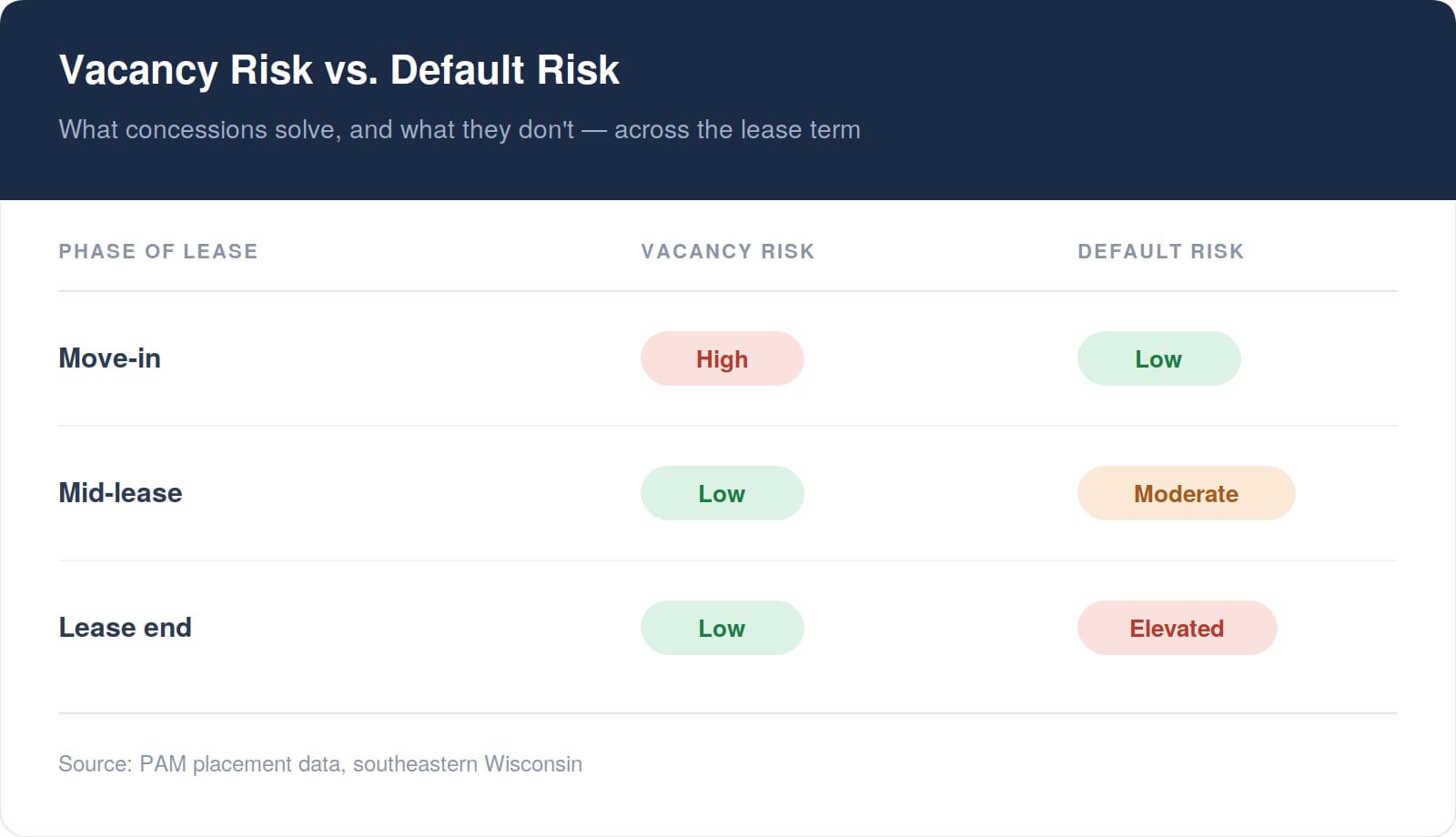
Why Do Concession-Based Placements Fail at 2-3x the Rate of Standard Deposits?
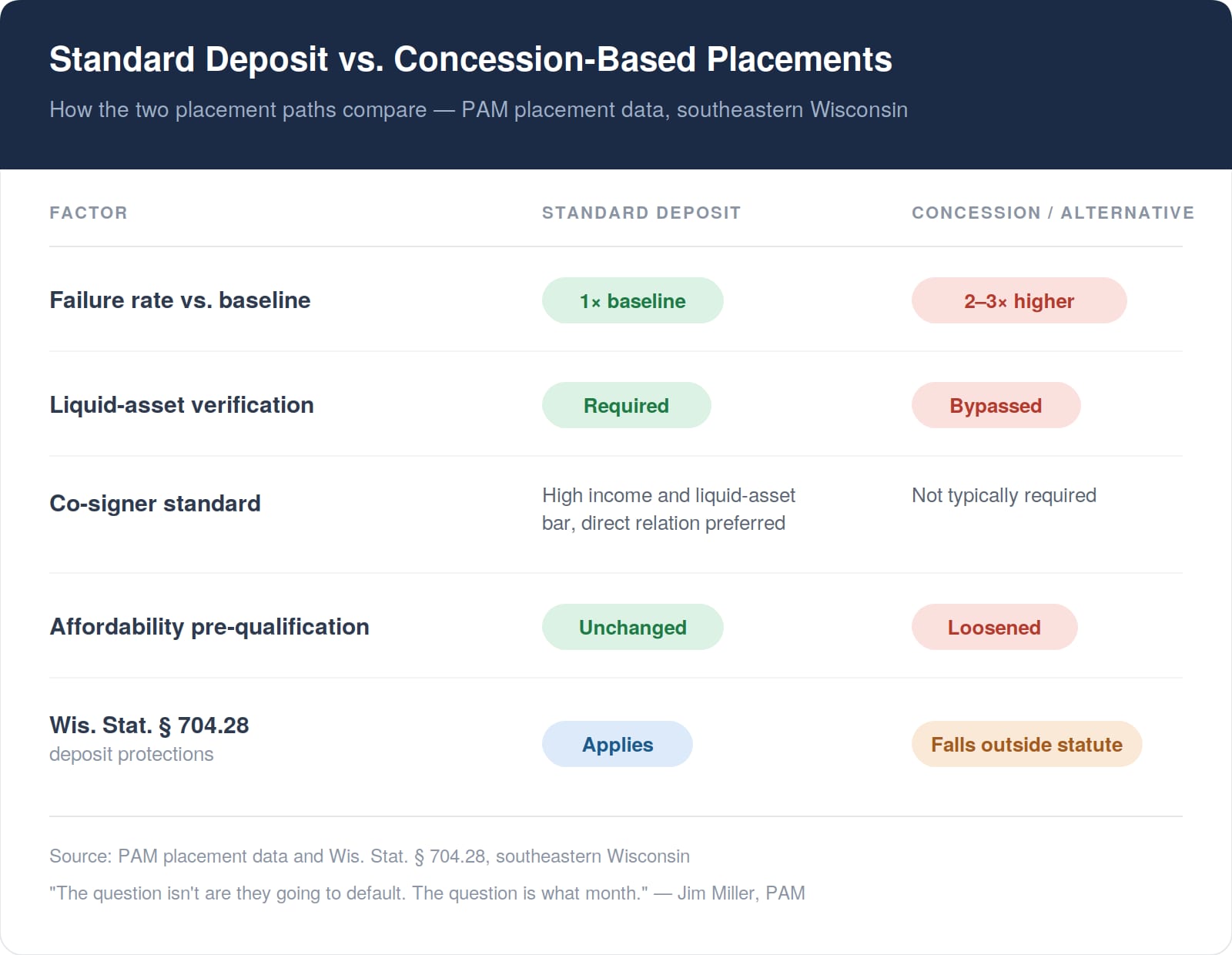
According to PAM's placement data, placements involving these structures failed at approximately two to three times the rate of standard-deposit placements, primarily due to the removal of liquid-asset verification and other affordability safeguards.
A rent concession changes the terms that the manager uses to approve a resident, and a deposit alternative removes the upfront risk of losing a deposit if they default.
A rent concession and a deposit alternative both alter the incentive to sustain payments. These two failure mechanisms work differently than an ordinary weak screening process. A standard security deposit requires proof of liquid assets. Concessions and deposit alternatives eliminate a requirement that helps reveal whether a resident could absorb rent increases.
Affordability is a major driver of rent-payment failure. Renters earning less than $25,000 a year were more than six times as likely to fall behind on rent in 2025 as renters earning $100,000 or more, according to the Federal Reserve's 2025 Report on the Economic Well-Being of U.S. Households.
That same income-driven pattern shows up in PAM's own placement data across southeastern Wisconsin. For PAM, security deposits are one of the clearest predictors of payment performance, and a resident who cannot cover the rent is more likely to stop payments. PAM identified this relationship by comparing placement outcomes across its own data. And the failure is more predictable when underlying safeguards are removed.
PAM measures this pattern without making assumptions, and the multiplier holds regardless of how a rent concession or deposit alternative is marketed to southeastern Wisconsin investors. Lower move-in costs can quietly yet substantially increase the risk of residents defaulting on rent. Understanding the reasoning behind this failure is just as important as the data itself.
What Does PAM's Placement Data Show That a Red Flag Alone Doesn't?
PAM requires third-party bank statement verification, confirms document authenticity and ownership, and holds co-signers to a higher income and asset standard than primary applicants, which concession and deposit-alternative products typically bypass.
This red flag indicates to property investors that concessions and deposit alternatives involve risk, but it stops there. PAM's own verification process uses third-party verification across all southeastern Wisconsin applicants as a data layer beneath the red flag.
PAM requires potential residents to submit bank statements that confirm they own the account, while verifying authenticity and affordability at once. This part of the verification process only takes an hour once an application is submitted. But concession and deposit-alternative options skip this step entirely, missing out on potentially valuable verification information.
Some potential residents do use a co-signer to provide another data-driven layer. But, as Jim puts it, “the co-signer has to be off the charts from an income standpoint and a liquid asset standpoint, and hopefully of some kind of direct relation to the resident.” This standard does these key things at once:
- Protects the affordability standard without dismissing the math behind it
- Ensures that the approval process is still based on verified numbers
- Reduces the odds that a co-signer walks away, since there is a direct relationship
For more information on the complete criteria for PAM’s resident screening process, including the underlying liquid-asset formula, review the following article: The PAM Resident Screening Checklist: A 99.5% Eviction Avoidance Rate.
What Questions Should Investors Ask Beyond "Do You Use Rent Concessions?"
Investors comparing property managers should first ask if a manager uses concessions. Then, they should learn more about who profits from the fees and who absorbs the cost of a failed placement.
More specifically, property investors in Milwaukee, Waukesha, Racine, Kenosha, Ozaukee, and Washington should ask:
- What is the completion rate of concession-based and deposit-alternative placements?
- Does the product change the affordability pre-qualification standard?
- Can you provide verified performance data, such as failure rate data?
- How do liquid assets get verified once a fee replaces a deposit?
- Is fee revenue tied to the actual performance of a placement?
Wisconsin's security deposit statute, Wis. Stat. § 704.28, requires landlords to follow specific rules for handling and accounting for a cash deposit. A deposit-alternative product operates outside that statutory framework entirely, which is one more reason to ask how it's verified.
These five questions will build on one another to turn one red flag into a more complete network for screening. The same logic applies to how insurers price risk, according to Columbia Business School research, which found that private insurers restrict coverage to middle-income renters, as insuring them without screening them first would be unprofitable due to risks.
This means that a property manager offering a concession or deposit-alternative product without separate performance data is taking on risk that insurers most likely wouldn't accept.
How Does Skipping Concessions Protect Investor NOI in Southeastern Wisconsin?
PAM avoids the failure mode described here simply by not offering concessions or deposit-alternative products, both of which are likely to work against investor NOI.
Avoiding a 2-3x failure multiplier on even one placement has a better chance of protecting investor interest than the promise to quickly fill vacancies. By requiring liquid assets equal to the annualized rent spread, that standard never gets replaced at PAM. When reviewing rental applications, PAM proves affordability the same way without exceptions.
This approach explains the PAM placement rate of 97.2% and the lease renewal rate of 88.76%. These two figures indicate the PAM process is effective for investors, who understand that rent concessions and deposit alternatives are attempts to sidestep an effective resident placement program that relies on proven processes and third-party verification services.
Southeastern Wisconsin investors choosing between property management companies should confirm that managers avoid rent concessions and deposit alternatives. Then ask questions to ensure the manager is assessing risks that could negatively impact long-term investor NOI.
To better understand why cheaper move-in costs fail to align with investor success, schedule time to speak with PAM and learn more about the verified data behind every red flag.