Why Does Managing a Wisconsin Rental from Out of State Require a Different Approach?
Imagine a San Francisco investor realizing $1.2 million or slightly more for a duplex buys three or four solid rentals in Milwaukee. The math isn’t a secret, and it hasn't been. Investors in areas like California, New York, and Massachusetts are increasingly buying property in lower-cost markets like Wisconsin, because the cash-flow math works better here than at home.
This isn't just a Wisconsin issue. According to Buildium's 2026 survey of small-portfolio rental owners, 55% don't live near the properties they own. Out-of-state ownership is becoming more of the norm across the industry. Working with out-of-state investors for the past 17 years has taught us at Performance Asset Management (PAM) one thing: the logic is straightforward, but questions arise after closing.
Owning a Wisconsin rental 2,000 miles away is different than owning one down the street. The difference shows up quickly. Owners need to know who answers when a furnace fails during a 20-below weekend in January. Small issues demand attention before they cost five figures.
Defaulting to comparing property managers by features and pricing may seem like the logical next step. But the smarter starting point is a self-assessment. Assessing goals, evaluating DIY experience, and verifying managers reveal whether self-managing or hiring makes sense. Getting this right prevents costly, hard-to-reverse decisions down the road.
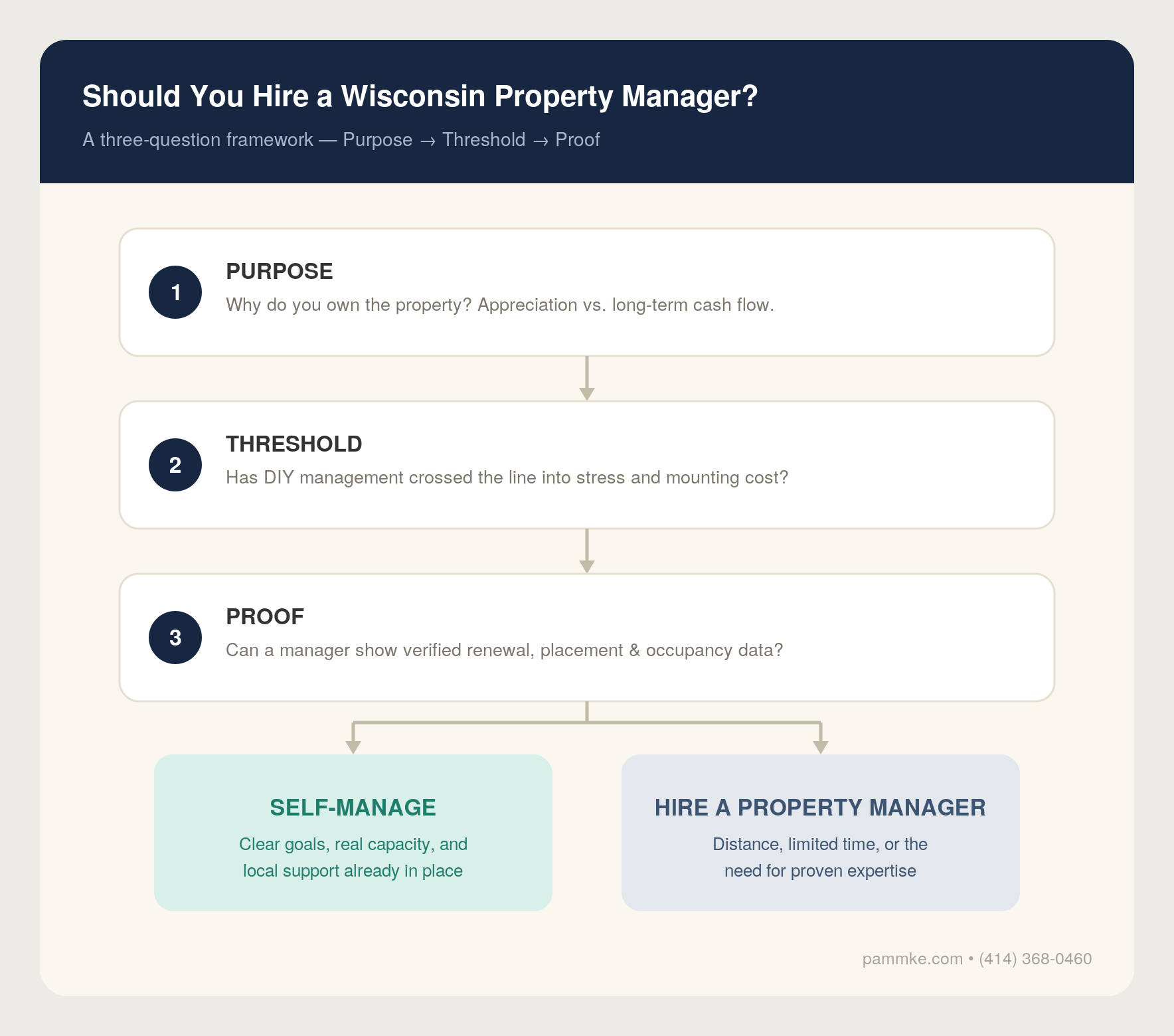
Why Do You Own the Property, and Does That Support Out-of-State Management?
The goals of each investor, whether for appreciation, long-term cash flow, or 1031 exchange placement, determine the level of oversight the property requires.
Clarifying the goal first prevents mismatched expectations about management involvement later. Owners seeking short-term appreciation have different needs than those building long-term rental income. Short-term investors typically require less oversight than long-term rental income. Oftentimes, short-term investors focus primarily on:
Buying below market value
Renovating to increase resale value
Entering neighborhoods with strong appreciation potential
Timing the market
Alternatively, long-term rental investors seek dependable, long-term cash flow. This demands consistent, ongoing attention, and an approach typically geared toward:
Positive monthly cash flow
Stable occupancy and lease renewals
Minimizing vacancy loss
Controlling operating expenses
Maintaining the property to preserve tenant satisfaction and long-term value
Some property owners acquire land through inheritance, while others make intentional decisions. A significant number of people left Southeastern Wisconsin to relocate for work and decided not to sell their home. However, 1031 exchange investors, named after Section 1031 of the U.S. Internal Revenue Code, defer capital gains taxes by reinvesting into another qualifying property.
How Do DIY Investors Cross the Threshold from Out of State?
The DIY threshold typically arrives once managing the property starts consuming more time and stress than it's worth, a line that comes faster from 1,500 or more miles away.
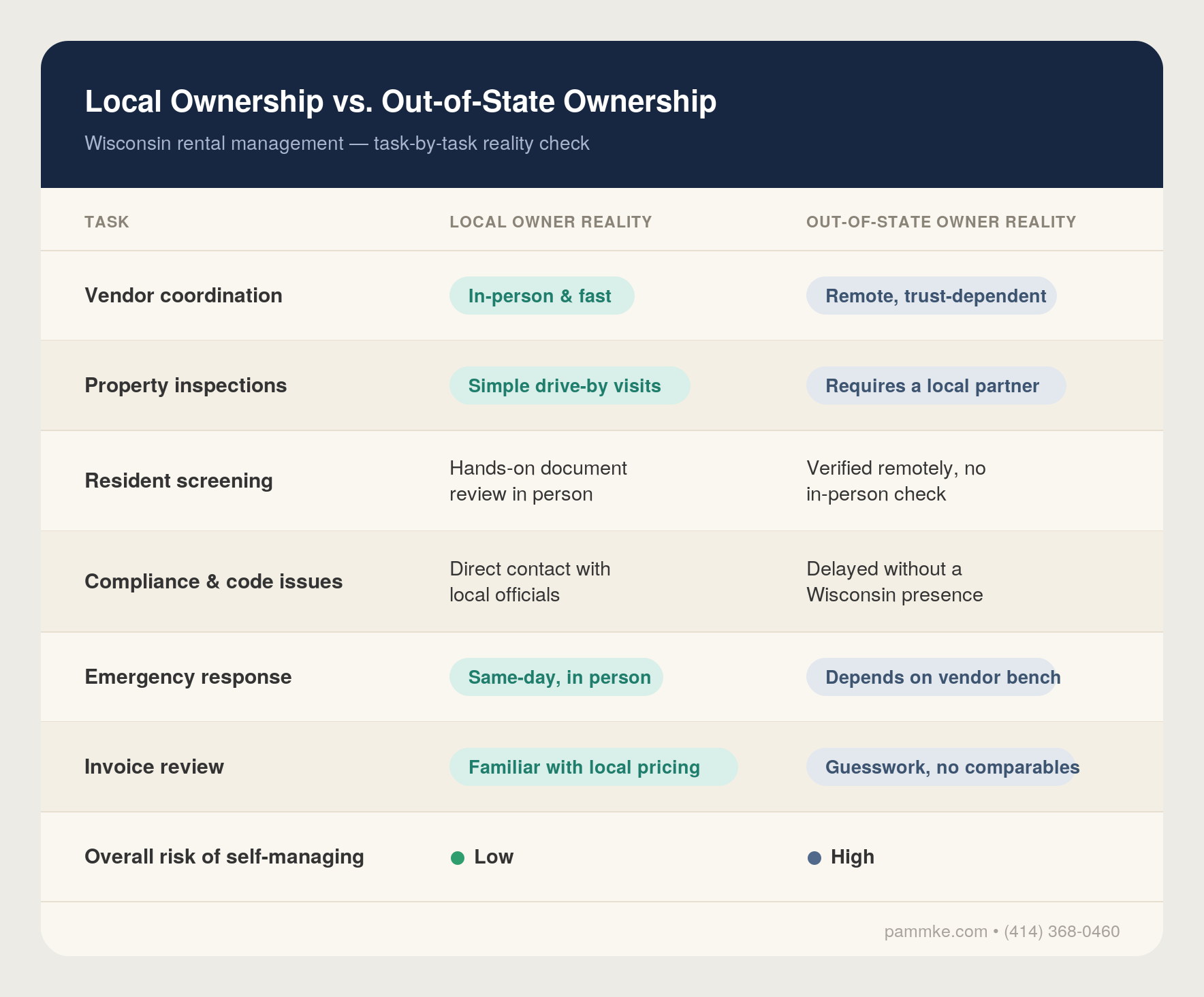
Out-of-state owners often transition from DIY investors to requiring a property manager, often without realizing it, because every small issue requires a phone call rather than a quick visit. A five-minute local fix becomes a coordinated, multi-call remote ordeal. For example:
Vendor scheduling requires someone physically available to supervise the work.
Invoice review becomes guesswork without a local frame of reference nearby.
Dispute resolution with a resident is harder to manage from afar.
Every winter in southeastern Wisconsin, pipes burst. One year, after eight days of below 20 degrees, five rentals had pipes burst in a matter of three hours. Even for a local owner, that’s a bad afternoon. For a DIY owner working out of state with no vendor bench already in place, five simultaneous emergencies with no one to call quickly turns “I've got this” into “I need help.”
Stress and mounting costs are usually early warning signs that out-of-state investors recognize. Waiting too long to recognize the threshold can compound financial and emotional costs, while recognizing it early prevents expensive mistakes made from a distance.
That same warning-sign pattern shows up even among owners who've already hired help. Lack of transparency is cited as one of the top three reasons rental owners switch property managers: 34%, behind poor communication (57%) and declines in service quality (54%), according to Buildium's 2026 survey of small-portfolio rental owners.
Who Has the Performance Math to Prove They Can Manage Your Property?
Investors should ask for verified renewal rates, placement success numbers, and occupancy data before hiring anyone, especially from out of state, where a bad hire is harder to catch early.
A manager without those metrics could be avoiding tracking these numbers, which is a red flag. This could be pointing to an undisciplined management process. Owning a property remotely requires visibility into the condition of the property without flying into southeastern Wisconsin. Specific questions that out-of-state investors can ask include:
Ask every candidate for their verified lease renewal rate upfront directly.
Ask for their resident placement success rate over the past year.
Ask for occupancy data across their entire managed property portfolio too.
An investor meeting with PAM who asked these questions would walk away knowing the lease renewal rate is 88.76%, resident placement success is 97.2%, and the occupancy rate is 98%. Review the PAM scorecard for investors guide for a high-level overview of these numbers.
Aside from numerical information, ask how they handle things when issues go wrong. Accountability is essential when problems happen. Out-of-state investors can greatly benefit from local expertise regarding Wisconsin's market dynamics and area knowledge.
Out-of-state property owners cannot easily monitor the performance of their investments like local investors can, and distance removes the ability to quickly self-correct. However, verified data can eliminate guesswork by providing a comparable performance track record. Real math separates a proven process from a convincing sales pitch.
How Should Out-of-State Investors Use This Framework Before Choosing a Wisconsin Property Manager?
Turn a convenience-driven decision into a structured one with these three questions: purpose, threshold, and proof. This especially matters for owners who can't easily reverse a bad hire from a distance.
Investors who can answer the three questions can evaluate their property manager with confidence. Part of the reason these questions work is that the results are repeatable and applicable to different property owners.
Because the stakes are high when it comes to out-of-state property investments, a small misalignment one month can lead to a financial problem by month six. Applying this framework is a necessary first step while searching for a specific management company. And taking this course of action is better than evaluating after signing a contract with a property manager.
Uncertain investors often compare pricing pages and features lists without understanding their reasons for owning the property, whether they have crossed the DIY threshold, or what proof a manager can actually provide. Out-of-state investors who can answer all of these questions are better prepared to find the right property manager.
For investors who've worked through purpose, threshold, and proof and are ready to act, find out more about the out-of-state tools available at PAM. Access the resources available specifically for this kind of decision. See what the numbers actually look like under real management. Schedule a call with PAM Founder Jim Miller.
Meet With Jim