Should Milwaukee-Area Property Investors Raise Rent at 2027 Lease Renewals?
Wisconsin property investors who can hold steady should pause renewal increases or keep a rent increase between $25 and $50 per month in 2027, said Performance Asset Management (PAM) Founder Jim Miller. Affordability is the top concern among PAM’s southeastern Wisconsin residents.
“There aren’t many humans on earth as bullish about higher rent prices than me,” said Jim. But for the first time since the financial crash, Jim is recommending a measured approach to renewal pricing for property investors through counties where PAM’s portfolio stretches: Milwaukee, Waukesha, Racine, Kenosha, Washington, and Ozaukee.
Keeping rent prices the same or close at any rental level lets investors show they care. Many residents know insurance, property taxes, and water costs have risen. Pushing them too hard could cost good residents, and replacing one runs about $5,000 in Wisconsin, said Jim. For an investor netting $200 a month, one turnover wipes out about 25 months of cash flow.
PAM works to keep current residents while staying aligned with investor Net Operating Income (NOI). Investors with higher income needs can raise rent. But they should implement a detailed retention plan early, such as PAM’s renewal conversation 120 days before the lease ends. Read more for Harvard’s affordability data, PAM’s 2026 renewal pushback on price, and a break-even table that shows how long it takes to repay a turnover after losing a resident to a rent increase.
This guidance reflects Jim Miller’s view of PAM’s 2026 resident and market data, and results vary with each property, lease, and investor goal. PAM has served southeastern Wisconsin investors and residents for 17 years. This information is general and does not constitute financial, legal, or investment advice.
Why Is Rent Affordability Putting Pressure on Wisconsin Lease Renewals?
Affordability is pressuring Wisconsin lease renewals because many residents are stretched, and some can’t absorb an increase. Harvard’s Joint Center for Housing Studies reports a record 22.7 million renter households, or 49%, were cost-burdened in 2024, meaning they spent more than 30% of income on rent and utilities.
Harvard also reports that growing cost burdens are impacting renters earning $45,000 to $75,000. And the Census Bureau’s 2024 American Community Survey shows the same strain locally: about 49% or roughly 91,000 of Milwaukee County renter households were cost-burdened. Three major signals at PAM are in line with that picture.
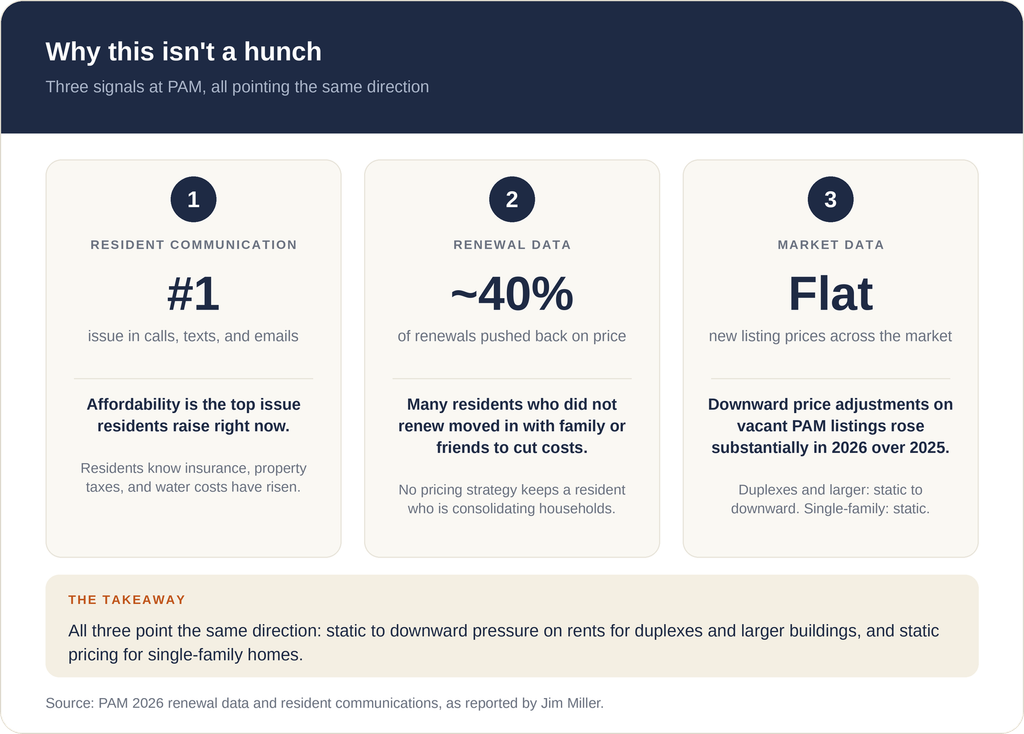
The first signal is the responses residents leave in their calls, texts, and emails. When a resident decides not to renew, a PAM specialist reaches out to ask why. Jim said residents have told PAM, “If you raise the rent, I can’t afford it. I have to move.” He added, “House payments are expensive. I don’t know what isn’t expensive anymore.”
The second signal is PAM’s own 2026 renewal data across its six-county portfolio: nearly 40% of residents who have renewed in 2026 pushed back on pricing.
Many residents who didn’t renew moved in with family or friends to cut monthly costs. And no renewal pricing strategy can keep a resident who has to consolidate households to save money.
The third signal is listing prices, which are not rising across the market. When PAM repriced vacant units, downward adjustments rose substantially in 2026 over 2025. Together, the signals point to static to downward pressure on rents for duplexes and larger buildings in southeastern Wisconsin, and static pricing for single-family homes, said Jim.
Should Milwaukee Investors Raise Rent at Renewal or Wait Until a Unit Is Vacant?
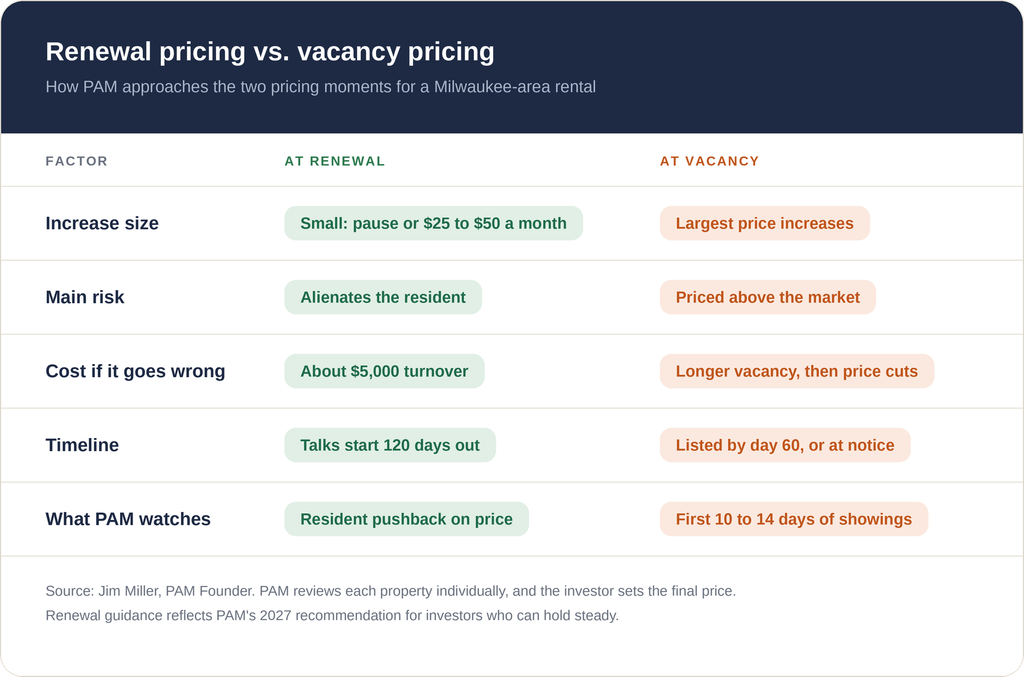
PAM keeps renewal increases small and takes its biggest price increases when a unit is already going vacant. A large increase on an occupied unit can alienate the resident and trigger an expensive rent-ready turnover.
For Jim, an available unit without a resident is an opportunity for investors to “reset the market.” Successfully implementing that strategy means accurately pricing the unit against comparable listings. Although a comparative market analysis reflects market conditions the day it's performed, the price of the same property could be $100 higher or lower just three weeks later.
When PAM pushed that approach, “oftentimes that failed” and the unit didn’t get rented at that price. Simply put, aggressive vacancy prices often failed to rent. Demand is the main force that sets rents. When it decreases, prices tend to drop and vice versa. That said, leases expiring between March 1 and July 31 fall in the window with the highest level of demand in southeastern Wisconsin, according to Jim.
In 2026, PAM cut asking rents on vacant units more often than in 2025. For investors, this suggests that asking rents are facing resistance, even at vacancy levels, so significant increases on occupied units are riskier. Read Declining Rent Trends Across America for more details on why southeastern Wisconsin stayed more stable than other parts of the country.
Is a Rent Increase Worth the Cost of a Turnover for Milwaukee-Area Investors?
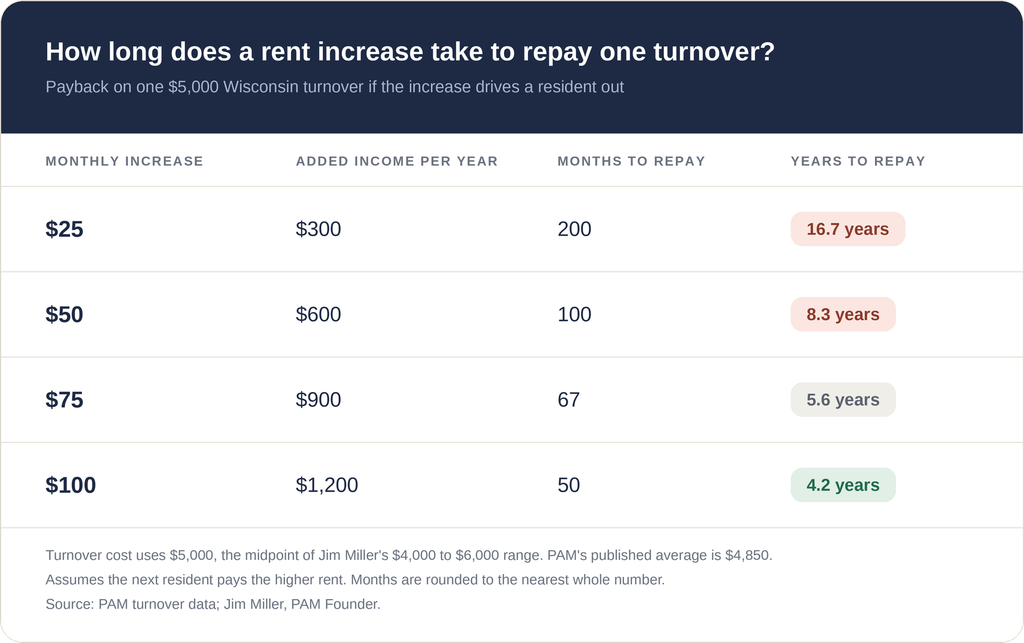
A rent increase rarely pays off if it drives a resident out. A $50 monthly increase takes about 100 months to repay one $5,000 Wisconsin turnover, and a $75 increase takes nearly six years.
The cost of one turnover in southeastern Wisconsin includes one month's vacancy, a placement fee, and rent-ready construction costs. Rent-ready work alone averages $2,000 to $3,000. But turnover can demand more, as an investor can be responsible for utilities, lawn care, and snow removal. That total is between $4,000 and $6,000, making $5,000 a mid-estimate.
Imagine an investor weighing whether a $75 increase is worth a turnover risk. Jim says each investor decides the rental price of their property. If that investor raises the rent and a resident declines to renew over a rent increase, PAM calls to ask why. The resident might say they can’t afford a $50 increase but can pay an additional $25.
Remember the break-even math: a $25 increase repays a turnover in about 200 months, and losing the resident costs the whole $5,000. A conversation with the renewal specialist could lead this investor to agree on a smaller increase that keeps the resident, rather than insisting on a larger increase and risking their departure.
As of March 2026, about 70% of investors accept PAM’s recommended renewal price, said Jim. The other renewals need human follow-up, which is where PAM’s renewal specialists step in. By day 60, the PAM lease renewal process earns a signed renewal or a live listing. PAM has a lease renewal rate of 88.76%, compared with a national average near 54%.
What Should Investors Do Before Raising the Rent in 2027?
- If the property allows, hold steady and pause the increase. Or, keep the increase between $25 and $50 a month.
- Run the break-even math before settling on an increase, as a $50 increase takes about 100 months to repay one turnover.
- Start the renewal conversation 120 days before the lease ends.
- Take the biggest price increases at vacancy, priced against comparable listings.
- If a resident pushes back, find out why before the unit gets listed.
Each year, Jim reviews renewals property by property and recommends a price for each. Schedule a meeting with Jim to review 2027 renewal pricing data for a specific unit.