What Is a Back-to-Back Rental Strategy and Why Does It Help Investor NOI?
Roughly a decade ago, property managers spent most of their time on collections. Digital payments didn’t exist, so companies had to send staffers door to door asking: “Where’s the rent?” That slow-moving era created a culture where vacancies were accepted because it was necessary. But that’s not the case today, and successful investors reject that mindset.
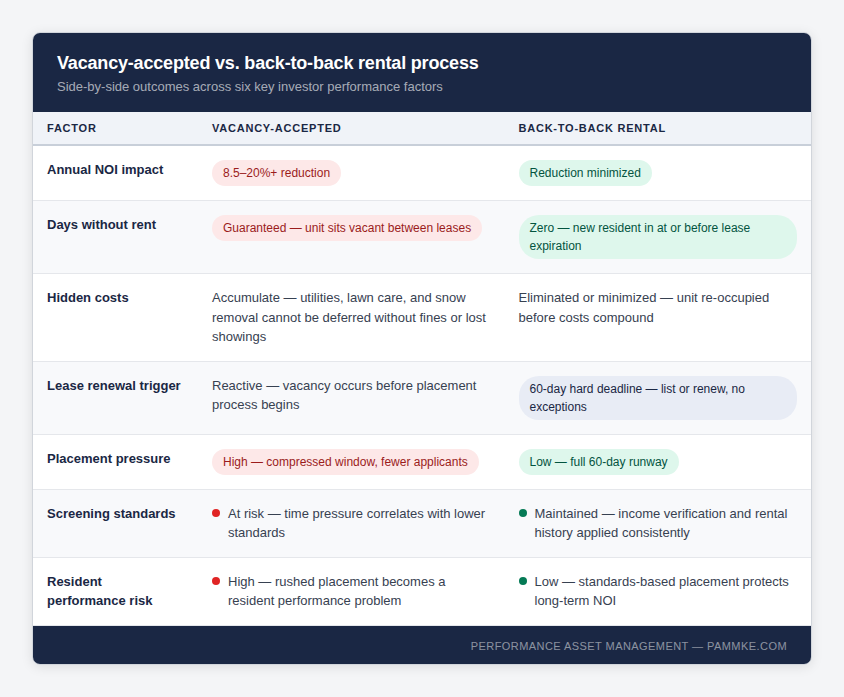
At Performance Asset Management (PAM), our data has shown that renting back-to-back is the most reliable structural tool for protecting annual Net Operating Income (NOI). According to roughly two decades’ worth of portfolio data, defaulting to vacancy guarantees a minimum 8.5% annual NOI reduction per vacancy.
The math helps illustrate why. A property renting for $1,500 per month generates $18,000 annually. Losing just one month of rent eliminates $1,500 in rental income before accounting for utilities, lawn care, snow removal, marketing expenses, and other costs that continue during vacancy. Those additional expenses are why the NOI impact of vacancy extends beyond the lost rent itself.
Actual losses can frequently run much higher than that minimum floor. And that means investors benefit from recognizing that a back-to-back rental strategy is an available operating choice, because it eliminates vacancy gaps as a routine cost of doing business. Keep reading to learn how to run a full resident placement process that attracts quality tenants and protects NOI.
How Does a Month-to-Month Lease Increase Vacancy Risk?
Month-to-month leases allow tenants to give notice as late as the first day of the month they're vacating, leaving landlords with as little as 31 days to place a qualified resident.
Affordability pressures are driving renters to relocate to lower-cost markets in the Southeast and Southwest, according to Newsweek. This reduces renter movement in Midwestern markets, including southeastern Wisconsin. And fewer tenants, because of affordability pressures, increase the risk of vacancies for Wisconsin investors.
Residential mobility has fallen to record lows as affordability challenges and economic uncertainty discourage household formation and interstate moves, according to the Harvard Joint Center for Housing Studies. This isn't about fewer renters existing in the market. It's about fewer renters actively looking to move at any given time, which is the pool landlords draw from.
This compressed placement window forces landlords to make decisions with fewer applicants. Decisions under pressure correlate with lower resident placement standards. Lower standards don't eliminate the risk. Instead, it gets repackaged as a resident performance problem.
This just means rushing to place a resident and accepting vacancies are versions of the same problem. To understand the tradeoffs of month-to-month leases, read our breakdown of pros and cons.
What Is the 60-Day Lease Renewal Rule and How Does It Protect Your Rental Income?
The 60-day rule requires that a property be either renewed or actively listed for rent no later than 60 days before a 12-month lease expires. This window gives investors enough time to run a full, standards-based resident placement process without sacrificing NOI.
Sixty days gives investors or a property management company the minimum amount of time to find a qualified tenant. That 60-day period offers enough time to cover advertising, showings, applications, screenings, and lease expiration. This hard deadline works for both DIY investors and managers, so it should be included in the lease language.
Investors working with property managers should confirm that their company has included this caveat in writing. The managers willing to offer financial recompense if day 60 passes without finding a tenant are showing strong operational signals.
To see how PAM applies this process across its southeastern Wisconsin portfolio, read how we handle vacancy. The combination of a strong renewal process and a strong placement process produces consistent NOI.
Does Prioritizing Tenant Quality Conflict with Reducing Vacancy?
When the right processes are in place, tenant quality and leasing speed are not competing priorities. Property managers who claim otherwise are revealing a structural misalignment with investor goals.
Every resident placement impacts performance. And in rentals, it isn’t a choice between someone on the lease and a qualified tenant. Instead, the choice is whether or not the placement performance is positive or negative. Implementing screening criteria that use income verification and rental history takes about as much time as loose screening methods.
For example, speed-to-lead is one of the highest-leverage levers available for reducing time-to-application. And 24/7 scheduling tools encourage renters to choose convenient showing times. Using these methods removes fiction from the leasing processes without lowering resident standards.
Finding quality residents requires consistent operational processes based on proven strategies rather than imagined market realities. Some property managers may claim that quality tenants take longer to find. But that is an industry misnomer. Historically, the property management industry used the quality versus speed framing to excuse underperformance.
Investors who accept that framing absorb the cost of someone else's operational failure. The right structure makes tenant quality and leasing speed complementary. Demanding both as an investor means expecting a healthy balance of quality and speed that supports NOI.
How Should Rental Property Investors Evaluate a Property Manager's Vacancy Strategy?
Investors should ask any property manager two direct questions: Do you have a documented lease renewal process with a 60-day trigger? And can you walk me through your resident placement criteria?
Lease Renewals and Investor NOI
Renting a property is like running a business. Investors are the CEOs of every asset they own, and vetting a property manager is their responsibility.
The first question an investor should ask about vacancy performance is how the property manager handles lease renewals. Firms that cannot clearly explain their renewal strategy are often focused on filling vacancies rather than preventing them. Here are several items investors should ask for:
Ask for specific dates and triggers, and avoid vague assurances about staying on top of renewals.
Verify whether the manager guarantees listing by day 60 or provides a financial remedy if they miss it.
Review their resident placement criteria and how each standard connects to investor NOI.
Income verification at three times the monthly rent is a widely accepted baseline, and confirm that they use it
Verifiable rental history is also important: past payment behavior predicts future payment behavior.
Avoid any PM that frames tenant quality and occupancy speed as a tradeoff. That framing signals that their operational structure isn't built around investor outcomes. This information applies to DIY investors and those with managers, as the evaluation processes are the same.
What's the Real Cost of Defaulting to Vacancy?
Vacancy is the predictable result of two processes, either working or failing, and investors who understand that can eliminate the gap as a routine cost of doing business.
Investors who seek a back-to-back rental strategy instead of defaulting to vacancy are setting themselves up for long-term NOI benefits. Generating back-to-back rentals requires a lease renewal strategy with a 60-day trigger and standards based on resident placement.
Vacancies are costly, as the utilities, seasonal maintenance, compressed timelines, and placement pressure add up on top of each month without collecting rent payments. That 8.5% of annual NOI reduction is a low estimate, as actual losses compound.
DIY investors benefit from adding a 60-day deadline into their lease language, and for investors shopping for property managers, it’s important to build 60-day deadline questions into your conversations with companies. Also, ask potential managers to walk you through their placement criteria.
PAM has an 88.76% lease renewal rate in 2026 across its southeastern Wisconsin portfolio, and we use 24/7 self-serve showing tools in addition to math-based screening to help support investor NOI. If you want to see how our lease renewal process and placement criteria work in practice, schedule a free consultation, and we'll walk you through it.