What Do Wisconsin Landlords Get for a Property Management Fee?
Do decisions regarding your rental happen through a laid-out process? Or is everything more of a gut reaction? And are you confident that your property manager is protecting your investment?
Unfortunately, investors face surprise vacancies, last-minute rent-ready bills, and tenants moving out unexpectedly. But the question landlords always ask us is, “What exactly do I get for a monthly fee?”
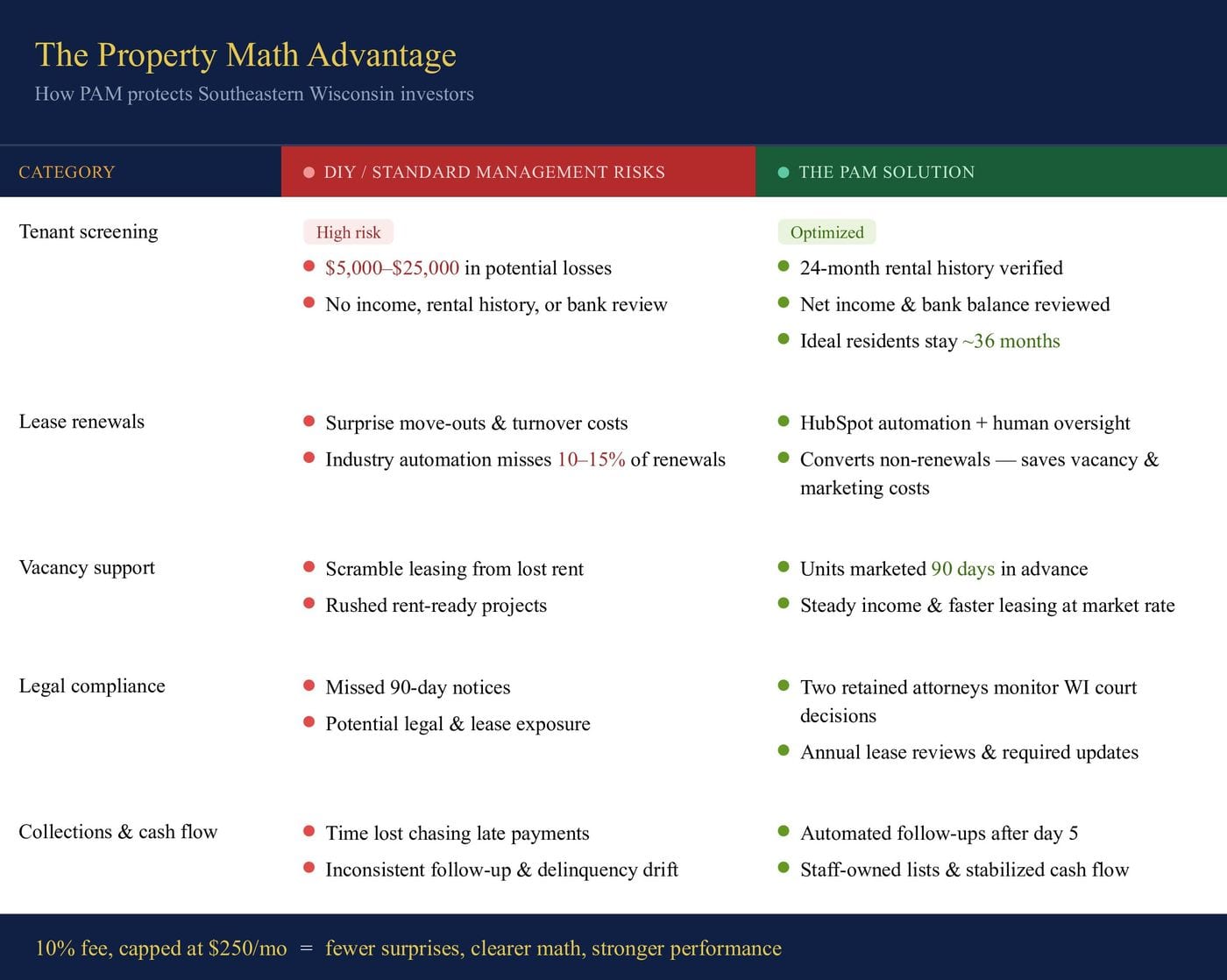
At Performance Asset Management (PAM), our costs buy performance, clarity, and fewer surprises. Our monthly management fees are 10% of the rent, with a maximum cap of $250. We only earn after successfully collecting rent. Additionally, the fee is waived if a property is vacant or non-paying. This model has been in place for almost two decades.
Property management value becomes evident when problems never become emergencies. This happens in large part because of predictable systems and reliable processes. If you’re considering working with a property management company, understand what you should be getting. Then, judge whether or not your manager is meeting your needs.
How Do Property Managers Screen Tenants in Wisconsin?
Professional property managers screen tenants using income checks, rental history, and fraud detection.
Resident placement is the foundation of property performance. Choosing quality residents can reduce turnover, vacancy, conflict, and financial instability. Ideal residents remain in a unit for about 36 months, pay on time, and contribute positively to the property and neighborhood. The right tenant is also a good neighbor. That quality alone can reduce conflict, driving performance.
Property managers who outperform go beyond typical resident placement standards. They treat screening and fit as long-term performance decisions. Poor resident placement can cost investors roughly $5,000 to $25,000 in losses, according to PAM data. Thorough placement decisions often include reviewing:
24-month rental payment history: Digitized time stamps verified by third-party services. This information can help investors assess whether a tenant is likely to pay rent on time.
Net income: Take-home pay offers a realistic view of financial health and rent affordability.
Bank account balance: Bank account balances provide insight into financial behavior. A healthy balance can indicate a tenant is more likely to pay
How Do Property Managers Reduce Vacancy and Improve Lease Renewals?
Property managers in Wisconsin help solve operational, financial, legal, and tenant-related problems. These issues directly impact rental income and long-term property performance.
Blending automated resources with intentional human oversight provides increased visibility. Managers with solid information in terms of lease renewals can reduce unwanted surprises. This works by protecting cash flow and creating a consistent income. It also reduces vacancy exposure and minimizes surprise move-outs.
For instance, at PAM, we went beyond industry-based automation systems that only work about 85–90% of the time. Most systems miss 10–15% of renewals, which leads to surprise vacancies. We built a system to eliminate that gap. That remaining 10–15% leads to late notices, surprise vacancies, and unnecessary rent-ready costs.
Late awareness leads to scrambled leasing, surprise vacancies, and rushed rent-ready projects. Instead, we adopted HubSpot to build a lease system. It combines automation and human oversight, which allows us to know:
Who has and hasn’t renewed
Who is moving out
Why are they moving out
When we need to market a property 90 days in advance of tenants leaving
What Results Should You Expect from a Property Manager?
Investors can expect improved cash flow stability, lower vacancy rates, stronger legal compliance, and clear performance reporting when working with a property manager.
A strong property manager improves income consistency. Investors get measurable value, beginning with clarity around expense exposure to financial risk.
For example, within 30 days, PAM runs two inspections to quantify risk. One inspection focuses on CapEx needs and long-term replacement planning. The other inspection targets income and expense drivers impacting monthly performance. When investors understand the math behind their property, they make stronger long-term decisions. Other measurable outcomes include:
Proactively managing lease renewals
Reducing late payments
Enforcing rent collection policies
Minimizing surprise vacancies
At times, residents may initially decline renewal. However, proactive communication and problem-solving can help. A property management team can convert multiple non-renewals into renewals. This avoids vacancy loss, rent-ready expenses, marketing costs, and leasing commissions. Those saved expenses directly improve cash flow.
In terms of staying compliant with Wisconsin landlord-tenant laws, at PAM, we retain two attorneys. Attorneys notify PAM about Wisconsin court decisions affecting lease language. Then, we adjust leases to avoid introducing new legal exposure for investors. Other benefits include:
Conducting annual lease reviews
Notifying us of court decisions impacting lease enforceability
Advising on required updates
What Questions Do Investors Commonly Ask PAM?
Q: How does PAM reduce vacancies?
A: Through thorough tenant screening, proactive lease renewals, and early marketing of properties. This happens 90 days before move-outs. The result is that PAM minimizes vacancy risk and unexpected turnover.
Q: What makes PAM’s tenant screening process different?
A: PAM checks 24 months of rent history, reviews net income, and examines bank accounts. The result is selecting qualified tenants who are likely to stay longer and pay on time.
Q: How does PAM handle late payments or delinquencies?
A: Automated follow-ups begin after the fifth day of non-payment. This is paired with human oversight to ensure collections are consistent. This reduces delinquency drift and stabilizes monthly cash flow.
Q: Does PAM help with legal compliance in Wisconsin?
A: Yes. PAM retains two attorneys who monitor Wisconsin court decisions. Specifically, they inform us when courts make decisions affecting leases. We get guidance on updates, ensuring investors remain compliant and stay protected.
Q: How transparent is the reporting?
A: Investors receive clear, detailed financial and operational reports. The data highlights income, expenses, CapEx needs, and performance metrics. Overall, it helps investors make informed decisions without guesswork.
Q: Can PAM help turn potential non-renewals into lease renewals?
A: Through proactive communication and problem-solving, PAM converts initial non-renewal decisions into renewals. This prevents vacancy loss and reduces rent-ready and marketing costs.
Q: How is PAM’s fee structured?
A: PAM charges 10% of rent, capped at $250 per month, only earning after rent is collected. Fees are waived for vacant or non-paying properties, aligning incentives with investor success.
Is a Property Management Fee Worth It for Milwaukee Landlords?
Professional property management is worth it when it replaces uncertainty with structured systems. Relevant examples include proactive renewals, transparent reporting, strategic inspections, and consistent collections.
Southeastern Wisconsin landlords are encouraged to question their property management fees. Start by finding out if it translates to fewer surprises, clearer math, and stronger long-term performance. Managers should protect rental income while reducing risks. Examples include resident placement, lease renewals, compliance oversight, and structured collections.
The reason why this matters is simple. Rental success in Milwaukee and throughout Wisconsin is about consistency. Just one missed renewal, poorly screened tenant, or a compliance mistake can eliminate months of hard work and profit.
For investors unsure if a property management company is worth the monthly fee, stop and ask questions. Find out how your renewals are tracked, how vacancies are prevented, and how legal exposure is reduced. Regardless of which company you choose, the right manager should be able to clearly explain its processes. And they should provide clear performance metrics that point to results.
While based in Milwaukee, PAM specializes in serving Southeast Wisconsin. We build our model around transparency, accountability, and results. Investors don’t just pay a fee; they gain a system designed to protect and grow their portfolio. For more info, check our investor fee transparency table. See exactly what you pay and what you get. Or reach out with questions.