What Does “It’ll Rent As-Is” Mean in Today’s Rental Market?
Two months can be all it takes to erase an entire year of profit on most rentals. Yet, investors still say, “Let’s just list it as-is and see what happens.” The lesson here is that investors sometimes underestimate the importance of that final polish to today’s renter. Failing to enhance your property can result in lower rents and increased vacancies, ultimately impacting profits.
At Performance Asset Management (PAM), we manage hundreds of investors and thousands of residents. They can attest that what looks acceptable to landlords can feel outdated to tenants. Seemingly small cosmetic issues signal neglect. However, cleanliness communicates professionalism and reliability almost immediately.
Fifteen years ago, rental marketing relied on yard signs and word-of-mouth exposure. In today’s photo-driven space, tenants compare dozens of similar listings instantly. They use multiple online platforms, which means demand determines pricing power. Outdated finishes or poor presentation reduce clicks before showings ever happen.
A lack of activity eliminates critical market feedback during the initial listing window. But landlords who upgrade strategically protect both rent levels and long-term asset stability. Use this article to access the information you need. Learn to invest in specific rental upgrades that actually improve performance and avoid the ones that hurt returns.
Why Do Investors Underestimate Property Renovations?
Investors underestimate property renovation costs because they rely on outdated rental standards and pre-2021 prices. They overlook today’s higher construction costs and the pressures of a digitally competitive rental market.
For almost a decade leading up to 2021, maintenance and renovation costs remained relatively stable. Investors became accustomed to certain price points. Since then, labor and material costs have increased significantly due to the following factors:
Labor shortages and immigration shifts have increased contractor scarcity nationwide
Tariffs and material sourcing changes increased costs across building supply chains
Building material prices are now often unstable due to supply fluctuations
Inflation permanently shifted baseline rent-ready project expenses upward
These factors have led to a sharp increase in baseline rent-ready project expenses. Investors comparing their current invoices to outdated benchmarks are doing themselves a disservice.
Higher rents require accepting higher operating and preparation costs. Tenants have higher expectations due to the transparency that websites like Zillow provide. Now, the marketplace determines acceptable condition standards, as opposed to investor preferences. Adaptable investors outperform those who are resistant to changes in pricing and expectations.
How Do Holding Costs Quietly Erase Rental Profits?
Each month a property sits vacant, it adds fixed costs without earning income. The importance of this lies in the fact that most rental properties operate on thin profit margins.
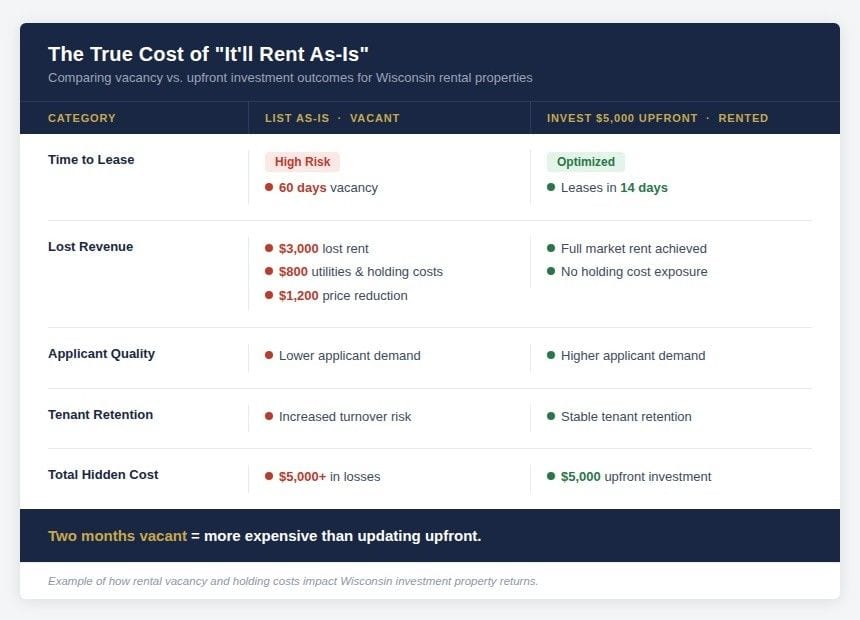
In the Southeastern Wisconsin rental market, a single month of vacancy can cost an investor nearly 8.5% of their annual income. Two months without tenants can reduce projected annual revenue by 17%. Most rental profits rarely generate annual profits exceeding 17%. This means most investors experience negative cash flow after two months of missed rent.
Vacant rentals still incur mortgage payments, property taxes, insurance, and utilities, which ultimately add up. Holding costs quietly accumulate while owners who list their “it’ll rent as-is” property on the market, waiting for the “right” tenant. Extended vacancies often guarantee a break-even or negative cash flow year.
Delayed leasing can compound financial pressure beyond a visible monthly rent gap. The real issue can stem from controllable, avoidable conditions that have little to do with incorrect pricing. Ignoring necessary updates can dramatically increase total losses. Investors often fail to realize how quickly a vacancy can negatively impact long-term returns.
When Does Skipping Renovations Cost More Than Upgrading?
When outdated conditions lead to extended vacancy, rent discounts, or weaker tenant demand in a competitive rental market, the cost of skipping renovations has exceeded the amount an investor would have spent performing strategic, rent-ready improvements.
Knowing the difference between rent-ready and move-in-ready is now essential. Applying that distinction is key to strong rental performance. Appliances and flooring have a significant impact on online engagement and the volume of showings. For example, a $5,000 update may prevent years of rent discounting and turnover instability:
Reducing the monthly rent of $250 results in an annual loss of $3,000.
Over five years, discounting can result in a revenue loss of more than $15,000.
What Should Landlords Consider Before Listing to Maximize Rent?
Carpeting looks outdated, as tenants prefer hardwood or luxury vinyl plank flooring
Lack of appliances immediately reduces perceived rental value and competitiveness
Absence of central air conditioning significantly weakens summer leasing demand
No off-street parking limits interest, especially in dense areas of Milwaukee, Wisconsin
Small bedrooms that cannot fit standard beds shrink the applicant pool
Popcorn ceilings, dated blinds, and mismatched fixtures reduce showing activity
Lingering pet hair and odors decrease applications before the price is discussed
Lower showing volume leads to weaker pricing power. However, a rental in higher demand lets landlords hold firm on strategic pricing decisions.
Stop Letting “As-Is” Cost You More by Avoiding Rental Vacancy
If you’re an investor tempted to list your rental “as-is,” understand the real risks. Holding costs, extended vacancies, and rental discounts slowly erode projected returns.
In competitive markets like Southeastern Wisconsin, failing to upgrade property can be costly. It’s often cheaper to make improvements than to ignore market standards.
Get ready for your next turnover by evaluating your unit. Think in terms of its potential to meet move-in-ready standards.
Our team at PAM works with investors. We align their property conditions with market expectations. Our efforts can minimize vacancy and protect long-term returns. If you need support to ensure your rental is ready to compete, reach out. Access a data-driven assessment to ensure your property and profits are working together.