What Do Wisconsin Landlords Actually Get From DIY Rent Estimators?
A California investor wanted to raise the rent on his Milwaukee single-family home by $1,100—a price far above the automated rent estimate. Because the investor insisted it was special, we at Performance Asset Management (PAM) ran an analysis. After reviewing the finishes and confirming demand, we went with a test. It rented in under ten days. Do you want to know why?
In Southeastern Wisconsin real estate, landlords need clarity around rent potential. However, expertise often beats automation. In the example with the California investor, PAM acknowledged that the home had elevated finishes. It was located near a Medical College. Additionally, single-family units perform differently from multifamily units.
Most Wisconsin property investors appreciate DIY rent estimators. In short, these rent estimators are fast, easy, and convenient. Despite their accessibility, they simplify local rent dynamics, which can be quite complex. Take this opportunity to gain a better understanding of DIY tools. Then decide if working with a property management company outweighs the perceived benefits.
Why Are DIY Rent Estimators Popular with Wisconsin Property Investors?
Wisconsin investors seek quick clarity on income potential, particularly following significant rent growth in local markets. DIY estimators feel data-driven and empowering, even though they often simplify complex dynamics.
Property investors benefit from knowing how much rent their property could realistically command. Rapid rent increases in Wisconsin from 2017 to 2024 created a sense of urgency.
Investors were especially concerned with understanding marketing pricing. Online rent estimators offer readily available solutions. Additional reasons DIY rent estimators are so popular include:
Answers are available, minus the time it takes to meet with property managers
Increased control is accessible before acquisitions and lease renewal decisions
Instant data can sound more enticing than a Comparative Market Analysis (CMA)
Numbers-driven investors like the idea of “math-based” rent estimator platforms
Speed of access is especially appealing in competitive markets like Milwaukee
Automation helps out-of-state investors who cannot physically visit properties
Rough budgeting figures become available during early underwriting conversations
Investors with small portfolios may view professional analysis as overly complex
DIY rent estimators have become increasingly popular mainly due to their perceived usefulness. There is an ease in simply entering an address into a field. Then, investors receive an automatic rent range in seconds.
These tools show investors how the broader marketplace looks. Investors can better estimate how the broader marketplace operates. It is possible to get a quick evaluation on multiple potential investment properties. At times, this can reduce perceived friction.
Understand the value of rent estimators, which can fail to provide definitive answers. Instead, think of them as one data point. Their accuracy can and does diminish under real circumstances.
How Accurate Are DIY Rent Estimators in Wisconsin?
National rent estimator platforms are typically about 60% to 75% accurate in Milwaukee, according to PAM data. The remaining gap often comes from neighborhood nuances, asset-type differences, and comp selection errors.
Within a complex market like Milwaukee, neighborhoods can shift dramatically every few blocks. Two nearby properties may show different demand patterns. This indicates that rental prices can be highly sensitive to location and specific assets. Rent estimators struggle to account for subtle block-by-block economic and demographic differences.
Rent estimator algorithms work by expanding search boundaries. This happens when they fail to find enough comparable properties. DIY rent estimators can often mix up asset types. For example, comparing duplexes to large apartment buildings. However, those asset types rent at very different levels:
A two-bedroom, one-bath duplex next to an eight-unit building may command $100–$500 more per unit, because it is 1,000 square feet with off-street parking.
Pricing the duplex based on the larger building’s data could lead to underpricing it, especially if the eight-unit apartment building has older units with outdated interiors.
In this example, rent estimators could also have trouble recognizing:
Interior finishes, such as upgraded kitchens or bathrooms
Old carpeting versus new flooring, as in luxury vinyl plank
Deferred cosmetic upgrades that may not appear in inspection summaries
Layout flow, lighting, or modern design appeal
Automated tools lack certain awareness. For instance, they struggle to understand how school districts affect the housing market. National rent estimators often overlook the impact that local employers have on a particular area.
For example, changes in hospitals or universities can lead to shifts in job demand. Automated rent tools can miss subtle but financially significant local differences. When this happens, a professional review becomes essential.
What Does Overpriced Rent Actually Cost Milwaukee Landlords?
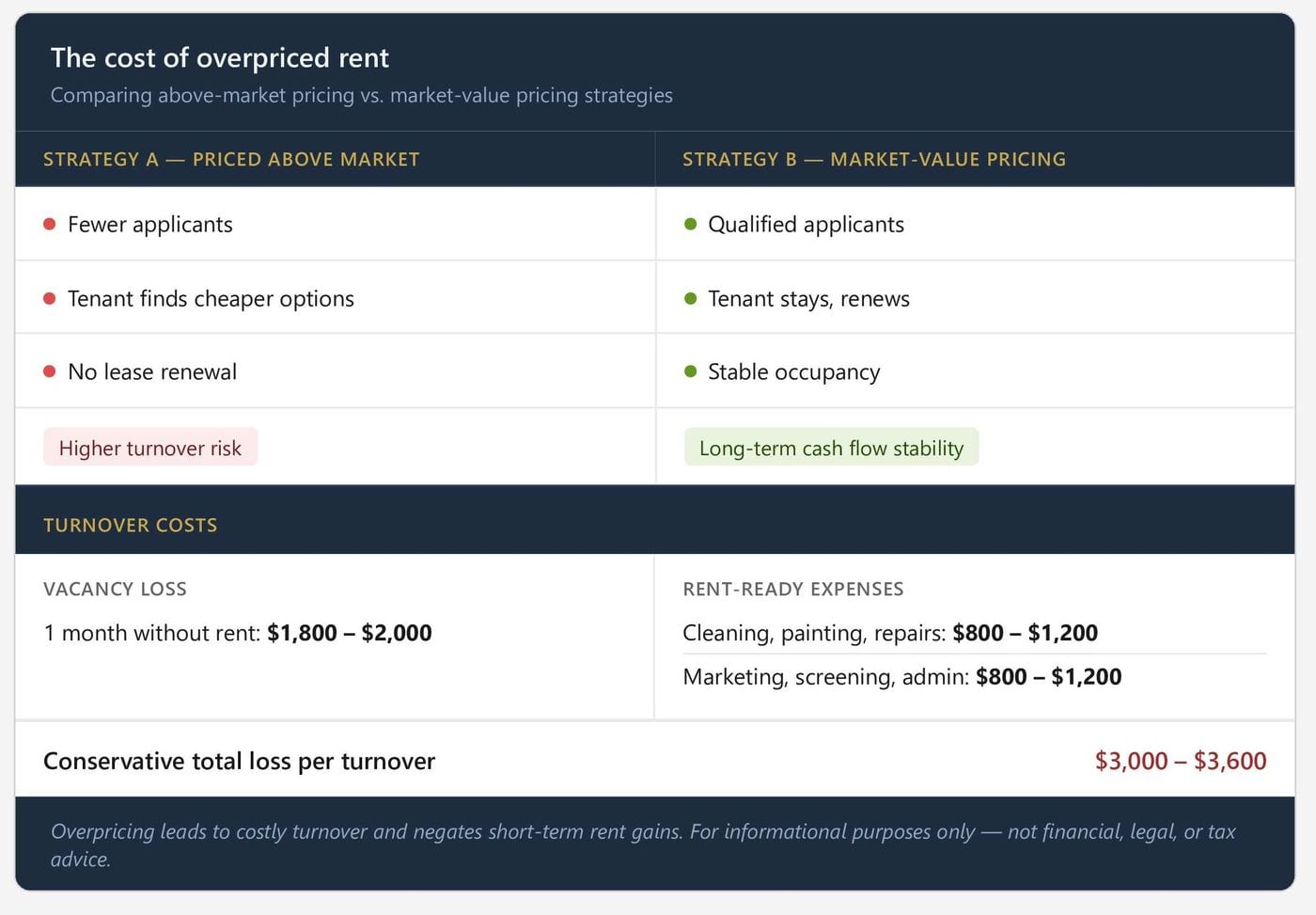
Relying solely on automated rent estimates can cause issues. Underpricing locks in reduced cash flow. Overpricing increases vacancy risk and turnover. Overpricing may also reduce the amount of showing volume, prolonging vacancy periods. Long vacancies lead to higher carrying costs, which include mortgage payments, taxes, and utility bills.
Even when overpriced properties find tenants, they may feel overcharged and vacate early. This creates a missed opportunity to secure a stable resident who could last for 36 months. Closing that window also impacts long-term profitability.
For example, consider an investor who uses a rent estimator to price a unit $150 above market value. That year, a landlord gained $1,800 in additional annual rent. While that may feel like a win:
Fewer qualified applicants apply
The tenant who rents may later realize they’re paying more than similar units
At lease renewal, they compare prices online and choose not to renew
Now there’s turnover, which can include costs from:
Vacancy Loss
1 month without rent
Example: $1,800–$2,000
Rent-Ready Expenses
Cleaning, painting, flooring touch-ups, repairs
Example: $800–$1,200
Leasing / Placement Costs
Marketing, showings, screening, and admin time
Example: $800–$1,200
Conservative total in losses: $3,000–$3,600
How Do Professional Inspections and CMAs Improve Rent Pricing?
Professional inspections and CMAs combine automation with local human judgment. This filters out flawed data, evaluates conditions, and aligns pricing with investor goals.
Physically walking through a property reveals details that photos may miss. In-person inspections encourage more accurate classification of finishes as premium, par, or discount. Local CMAs focus on the market environment where the property is located. A review from a person eliminates comparison flaws pulled from poorly matched neighborhoods.
A property management company that reviews CMAs internally can identify potential data distortions. Notes clarify issues where automation may have led to questionable data. Lease renewals are evaluated annually to adjust for changing market conditions.
Are DIY Rent Estimators Enough for Milwaukee Rental Properties?
DIY rent estimators provide a quick overview. At times, it lacks precision, particularly in densely populated areas such as Milwaukee. Algorithms often struggle to grasp the subtle differences between various blocks. In turn, accurate rent pricing avoids seemingly small errors that compound across time.
Move beyond relying on automated rent estimates for final pricing decisions. Consider a locally reviewed CMA before listing or renewing your property. Have your property physically evaluated to determine details like finishes. Following these steps can help in evaluating your pricing strategy.
PAM merges automation with guidance from local experts. Our goal is to refine rent pricing decisions. Every CMA undergoes internal review. We consider asset type, condition, and demand drivers before suggesting final pricing. Share your property address for a locally reviewed CMA today.