What Does Rent-Ready Mean for Property Investors?
Years ago, rent-ready meant the heating worked, and the roof didn't leak. Today, it involves competing against thousands of photos on Zillow, giving Southeastern Wisconsin residents access to dozens of comparable units in seconds. If your property fails to meet their standards, they move on, and every day the space sits vacant typically costs more than repairs.
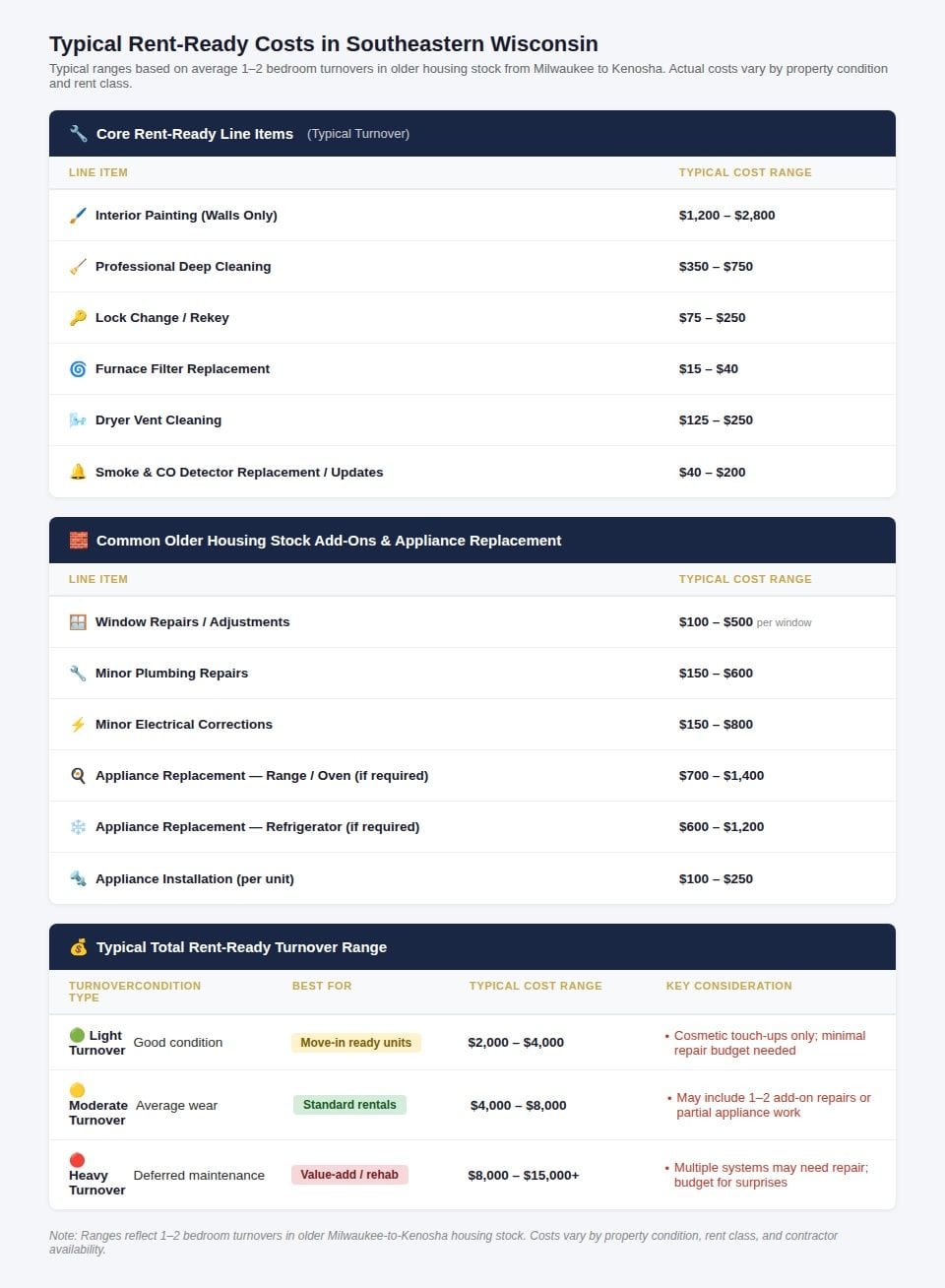
Depending on whether it’s a light or a heavy turnover, an investor could expect to pay between $2,000 to $15,000 to make sure their property is rent-ready.
Since tenants evaluate properties in seconds before even thinking about stepping inside, the goal at Performance Asset Management (PAM) is to distinguish between rent-ready and move-in-ready, which focuses on detailed cleaning and presentation within 72 hours of tenants moving in. Move-in-ready is a separate final stage beyond basic rent-ready.
Being transparent about what rent-ready means affects trust, resident satisfaction, and long-term lease renewal probability. Investors who want to get the most returns from the efforts they put into making their properties rent-ready should continue reading to learn how to create strategic cost controls.
What Actually Drives Rent-Ready Costs for Property Investors?
Preparing a space to be rent-ready requires going beyond meeting the minimum legal standards. For property investors, it means the unit is meticulously crisp and clean with every functional component working properly.
Because rental marketplace expectations have elevated, tenants viewing a space expect that it is safe and functional. For an investor, that means spending $2,000 to $15,000 to address the following issues:
Appliances are fully operational
Plumbing is working properly
Electrical outlets are safe
Windows can open and close without any problems
No leaks, hazards, or deferred maintenance
Inside an average-sized unit in the Southeastern Wisconsin market, there can be over 100 functional touchpoints. That means a property is rent-ready when all of those potential issues meet marketplace expectations, instead of being up to par with habitability codes.
Resident Expectations
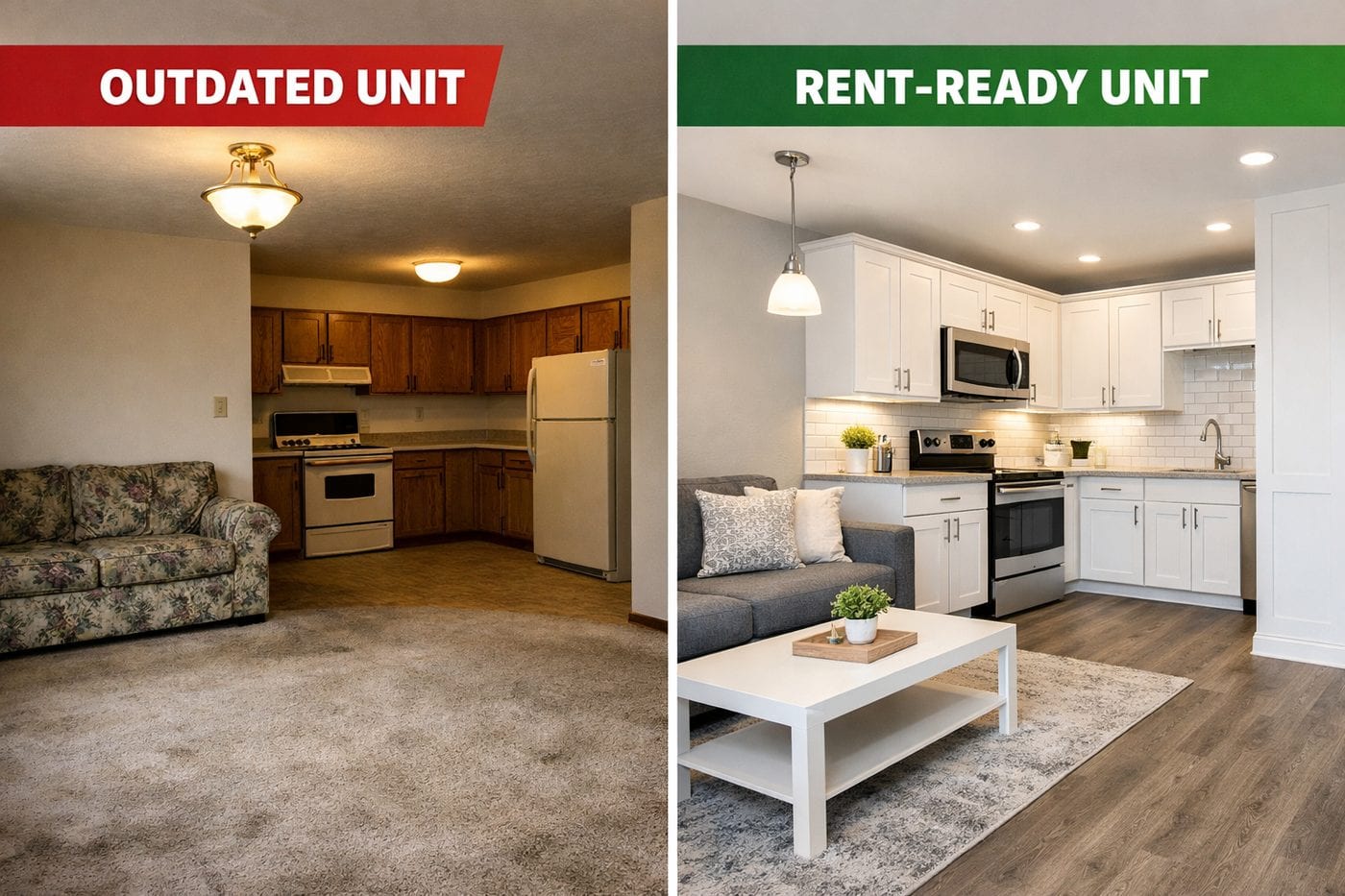
Although rent-ready requirements are primarily about meeting baseline expectations, cosmetic improvements become necessary when they affect competitiveness. Some examples include aged carpeting in a market dominated by luxury vinyl plank, worn kitchens in a premium-priced segment, and antiquated fixtures that make the unit feel dated compared to nearby listings.
Investors pricing a property at a premium tier need to showcase finishes supporting that price range. Naturally, property owners targeting the middle-range tier must also make improvements that align with the marketplace. However, over-improving to exceed neighborhood standards often fails to produce proportional returns.
Labor-Driven Budgets
Most rent-ready budgets are driven more by labor than materials, as labor typically accounts for roughly 75% of total turnover cost, and the other approximately 25% goes to materials, according to PAM data. Nearly every turnover includes painting and professional deep cleaning, with common recurring line items often including:
Lock changes and rekeying
Furnace filter replacement
Dryer vent cleaning
Smoke and carbon monoxide detector updates
In older housing stock (common in southeastern Wisconsin), additional costs often include:
Window adjustments or repairs
Plumbing fixes (minor leaks, valves, caulking)
Small electrical corrections
Issues that investors run into when making a unit rent-ready have less to do with underestimating cost and more to do with misunderstanding marketplace expectations. Five or ten years ago, clean enough was acceptable. This digital marketplace holds properties more accountable with high-resolution photos and comparison shopping, which has raised the bar.
New property owners are often surprised by the level of cleaning required to make a property rent-ready. More specifically, the standard of everything working perfectly, and the standardization of finishes in competitive markets. For these investors, the biggest surprise isn’t materials or labor—it’s the expectation gap.
What Are the Risks of Listing a Property Before It Is Rent-Ready?
Listing a property before it is rent-ready can create short-term visibility but long-term performance problems, such as extended days on the market, bad first impressions, pressure to reduce rent, attracting the wrong tenants, and increased turnover.
A rental property being listed before it is rent-ready can suffer in terms of damage to its reputation and its perceived value. Online platforms are supported by algorithms that reward user engagement and penalize listings when they’re stagnant.
Pricing a unit incorrectly also creates skepticism from potential tenants who may assume the space may have defects because the space is lingering online. These factors can take away from the leverage a property owner has in terms of negotiation with tenants.
Listing a unit when it is rent-ready helps investors maintain a high occupancy rate and protect rental income. Rent-ready completion and comparative market analysis are most effective when they work together. The speed of leasing relies heavily on workflow systems and automation, as the quality of construction alone cannot determine how long a property will be vacant.
How Should Investors Decide Which Improvements Actually Deliver Returns?
Back-to-back occupancy requires that investors precisely coordinate and execute various operations. Since residents typically form lasting impressions early in the rental process, showcasing a well-prepared unit helps build trust right away, which is directly linked to the likelihood of lease renewals.
Capital expenditures are unavoidable in real estate ownership. However, turnover expenses caused by poor execution are completely avoidable, as professional systems change the narrative. A rent-ready expense that initially may appear reactive can become a strategic cost control measure.
What systems does PAM use when delivering rent-ready units?
Macro factors determine the overall rent range within a neighborhood, such as location and neighborhood quality, bedroom count and layout efficiency, parking availability, central air conditioning, pet policies, and amenities.
Similarly, micro factors influence positioning within that established space. Kitchens and bathrooms provide strong differentiation between comparable units. Preparing properties must align with the tier strategy and data-driven comparables. To address rent-ready requirements, PAM implements a structured process:
Conduct a rent-ready inspection with photos and video.
Create a detailed scope of work.
Send the scope to three vendors for competitive bids.
Present the bid package to the owner for approval.
Perform a CMA to confirm optimal rent positioning post-completion.
How Can Investors Control Rent-Ready Costs?
Investors who follow structured rent-ready processes consistently reduce vacancy, control turnover costs, and protect long-term returns.
Being able to understand actual rent-ready standards helps investors avoid costly mistakes. Markets like Southeastern Wisconsin are competitive, which means that presentation, functionality, and timing directly impact leasing speed and rental income.
Poor execution or misaligned expectations can cause an extended vacancy, which can be a major issue that drastically reduces investment performance. However, investors who rely on data can make acute decisions about repairs, upgrades, and rent positioning strategies.
Taking steps to make strategic improvements, aligned with neighborhood standards, can maximize ROI, while avoiding over-improving to the point of diminished returns. The next step for investors is implementing a system that includes inspections, a work scope, bidding on vendors, and market analysis.
Additionally, PAM maintains a 60-day lease renewal runway whenever possible. That allows time to test pricing strategy, position premium assets effectively, and avoid unforced vacancies.
Process discipline controls cost. To learn how PAM can help improve your rent-ready process to make it more effective and efficient, fill out our form to schedule your free consultation.