Why Do Wisconsin Landlords Overprice Their Rental Properties?
Refusing to lower the price on a rental could cost one month of rent. And holding firm on $50 above market could then lead to losing not just one but two months of rent. That’s a fact most southeastern Wisconsin investors don’t want to hear. It’s also the foundation for the math that explains a common, costly mistake: pricing a rental above market value.
When investors overprice a rental, it can lead to vacancies. Months without rent can turn into 10-25% of their annual Net Operating Income (NOI) from just one pricing mistake, assuming it stops there. Performance Asset Management (PAM) founder Jim Miller was a Wisconsin investor for years before building a company that protects investors from this exact mistake.
The good news for DIY investors and property owners who use managers is that the mistake is entirely avoidable, as long as a successful pricing process is in place. This content describes the math supporting these observations, outlines the data-driven processes, and details the mistakes, so Wisconsin investors can stop leaving NOI on the table by overpricing listings.
How Does Overpricing a Rental Damage Your NOI?
Overpricing a rental property in Wisconsin can trigger immediate, compounding expenses that most investors fail to calculate until it's too late.
Four common sources of pricing misinformation that consistently leads investors to set rents above what the Wisconsin rental market will actually support include:
Realtor advice: as the most common origin of pricing information, realtors can overstate rental income to help close a sale
Outdated information: people selling their homes may provide historical rent figures that no longer reflect the current market
Misleading comparisons: apples-to-oranges comparisons between very different homes, such as duplexes versus single-family units, can distort information, as Identical asset type, bedroom count, bath count, and proximity are non-negotiable comparisons
Overly optimistic investors: seeing the best outcome in a situation can become dangerous when it overrides what market data actually shows
Since August 2024, southeastern Wisconsin has shifted from a location market to an affordability market, meaning the price an investor wants to charge matters far less than the price the market will support. Ultimately, affordability is the key factor driving where residents live.
Losing rent to overpricing is typically the first line item. The real cost is vacancy. Without residents paying rent, energy bills continue to accrue, especially in an area like Wisconsin, where temperatures drop dramatically during the winter.
Milwaukee neighborhoods like Bay View and the Historic Third Ward fine landlords for uncut lawns and unshoveled walks, and neighbors notice the eyesore too.
For example, a single month of vacancy on a $1,000 per month unit can cost $1,200 or more.
Option A: Hold firm at $1,000 and go vacant for one month
You lose $1,000 in rent for that vacant month
Plus energy bills during vacancy
Plus lawn or snow maintenance
This adds up to approximately $1,200 in losses for one month
Option B: Drop to $950 and rent it immediately
You're collecting $50 less per month than you wanted
Over 12 months that's $50 x 12 = $600 in "lost" income
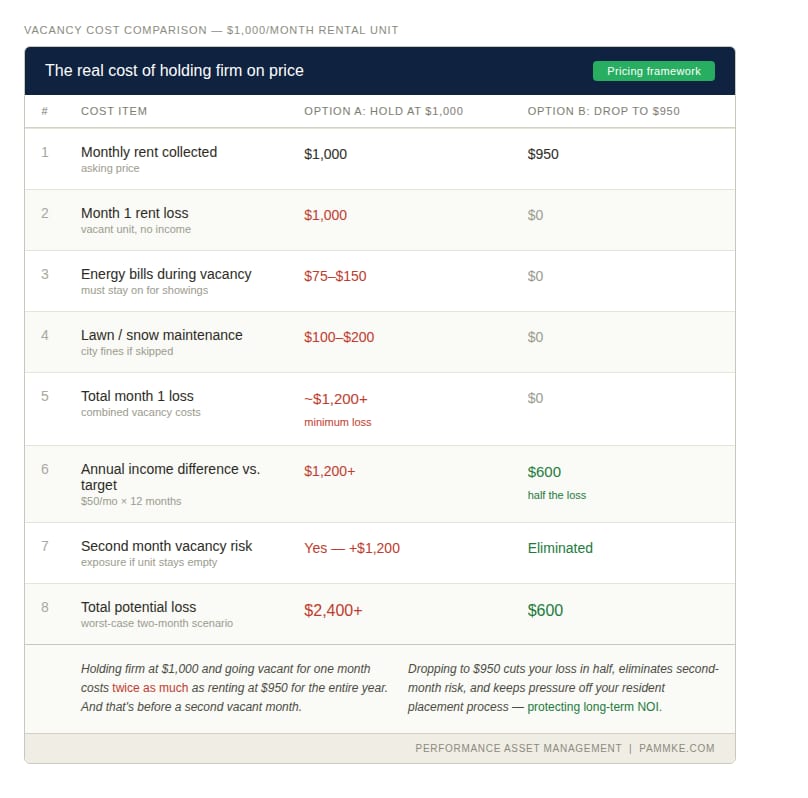
By insisting on $1,000 and going vacant for even one month, you've already lost twice as much as you would have lost by renting at $950 for the entire year. And that's before factoring in the risk of a second vacant month, which doubles the damage again, especially during months when tenants lose interest in moving due to harsh weather conditions.
The investor feels like they're protecting income by holding the higher price, but math shows they're doing the exact opposite.
How Does an Overpriced Listing Hurt Future Leasing?
Overpricing a rental property in Wisconsin filters out the most financially responsible renters. Accountable, qualified renters make decisions based on affordability math. An above-market price attracts residents with financial histories that signal a higher risk.
Qualified residents make rental decisions grounded in verified affordability. That means an overpriced property forces financially sound renters to seek other spaces, and these are exactly the type of tenants that investors need to protect their NOI in the long term.
Applicants willing to stretch for an above-market rent are making poor decisions by overextending themselves financially. This hurts their chances of saving emergency funds and instead relies on a paycheck-to-paycheck mentality that limits their ability to renew leases.
A rushed or criteria-compromised placement can double your NOI loss from vacancy. In a worst-case scenario, poor resident placement can triple the financial damage of a vacant month. Vacancy alone can diminish investor NOI by 10–25%, and a criteria-compromised placement can double or triple that damage on top of it.
Very quickly, the losses can stack: overpricing creates a vacancy, that vacancy leads to placement pressure, and placement pressure increases the risk of choosing a bad tenant, which drains investor NOI.
How Does PAM Price Rental Properties in the Wisconsin Market to Protect Investor NOI?
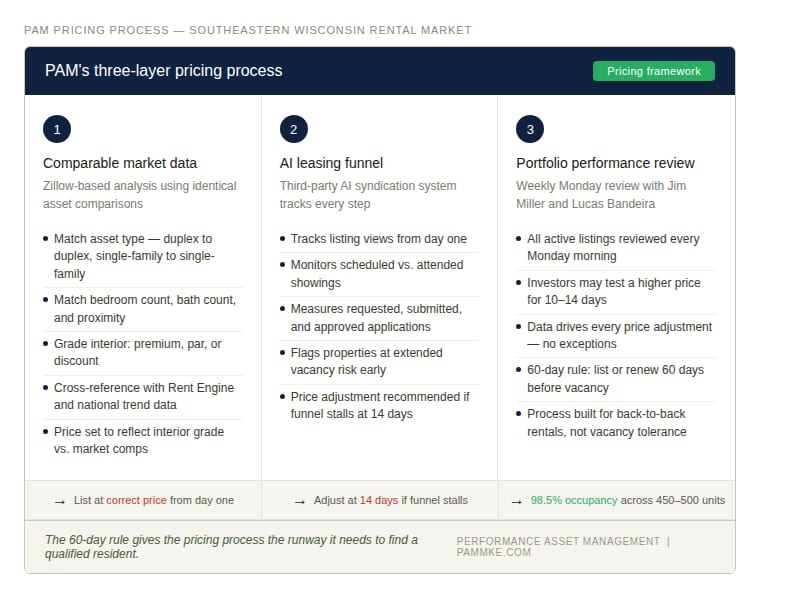
PAM uses a three-layer pricing process: Zillow-based market comps, AI-powered leasing funnel data, and portfolio-level performance analysis to ensure every rental listing in southeastern Wisconsin is positioned to lease quickly to a qualified resident. This process is the operational backbone behind PAM's 98.5% occupancy rate.
Start with Comparable Market Data
Zillow dominates the southeastern Wisconsin rental market, as roughly 90% of Wisconsin rentals happen there. PAM pays for Zillow Premium to maximize listing placement across more renter searches, as renters filter by zip code, bedroom count, street, and price range when searching.
A correctly priced listing shows up every time a renter's budget parameters match your unit. List at $1,495 in the right area and you appear for every $1,500-budget search, consistently. List too high, reduce the price, and Zillow now has two conflicting records for your address. The algorithm registers uncertainty and begins recommending your property less frequently.
Use Zillow to find an identical asset type, in terms of bedroom and bath count, along with comparable proximity. Interior condition is graded premium, par, or discount, and price is set to reflect that grade. PAM also uses Rent Engine and national trend data to cross-reference local market findings.
AI Tracks the Full Leasing Funnel
An AI syndication system from a third-party provider tracks the leasing funnel from visibility to deposit. It provides data on the potential tenants viewing the listing. Then it makes calculations by crunching the following numbers:
Potential tenants interested in a unit
Scheduled showings
Attended showings
Requested applications
Submitted applications
Approved applications
Approved applications with a deposit
Portfolio Performance Analysis
If activity data isn't moving in 14 days, PAM recommends a price adjustment, without exception. PAM Leasing Coordinator Lucas Bandeira reviews all active listings with Jim weekly. Investors who want to test a higher price get 10–14 days. Then the data drives the decision. PAM's pricing approach is built around back-to-back rentals, not vacancy tolerance.
This 60-day rule to list or renew by day 60 gives the pricing process the runway investors need.
How Can Wisconsin Investors Stop Leaving NOI on the Table?
PAM's data-driven pricing process, backed by AI leasing funnel analysis and a portfolio of 450–500 southeastern Wisconsin units, offers a verified, repeatable system for maximizing occupancy and rental income year over year.
In today's affordability-driven Wisconsin rental market, what an investor wants to charge and what a qualified resident will pay are two very different numbers. The gap between them is where NOI disappears.
Overpricing by even $50 can trigger vacancy, inflated costs, and attract poor tenants. Getting the price right is how investors attract qualified, financially responsible residents who renew.
To become more equipped at pricing rentals accurately, start with Zillow, build PAM’s 60-day rule into your process, and review leasing data at the 14-day mark and adjust the price when necessary. PAM manages approximately 450 southeastern Wisconsin units with a 98.5% occupancy rate, built on this process.
PAM's pricing system was created and polished over 17 years, but it originated from Jim learning from investor mistakes that you don’t have to make. For more information on this earned process, schedule a meeting to get your process reviewed.