What Makes PAM Different From Other Milwaukee Property Managers?
Performance Asset Management (PAM) was founded 17 years ago after the frustrations with property management companies that Jim Miller experienced firsthand. At the time, he was an investor reviewing incorrect balances produced by companies that poorly managed tenants. Back then, southeastern Wisconsin managers were typically greenlighting any tenant with first month's rent and a basic security deposit, a process he would later steer his company away from.
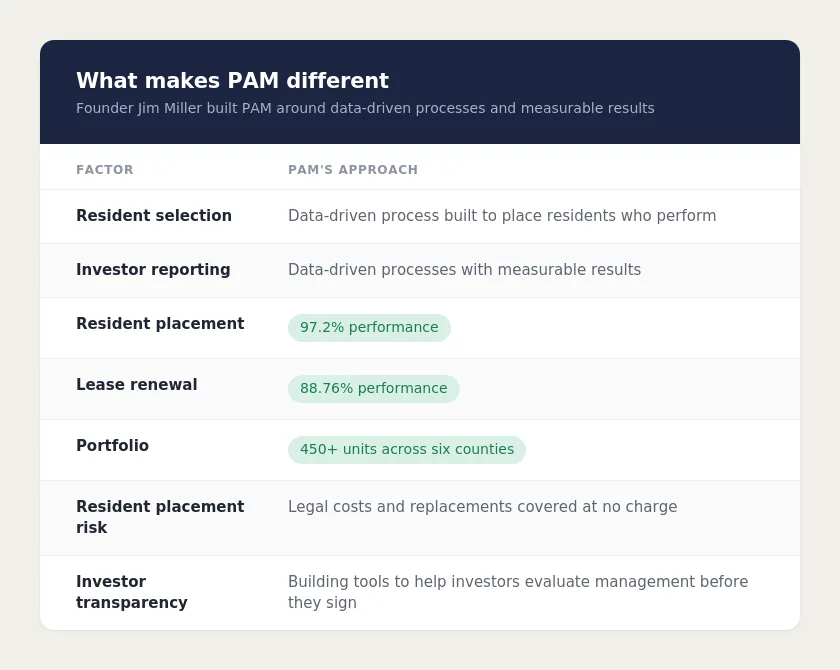
Despite the headaches those processes caused, they shaped what PAM would become: a company that uses data-driven processes and measurable results. And that original frustration still drives PAM, which is building tools to help investors spot bad management before they sign.
When Jim named his company, he left his own name out of it entirely. “The performance is in the name of PAM,” he said, adding, “I was going to pick residents that perform.” Resident placement now sits at 97.2%, lease renewal performance at 88.76%, and total units managed at over 450. Learn how PAM turns that process into a public evaluation tool investors can use to score their own manager.
Why Did Performance Asset Management Start in Milwaukee?
PAM started because the 2008 financial crisis ended Jim Miller's home-flipping business, and he chose to stay in real estate by building a property management company instead.
Around the time of his bad manager stretch, other real estate investors were having their own troubles. In 2008, home prices fell, and job losses climbed, while foreclosure filings surged 21.5% in Wisconsin, setting a record, reported the Milwaukee Journal Sentinel. From 1995 through 2006, Milwaukee saw an average of 800 house foreclosures a year. Then, in 2007, there were over 1,300 foreclosures, according to the Marquette Law School Faculty Blog.
Although he was reinventing himself professionally, Jim still wanted to remain invested in real estate because of opportunities that still existed in the industry. His property management model was built around serving Milwaukee-area investors better, in part by filling a gap.
According to the Harvard Joint Center for Housing Studies, single-family rental households grew substantially following the Great Recession, peaking at 15.2 million in 2016. PAM focuses on single-family homes and duplexes in areas renting above $1,000 per month. Jim’s working-class upbringing shapes how he runs PAM, which has grown from a founding niche to its current portfolio size. But despite its growth, PAM wasn’t meant to be the best fit for every investor.
The three main investor profiles that work best with PAM are first-time or accidental investors, portfolio builders, and experienced investors. Keep reading for more on how and why these investor profiles work best with PAM: What Type of Investor Works Best with a Property.
Why Did PAM Move From Automation to a Humanation Model and What's Next?
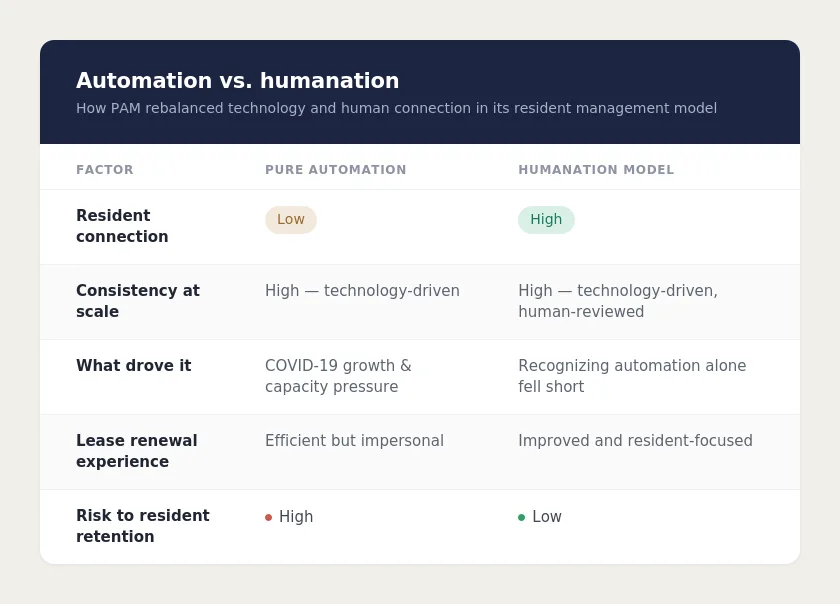
PAM discovered that pure automation eliminated the human connection residents and investors needed, so it built "humanation" to combine both. That data-motivated strategy continues shaping how PAM supports southeastern Wisconsin investors.
Around 2012, PAM digitized rent collection ahead of most of its competitors in the southeastern Wisconsin property management industry. And it opened the door to PAM taking advantage of technology on a wide scale to free up capacity. While the growth, scale, and pressures brought by COVID-19 prompted PAM to adopt automation, the success of rent collection set the tone.
PAM continued to use technology to improve consistency. But this time, it eliminated too much of the human connection that managing residents demands. After a balance was reached, PAM coined the term humanation to describe how automated resources are paired with human connection while making the lease renewal process better for residents.
For the full story, read How PAM Built a Lease Renewal Process That Works (After One Didn't). But the same data discipline behind those results is now driving PAM's next initiative for investors, which is focused on developing new ways to better evaluate property management performance. More on that will be shared.
How Does PAM Define Success for Milwaukee and Greater Wisconsin Investors?
PAM defines success as sustained investor Net Operating Income and long-term resident retention. The goal is attracting long-term clients, a philosophy that shapes how PAM structures both its guarantees and its fees.
PAM aligns its internal processes with investor Net Operating Income (NOI) through a fee-alignment structure, emphasized by Jim, who stated, “I don't want a client for a couple years. I want clients for life.” Taking responsibility for resident placements by covering legal costs and replacements at no charge applies that mindset.
Although state law requires property managers to advocate for both residents and investors, Jim said he sees himself as a steward, not an owner, of what he's built. And this mindset carries into how PAM operates day to day.
PAM's vision for the future is rooted in its origin during the financial crisis, when three property management companies failed to report accurate rental income numbers, and in its more recent strides combining automated resources with human intervention. The goal is to continue supporting investors through data-rich resources moving forward.
For more information on the upcoming tools that PAM has to offer investors, such as the Five PAM Pillars, schedule time with Jim. Or, stay abreast of the resources available online.