What Happens to Lease Terms When Property Investors Switch Managers in Wisconsin?
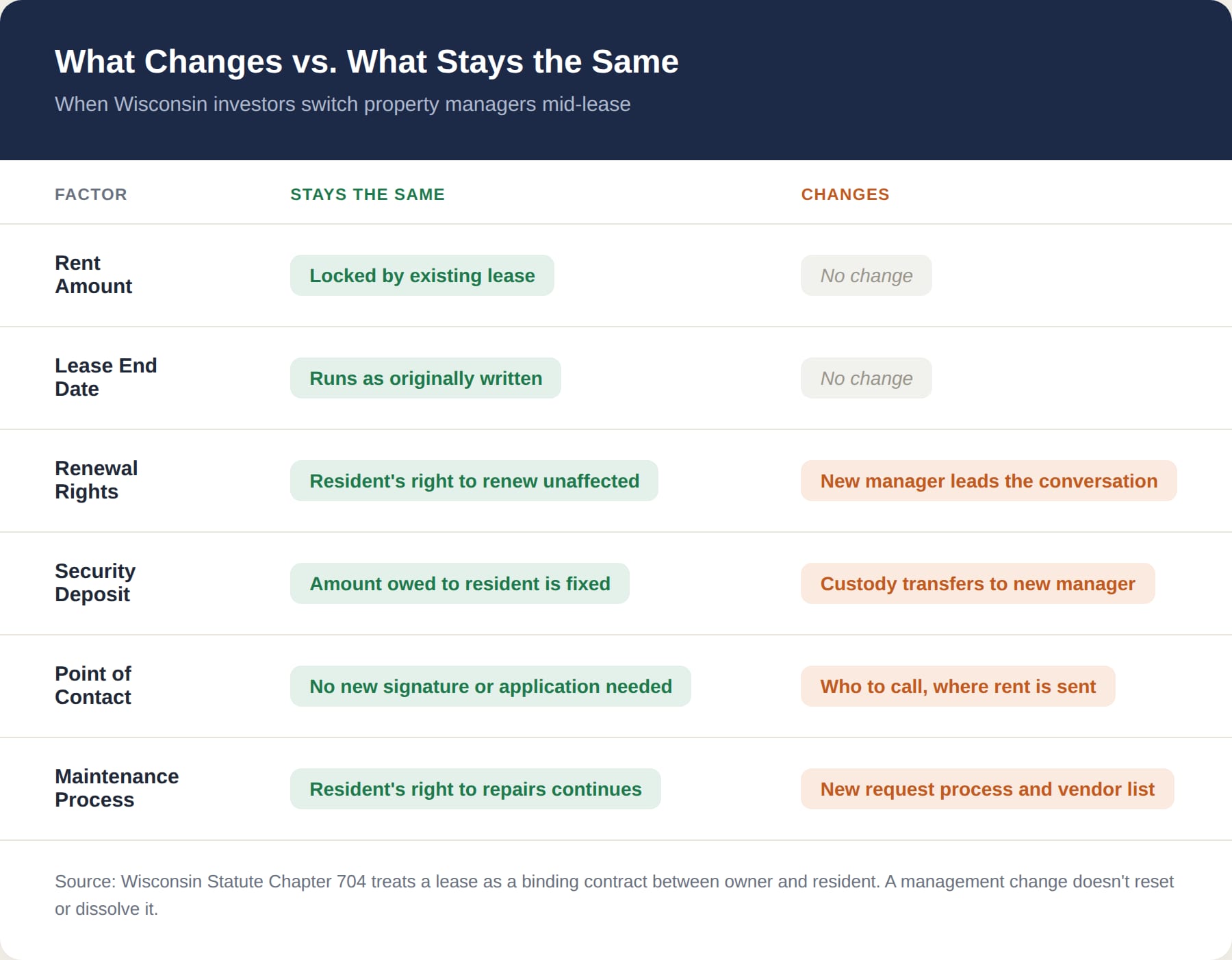
When a Wisconsin investor switches property managers, existing leases stay in force exactly as written. Rent, lease term, security deposit, and every other provision carry over unchanged, because the lease is a contract between the owner and the resident. The property manager acts as the owner's agent, so a new manager takes over administering the lease without the power to change on its own.
That holds even when the inherited lease comes with serious problems. Taking over a duplex in Milwaukee County mid-lease means opening up the file on residents and finding “three or four evictions" and stacks of “property judgments,” along with an estimated $15,000 to $30,000 in damages that a placement made by a previous manager caused. As Performance Asset Management (PAM) Owner Jim Miller recently said, "There must have been zero screening for this placement.”
It’s been over 17 years since PAM first opened its doors, and one lesson stands out from almost two decades of experience. The lease that comes with a property keeps running whether it’s good or bad, exactly as written. This is consistent with Wisconsin Statute Chapter 704, which treats a lease as a binding contract between owner and resident. The statute reinforces that a lease doesn't dissolve or reset just because the managing party changes.
Wisconsin property investors who assume switching managers means rewriting or renegotiating every lease are wrong, and that assumption can create unnecessary panic during an already stressful transition. Keep reading to understand exactly what happens to lease terms, security deposits, and resident notices and what southeastern Wisconsin investors need to verify before signing on with a new property manager.
What Actions Do Wisconsin Residents Need to Take When Their Property Manager Changes?
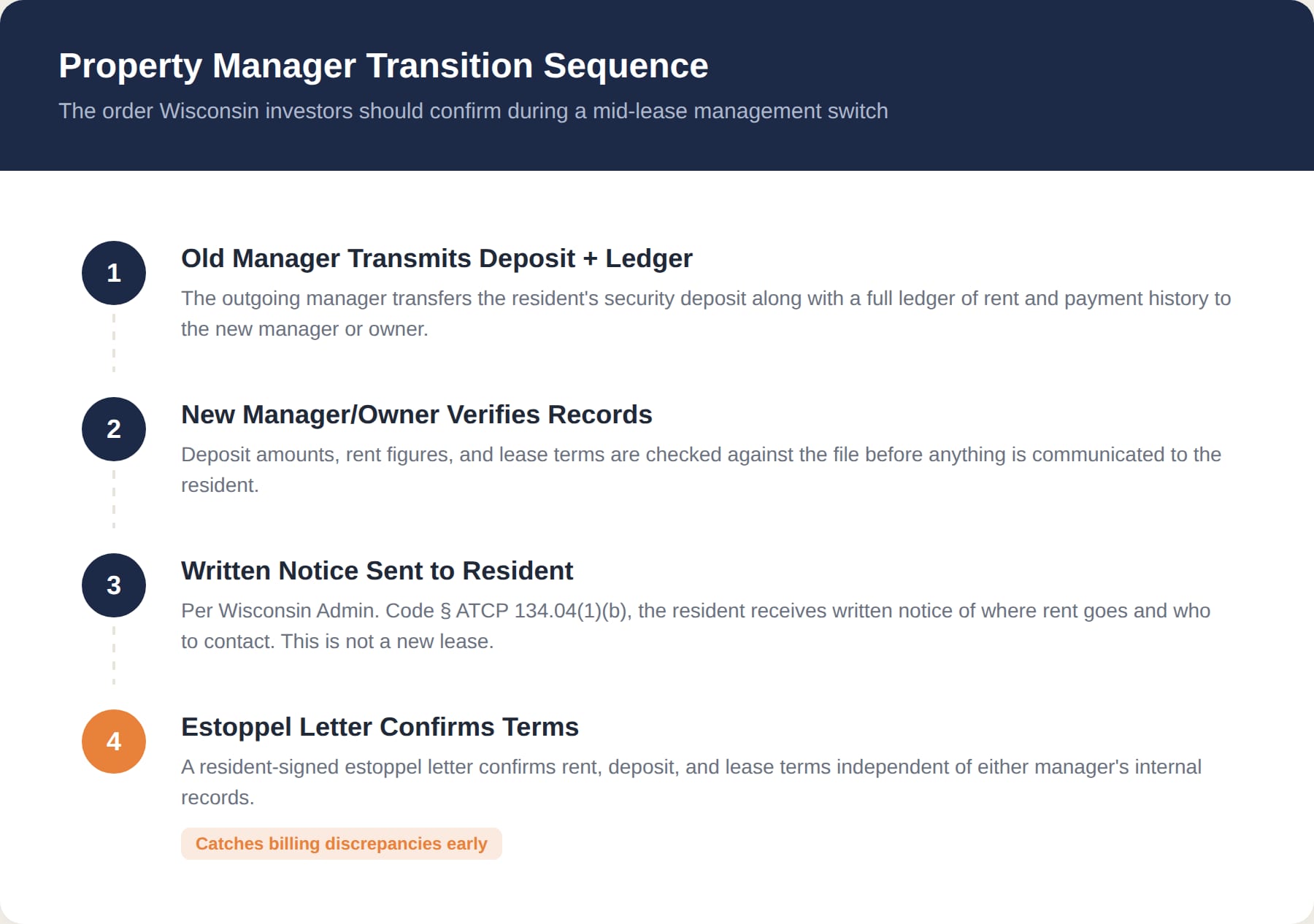
Residents generally don’t need to sign a new lease. Their existing lease stays fully intact with the new manager. Wisconsin Admin. Code § ATCP 134.04(1)(b) requires written notice informing residents where rent goes and who to contact.
Southeastern Wisconsin residents already under a lease don’t need to provide a new signature, application, or take a screening step. The only real change in a property manager transition is that a new administrative party is responsible for enforcing and servicing the lease.
Property managers act as agents who execute the terms included in the signed contract. Because agents can misunderstand the limits of that role, investors should confirm any new manager grasps this distinction before the transition begins. Poorly written or delayed notices, not the lease itself, cause most resident confusion.
However, some confusion can arise from managers failing to understand the limitations of their role. Examples of this causing problems for investors include:
- Mistakenly contacting residents mid-lease to propose new rent terms early
- Assuming a management switch resets the lease entirely
- Confusing residents and causing distrust when a new manager suggests terms are already changing
A manager who reaches out immediately upon being assigned a new resident to renegotiate a lease that has months or years left on its term risks creating confusion by treating terms in an existing lease as though the items are subject to change.
Alternatively, a proactive property manager may reach out at the natural renewal window, such as in the humanation process described in this article: Human Connection in Wisconsin Leasing.
At PAM, the renewal conversation starts 90-120 days before a lease actually expires. This is different from reopening an active, still-running lease term. And asking residents whether or not they want to renew is different from changing current lease terms.
What Is an Estoppel Letter and Why Does It Matter During a Property Manager Transition?
An estoppel letter is a resident-signed statement confirming rent, deposit, and lease terms independent of either manager's internal records. Southeastern Wisconsin investors use it to catch billing discrepancies before they escalate.
Southeastern Wisconsin investors who request an estoppel letter for each unit can address gaps caused by incomplete handoff documentation. Identifying discrepancies early is much less expensive than addressing them after months of mismanagement. This single document can help prevent expensive surprises during a portfolio transition.
Security deposits often lead to costly mistakes during property manager transitions, and an estoppel letter can directly resolve this issue.
What Happens to a Security Deposit When You Switch Property Managers?
Deposit handling during a transition should be fully documented, with the amount held for each resident clearly identified. A shortfall or missing paperwork can become a southeastern Wisconsin investor's liability the moment the switch finalizes.
The 21-day security-deposit deadline applies to the landlord's obligation to return the deposit to the resident; Wisconsin law does not appear to establish a separate 21-day deadline for an outgoing property manager to transfer the deposit to a successor manager.
Wisconsin Statute § 704.28 governs how much a landlord can lawfully withhold from a deposit and the timeline for returning it, while the itemized withholding statement itself is required separately under ATCP 134.06(4), Wis. Admin. Code. An estoppel letter gives investors a way to confirm both figures match reality, independent of either manager's internal paperwork.
What Lease Problems Should Investors Check Before Finalizing a Property Manager Switch?
Investors should confirm the lease contains no illegal fee language, since defective leases can trigger legal and financial risk regardless of who manages the property. A qualified new manager audits the lease document itself, not just daily operations.
For example, Koble v. Marquardt illustrates the potential consequences that can happen due to defective lease language. The Wisconsin Court of Appeals ruled that a defective lease provision could support double damages or a property owner paying twice the rent back to a tenant. Eventually, the Wisconsin Supreme Court held that the tenant had not established the pecuniary loss required to recover damages under Wis. Stat. § 100.20(5).
But for investors switching property managers, the larger takeaway is that inherited leases still deserve careful review. A new manager may inherit lease language created before taking over the property. But identifying potentially defective provisions early can help investors address problems before they become disputes.
Junk fees are another red flag investors should use to spot managers who will drain net operating income. Liability follows the property owner, regardless of which management company created the original lease. A line-by-line legal review is the best way to identify whether signing a new management agreement is the right move.
Switching property managers means changing who administers the lease, while the lease terms stay the same. Staying protected as an investor means verifying deposits, notices, estoppel letters, and leases upfront. Managers who understand these distinctions show competence and can support Wisconsin investors by helping them remain in compliance with state laws.
PAM audits every inherited lease and deposit record before finalizing every new southeastern Wisconsin portfolio transition. We work closely with investors while onboarding them with PAM resources to ensure their questions are encouraged and answered. For more information on how PAM supports investors switching property managers, set aside time to speak with Jim.