Any Wisconsin lease with so much as a drafting error could have led to a landlord paying double the rent in damages for every month the tenant lived there, due to a Court of Appeals ruling in Koble v. Marquardt. The problem didn’t stop there. A Wisconsin law known as Chapter 704 statutes restricts changing a signed lease mid-term, leaving property investors defenseless.
But the Supreme Court of Wisconsin reversed that ruling and restored legal boundaries on June 5, 2026. Even though landlords were handed a win, buried in that decision is a direct threat to anyone who uses a property manager that charges junk fees. Because if your lease goes to court, your name is on it. And you're responsible.
To keep our investors protected against these situations, we at Performance Asset Management (PAM) meet annually with legal counsel to review our leases against the latest court decisions and how they’re interpreted. Keep reading to learn what the ruling actually says, what it means for the lease on your property now, and what you as a Wisconsin investor should do next.
How Does Koble Make Wisconsin Leases Even More Important?
The Koble case began with a single flawed lease clause and escalated into a Wisconsin Supreme Court case. It showed that what's in your lease, and what's missing from it, carries heavy legal and financial consequences.
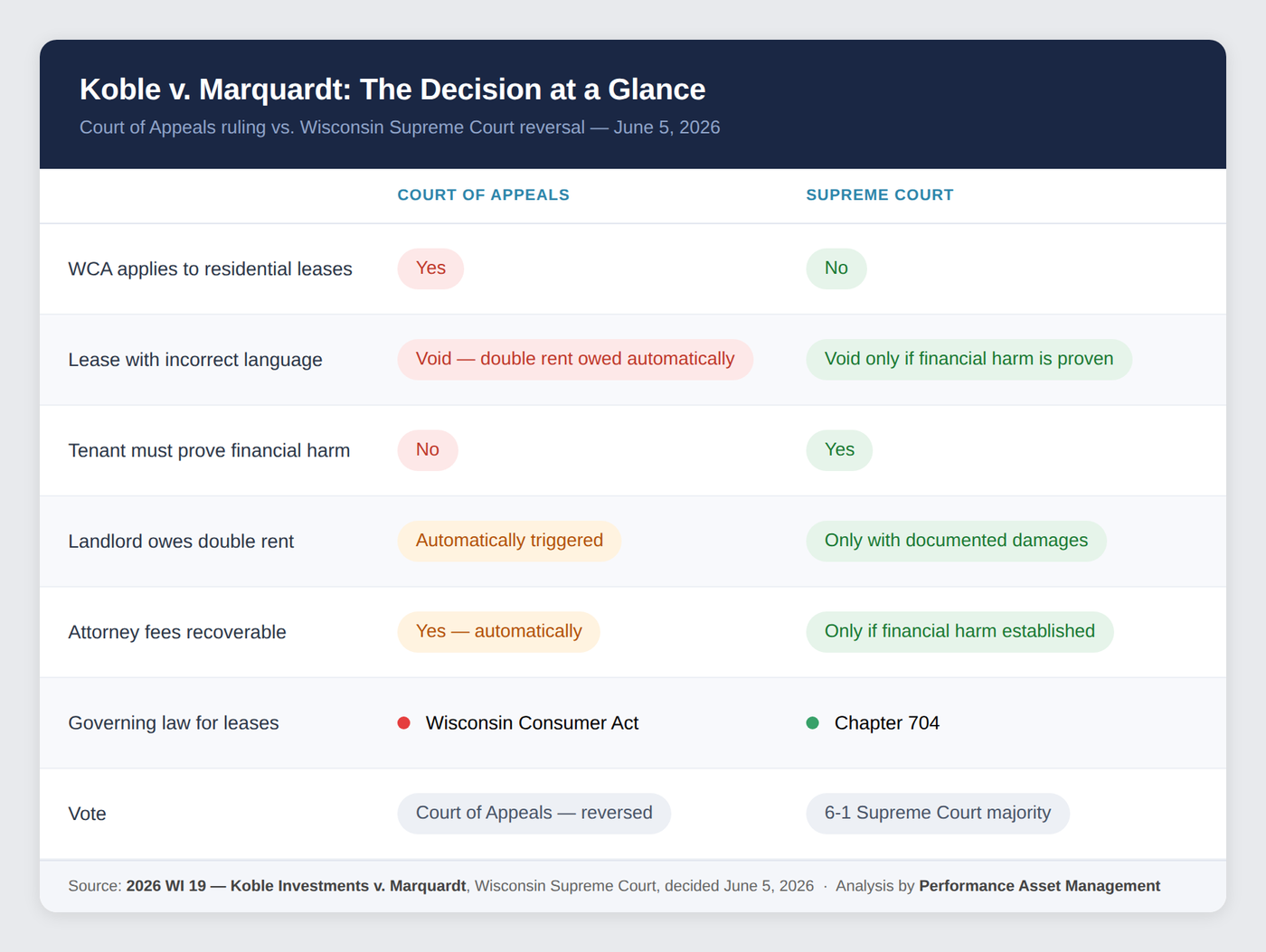
A lease with incorrect language triggered the entire Koble litigation chain. Because Wisconsin Chapter 704 statutes prohibit changing a signed lease mid-term, the Wisconsin Court of Appeals declared Koble's lease void over a required notice that was missing. That meant the landlord had to pay double the rent payments made under the voided lease.
The court of appeals declared the lease void because it was missing a required notice under Wisconsin law. From there, it awarded double all rent paid under that lease. The Supreme Court reversed the ruling. Under their logic, paying rent in exchange for housing isn't a financial loss, and double damages under §100.20(5) require proof of actual pecuniary harm.
What Does Koble Say About When Double Damages Actually Apply?
The Supreme Court did two things with this decision: it wiped out the court of appeals ruling as precedent, and it repositioned the double-rent standard to apply only where tenants experience real financial harm, a critical distinction for Wisconsin investors.
Instead of eliminating the double-rent penalty, the Supreme Court repositioned it. Financial harm has to be real, documented, and caused by the specific lease violation. The ruling clarifies what constitutes financial harm: unauthorized fees in the lease. Common examples of those that property managers in Wisconsin charge include:
Risk mitigation fees
Alternative security deposits
Resident benefit packages
Move-in fees and administrative fees not codified in Chapter 704 also qualify, and Wisconsin courts have ruled against charges not grounded in those statutes, according to local industry attorneys. The double-rent standard is still available to tenants. But it requires proven harm.
What Should Wisconsin Rental Property Investors Do Right Now in Response to Koble?
The Koble ruling rewards investors who operate with updated leases, transparent fee structures, and a property manager who has incentives aligned with the owners.
If a property manager is charging residents unauthorized fees, owners are liable, even if that revenue never reaches the investor.
The Supreme Court's ruling on financial harm points directly at the junk fee structure and puts investors on the hook to the tune of double the rent paid. Investors working with a property manager should ask:
What Does a Property Manager Actually Charge Residents?
Investors should ask the property manager for a complete list of every fee charged by residents and make sure to get it in writing. A manager who won't provide that list in writing has already provided enough information. Beyond the more obvious fees, watch for these:
Monthly administrative
Billing
Lease preparation
Online Portal
HVAC program
Utility billing
Routine pest control
Risk and compliances
Is a Lease Current, Wisconsin-Specific, and Legally Updated?
Work with a lawyer who understands the property landscape in Wisconsin. For example, PAM works with attorney Tristan Pettit of Pettit Law Group S.C. This Milwaukee-based law firm specializes in landlord-tenant law. Qualified attorneys can help with creating leases in addition to reviewing them on an annual basis. Leases that haven’t been reviewed by a Wisconsin attorney in the last year may be outdated.
Does a Property Manager’s Fee Structure Create a Liability?
Reviewing a property manager's fee structure also includes assessing it. Find out if any of those fees are unauthorized under Wisconsin laws. Work with an attorney to find out if they are the kind of fees courts have consistently ruled against. If yes, those fees now meet the threshold for double-rent damages under Koble.
Property managers who can't tell you which fees are codified in Chapter 704 and which aren't have already created the problem.
How PAM Thinks About Koble and What That Means for Your Investment
The Koble ruling clarified existing risks for Wisconsin investors. Those who act on what the Supreme Court decided are in a stronger position than before the ruling.
By overturning the Court of Appeals ruling, the Wisconsin Supreme Court has changed how the double-rent penalty is applied. Now, it applies to situations where tenants experience provable financial harm. Before, tenants only needed to show that a lease had defective language.
While the threat of double rent charges may seem unsettling, successful investors understand that leases determine their level of legal exposure. Investors can protect themselves by auditing what residents are being charged, confirming leases are current and Wisconsin-specific, and evaluating whether a fee structure creates liability.
PAM has been in the industry for 17 years, and we offer lease protection designed specifically for southeastern Wisconsin rental property owners. Each of our leases is reviewed annually by legal counsel, and we don't charge junk fees, especially those that the Supreme Court defines as illegal. For a second set of eyes on your lease, set up an appointment.